

Protesters attacked metal barriers erected to protect the Lebanese Parliament a day after a new government was formed to tackle the country's deepening financial crisis.
Demonstrators threw rocks and cement chunks at riot police, who responded with tear gas and water cannon.
“We want all the politicians to leave,” said a young protester, who had his face covered by a scarf. “We want someone new from the revolution to represent us. This is a Hezbollah government.”
Despite promises of an independent government of specialists, Lebanon’s new ministers have been mostly picked by the parties that back new prime minister Hassan Diab.
They include Iran-backed Hezbollah and its allies.
The protesters came mostly from Tripoli, although there were others from Beirut.
“They are the poorest people in the country and have the least access to education, so they are the ones who will become more violent than others,” said Rawane Khalil, 26, who was watching the violence.
Others said that the police action was disproportionate.
“A riot cop dressed from head to bottom in shields does not need to be scared of a rock or a stone and shoot rubber-coated steel bullets at a distance of 2 or 3 metres,” said Ziad Nassar, a Lebanese expatriate.
-
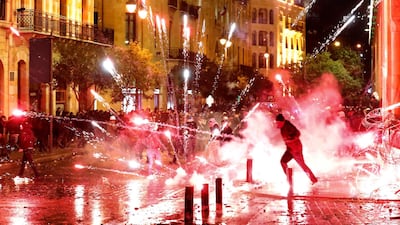
Anti-government protesters throw firecrackers at riot police during a demonstration against the new government, near Parliament Square, in Beirut, Lebanon. AP Photo -
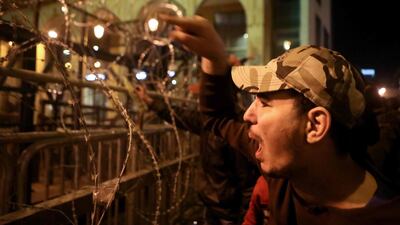
Lebanese anti-corruption protesters shout slogans outside the parliament during a protest in downtown Beirut. AFP -
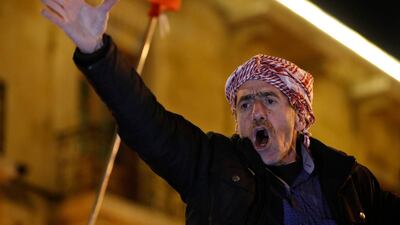
An anti-government protester shouts slogans during a protest against the new government, near the parliament square, in Beirut. AP Photo -

An anti-government protester shows off the liquid pepper on his hand after he was sprayed by the riot police during continuous anti-government protests outside of the Lebanese Parliament building in downtown Beirut. EPA -
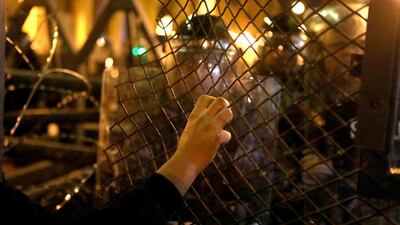
A Lebanese anti-government protester holds on to a police fence as riot police guard an access to the parliament during clashes with anti-government protesters in downtown Beirut. AFP -
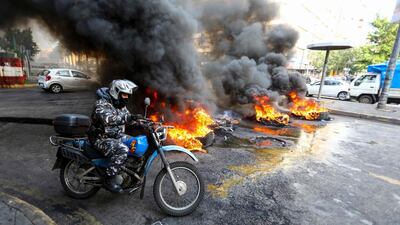
A Lebanese policeman rides his motocycle passed a road, blocked by anti-government protesters with burning tyres, in the capital Beirut. AFP -

An anti-government protester is sprayed by a water cannon as he films by his mobile phone during a protest against the new government, near the parliament square, in Beirut. AP Photo -
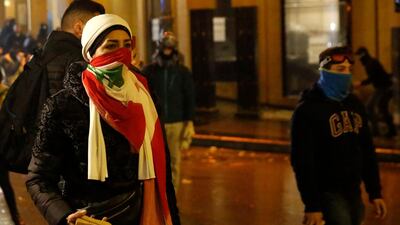
An anti-government protester holds a stone as she prepares to throw it at the riot police during a protest against the new government, near the parliament square, in Beirut. AP Photo -
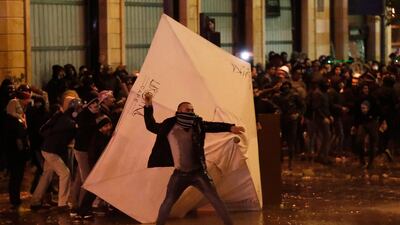
An anti-government protester prepares to throw stones at the riot police during a protest against the new government, near the parliament square, in Beirut. AP Photo -

Anti-government protesters remove barbed wire during continuous anti-government protests outside of the Lebanese Parliament building in downtown Beirut. EPA -
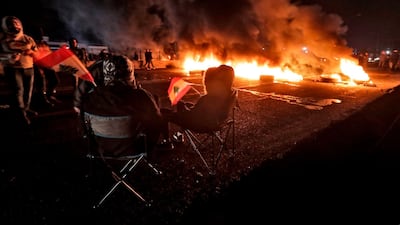
Anti-government protesters sit on chairs waving Lebanese national flags as tyres are aflame to cut off a section of the Beirut-Byblos highway in the coastal city of Byblos, as they protest the newly-announced government formed by Prime Minister Hassan Diab. AFP -
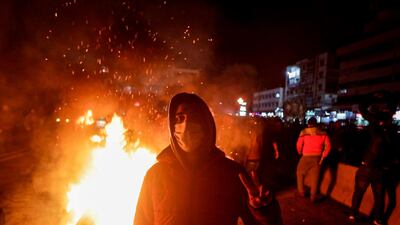
An anti-government protester flashes the victory gesture while tyres are set aflame as demonstrators cut off a section of the Beirut-Byblos highway in Byblos, as they protest the newly-announced government formed by Prime Minister Hassan Diab. AFP


Mr Nassar went home from Qatar to join protests when they started on October 17.
“I came with a biking jacket, a helmet, goggles and I have a medical kit in my bag," he said.
"It is not normal that a protester carrying a Lebanese flag needs to protest as if he is fighting a war.”
About an hour later, violence increased outside Parliament, with young men breaking the cement facade of luxury stores on the street to throw the debris back at the police.
They ripped potted trees from the street to throw them at riot police, who were protected by the metal barriers.
Protesters eventually tore off one barrier and pushed it through the cheering crowd.
As they started to dismantle the barbed wire between them and riot police, security forces dispersed the crowd with tear gas.
Lebanon’s anti-government protests started peacefully on October 17 but escalated last week. Hundreds of people were wounded.
At least two protesters lost their eyesight last Saturday because of rubber bullets, Human Rights Watch said.
On Tuesday evening, protesters briefly cut roads across Lebanon with burning tyres after the new Cabinet was announced.
Hundreds of protesters gathered outside Parliament, throwing rocks at security forces. Riot police sprayed them with tear gas for the first time.
Most roads were reopened by late morning on Wednesday, the state-run National News Agency reported.
After the announcement of the new Cabinet, videos of celebratory gunfire circulated on social media, purportedly from the Bekaa Valley, a Hezbollah stronghold from which several ministers hailed.
Lebanon had been without a government since October 29, when former prime minister Saad Hariri resigned due to the mass protests caused by a worsening economy.
Hezbollah has been hostile to protesters, accusing them of being infiltrated by foreign powers.
Shortly after the formation of the government on Tuesday, an undated video circulated of Health Minister Hamad Hasan speaking at a rally.
Mr Hasan is the president of the Municipalities Federation in a Hezbollah stronghold, Baalbek, in east Lebanon.
In the video, he criticises protests, calling them a “black movement”. He seemed to backtrack in a press release on Wednesday, saying that the video was “edited” and “did not present the correct image of my point of view”.
He added that he was part of a “government of technocrats” that does not “represent parties, but the aspirations of our society and our youth. My party is Lebanon.”

