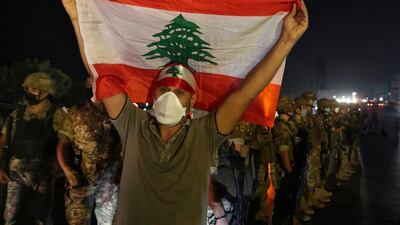
A protester holds up a Lebanese flag during a protest over Lebanon's economic crisis in Jal El Dib, north of Beirut, on September 27, 2020. AP Photo

Lebanese parties silent after harsh criticism from Emmanuel Macron


Sunniva Rose
  • English
  • Arabic

Lebanese politicians responded cautiously on Monday to French President Emmanuel Macron’s accusations of “collective betrayal” after they failed to form a reformist government despite their promises to quickly address the country’s multiple crises.

President Michel Aoun reaffirmed his support for Mr Macron’s efforts to help the country during a meeting with French ambassador to Lebanon Bruno Foucher, noting France’s “concern for Lebanon and the Lebanese”, the state-run National News Agency reported.

President Aoun said he “regretted” prime minister-designate Mustafa Adib’s failure to form a cabinet. Nominated on August 31, nearly three weeks after the resignation of the former government in the wake of the deadly August 4 blast at Beirut port that killed nearly 200 people, Mr Adib stepped down on Saturday as political parties insisted on controlling key portfolios.

French President Emmanuel Macron with Lebanon's President Michel Aoun at the presidential palace in Baabda near Beirut on September 1, 2020. Reuters

President Aoun is expected to reconvene parliament to discuss a new candidate for the premiership, but Lebanese media reported that binding consultations had not begun yet on Monday. President Macron on Sunday gave Lebanese leaders another “four to six weeks” to form a cabinet.

Parliament is scheduled to meet on Wednesday and Thursday to discuss 40 draft laws, including controversial and repeatedly postponed legislation to fight corruption and lift banking secrecy.

President Macron blasted the entire Lebanese political class in a press conference on Sunday, saying they had not respected their promise to form an independent government within 15 days of his second visit to Lebanon in less than a month on September 1.

The Beirut port explosion deepened Lebanon’s existing woes, which include hyperinflation, record-high unemployment, de facto capital controls in addition to a rapid devaluation of the currency by about 80 per cent.

“I take note that Lebanese political forces made the choice to preserve their partisan and individual interests at the expense of the country’s interest,” said Mr Macron, speaking from the Elysee Palace.

“I am ashamed for your leaders. I am ashamed,” he said in response to a Lebanese journalist’s question, and highlighted the risk of civil war if the political deadlock continued.

“Every day that passes makes finding an agreement more difficult. Every day that passes increases chances of a flare-up of violence,” he said.

President Macron accused Lebanon’s two Shiite parties, Iran-backed Hezbollah and its local ally Amal, of torpedoing the negotiations to form a government. Amal insisted on having a party loyalist at the head of the Finance Ministry, which it has controlled since 2014.

“Hezbollah cannot operate at the same time as an army against Israel, a militia unleashed against civilians in Syria and a respectable political party in Lebanon,” President Macron said.

“Today, the question is really in the hands of [Amal leader Nabih] Berri and Hezbollah: 'Do you want the worst-case scenario or do you want to engage the Shiite camp towards democracy, in the interest of Lebanon?'” asked President Macron.

There was no response from either party on Monday. Former finance minister and Amal member Ali Hassan Khalil, who was sanctioned by the US government for corruption and material support to Hezbollah on September 8, told local television network LBCI that he had “no comments on what was stated in the conference of the French president”.

Hezbollah leader Hassan Nasrallah is expected to respond to President Macron’s accusations in a speech on Tuesday evening. The US considers Hezbollah to be a terrorist organisation, but France makes a distinction between its military and political wing.

Lebanon’s Jaafarite Mufti Ahmad Kabalan, who is traditionally aligned Hezbollah, said on Monday that President Macron’s words were a “grave political injustice”.

“We are very open to the French initiative, but we will not accept anything less that what is in the nation’s interest, and threats are shameful. Our doubts are growing,” he said, according to the NNA.

Lebanese daily Al Akhbar, which is sympathetic to Hezbollah, wrote on Monday that the French president had "joined Washington and Riyadh", in reference to their hardline approach to the Iran-backed party, and described Mr Macron's tone as "insolent".

The newspaper claimed that Mr Adib did not resign because of Amal’s insistence on controlling the finance ministry but because of “America’s determination to keep Hezbollah out of the government”.

The European Union joined France in expressing its “disappointment” and “concern” at the political deadlock in Lebanon, stating on Monday that politicians “must unite and do their utmost for the timely formation of a government”.

Tu%20Jhoothi%20Main%20Makkaar%20
%3Cp%3E%3Cstrong%3EDirector%3A%20%3C%2Fstrong%3ELuv%20Ranjan%26nbsp%3B%3C%2Fp%3E%0A%3Cp%3E%3Cstrong%3EStars%3A%20%3C%2Fstrong%3ERanbir%20Kapoor%2C%20Shraddha%20Kapoor%2C%20Anubhav%20Singh%20Bassi%20and%20Dimple%20Kapadia%3C%2Fp%3E%0A%3Cp%3E%3Cstrong%3ERating%3A%3C%2Fstrong%3E%203%2F5%3C%2Fp%3E%0A
Jetour T1 specs

Engine: 2-litre turbocharged

Power: 254hp

Torque: 390Nm

Price: From Dh126,000

Available: Now

UAE currency: the story behind the money in your pockets

The Outsider

Stephen King, Penguin

Mercer, the investment consulting arm of US services company Marsh & McLennan, expects its wealth division to at least double its assets under management (AUM) in the Middle East as wealth in the region continues to grow despite economic headwinds, a company official said.

Mercer Wealth, which globally has $160 billion in AUM, plans to boost its AUM in the region to $2-$3bn in the next 2-3 years from the present $1bn, said Yasir AbuShaban, a Dubai-based principal with Mercer Wealth.

Within the next two to three years, we are looking at reaching $2 to $3 billion as a conservative estimate and we do see an opportunity to do so,” said Mr AbuShaban.

Mercer does not directly make investments, but allocates clients’ money they have discretion to, to professional asset managers. They also provide advice to clients.

“We have buying power. We can negotiate on their (client’s) behalf with asset managers to provide them lower fees than they otherwise would have to get on their own,” he added.

Mercer Wealth’s clients include sovereign wealth funds, family offices, and insurance companies among others.

From its office in Dubai, Mercer also looks after Africa, India and Turkey, where they also see opportunity for growth.

Wealth creation in Middle East and Africa (MEA) grew 8.5 per cent to $8.1 trillion last year from $7.5tn in 2015, higher than last year’s global average of 6 per cent and the second-highest growth in a region after Asia-Pacific which grew 9.9 per cent, according to consultancy Boston Consulting Group (BCG). In the region, where wealth grew just 1.9 per cent in 2015 compared with 2014, a pickup in oil prices has helped in wealth generation.

BCG is forecasting MEA wealth will rise to $12tn by 2021, growing at an annual average of 8 per cent.

Drivers of wealth generation in the region will be split evenly between new wealth creation and growth of performance of existing assets, according to BCG.

Another general trend in the region is clients’ looking for a comprehensive approach to investing, according to Mr AbuShaban.

“Institutional investors or some of the families are seeing a slowdown in the available capital they have to invest and in that sense they are looking at optimizing the way they manage their portfolios and making sure they are not investing haphazardly and different parts of their investment are working together,” said Mr AbuShaban.

Some clients also have a higher appetite for risk, given the low interest-rate environment that does not provide enough yield for some institutional investors. These clients are keen to invest in illiquid assets, such as private equity and infrastructure.

“What we have seen is a desire for higher returns in what has been a low-return environment specifically in various fixed income or bonds,” he said.

“In this environment, we have seen a de facto increase in the risk that clients are taking in things like illiquid investments, private equity investments, infrastructure and private debt, those kind of investments were higher illiquidity results in incrementally higher returns.”

The Abu Dhabi Investment Authority, one of the largest sovereign wealth funds, said in its 2016 report that has gradually increased its exposure in direct private equity and private credit transactions, mainly in Asian markets and especially in China and India. The authority’s private equity department focused on structured equities owing to “their defensive characteristics.”

25%20Days%20to%20Aden
%3Cp%3EAuthor%3A%20Michael%20Knights%3C%2Fp%3E%0A%3Cp%3EPages%3A%20256%3C%2Fp%3E%0A%3Cp%3EAvailable%3A%20January%2026%3C%2Fp%3E%0A
Sweet%20Tooth
%3Cp%3E%3Cstrong%3ECreator%3A%20%3C%2Fstrong%3EJim%20Mickle%3Cbr%3E%3Cstrong%3EStarring%3A%20%3C%2Fstrong%3EChristian%20Convery%2C%20Nonso%20Anozie%2C%20Adeel%20Akhtar%2C%20Stefania%20LaVie%20Owen%3Cbr%3E%3Cstrong%3ERating%3A%20%3C%2Fstrong%3E2.5%2F5%3C%2Fp%3E%0A
AI traffic lights to ease congestion at seven points to Sheikh Zayed bin Sultan Street

The seven points are:

Shakhbout bin Sultan Street

Dhafeer Street

Hadbat Al Ghubainah Street (outbound)

Salama bint Butti Street

Al Dhafra Street

Rabdan Street

Umm Yifina Street exit (inbound)

'Ashkal'
%3Cp%3E%3Cstrong%3EDirector%3A%3C%2Fstrong%3E%20Youssef%20Chebbi%3C%2Fp%3E%0A%3Cp%3E%3Cstrong%3EStars%3A%3C%2Fstrong%3E%20Fatma%20Oussaifi%20and%20Mohamed%20Houcine%20Grayaa%3C%2Fp%3E%0A%3Cp%3E%3Cstrong%3ERating%3A%3C%2Fstrong%3E%204%2F5%3C%2Fp%3E%0A
No more lice

Defining head lice

Pediculus humanus capitis are tiny wingless insects that feed on blood from the human scalp. The adult head louse is up to 3mm long, has six legs, and is tan to greyish-white in colour. The female lives up to four weeks and, once mature, can lay up to 10 eggs per day. These tiny nits firmly attach to the base of the hair shaft, get incubated by body heat and hatch in eight days or so.

Identifying lice

Lice can be identified by itching or a tickling sensation of something moving within the hair. One can confirm that a person has lice by looking closely through the hair and scalp for nits, nymphs or lice. Head lice are most frequently located behind the ears and near the neckline.

Treating lice at home

Head lice must be treated as soon as they are spotted. Start by checking everyone in the family for them, then follow these steps. Remove and wash all clothing and bedding with hot water. Apply medicine according to the label instructions. If some live lice are still found eight to 12 hours after treatment, but are moving more slowly than before, do not re-treat. Comb dead and remaining live lice out of the hair using a fine-toothed comb.
After the initial treatment, check for, comb and remove nits and lice from hair every two to three days. Soak combs and brushes in hot water for 10 minutes.Vacuum the floor and furniture, particularly where the infested person sat or lay.

Courtesy Dr Vishal Rajmal Mehta, specialist paediatrics, RAK Hospital