
Lebanon's army reopened most of the country's roads on Wednesday morning after Prime Minister Saad Hariri presented his resignation.
The army issued a statement early in the morning asking protesters to reopen roads that had been closed 14 days since the beginning of massive anti-government protests.
By midmorning, the security forces had reopened nearly all of the country’s main roads.
The state-run National News Agency reported that the army cleared an important roadblock north of Beirut in Jal el Deeb. Hundreds of people who had parked their cars in the middle of the motorway removed them "in fear of the soldiers", reported local newspaper The Daily Star. In the city of Jbeil, protesters brought a bulldozer to clear the rubble they used to block the road.
The army did not use violence as they removed the roadblocks, according to witnesses and local media. "We respect the army's request. We are staying on the side of the street and not evacuating. If we do not get what we want – a technocratic government – we will block it again," said a protester on one of Beirut’s main roads, known locally as The Ring.
However, many protesters were injured last week when soldiers unsuccessfully attempted to clear roads for the first time.
Just hours before Mr Hariri’s resignation speech on Tuesday, hundreds of supporters of the Shiite party Hezbollah and its ally Amal attacked protesters who had been camped out for days at The Ring.
Between 200 to 300 men then ransacked Martyrs’ Square, tearing down protesters' stages and burning their tents.
Hezbollah denied any affiliation with a dozen or so of its supporters who attacked protesters with sticks and chairs in Beirut. Its leader, Hassan Nasrallah, said in a speech on Friday that he was against the government’s resignation and accused the protesters of being manipulated by foreign countries.
-
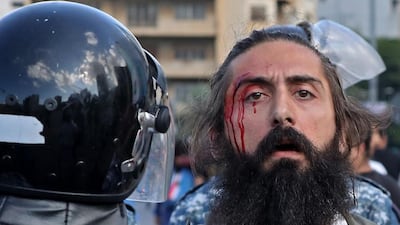
An injured man stands near Lebanese security forces trying to prevent clashes between demonstrators and counter-protesters in the centre of the capital Beirut during the 13th day of anti-government protests. AFP -
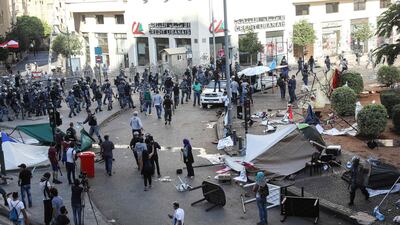
Lebanese security forces intervene after counter-protesters clash with anti-government demonstrators destroy a protest site in the centre of the capital Beirut during the 13th day of anti-government demonstrations. AFP -
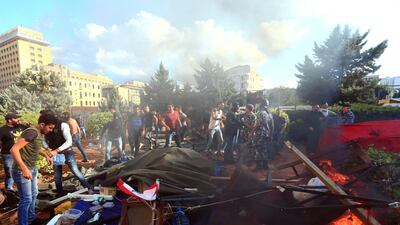
Lebanese security forces intervene between clashing demonstrators and counter-protesters in the centre of the capital Beirut during the 13th day of anti-government protests. AFP -
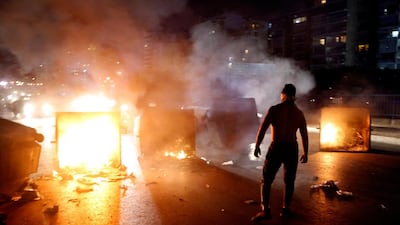
A supporter of Lebanese Prime Minister Saad Hariri burns garbage containers to block a main road, in Beirut, Lebanon. AP Photo -
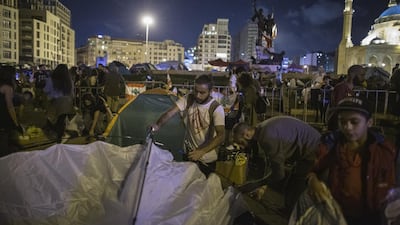
Anti-government protesters put up a tent in Martyrs' Square in Beirut, Lebanon. Getty Images -
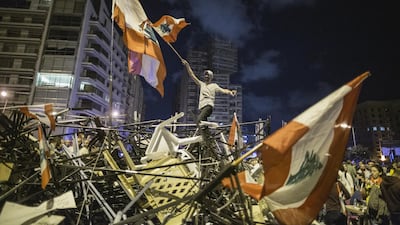
An anti-government protester waves a Lebanese flag as he stands on top of a pile of broken tents in Martyrs' Square in Beirut, Lebanon. Getty Images -
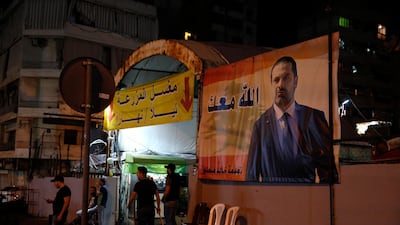
Supporters of Lebanese Prime Minister Saad Hariri stand next of his portrait with Arabic words that read, "God with you," in Beirut, Lebanon. AP Photo -
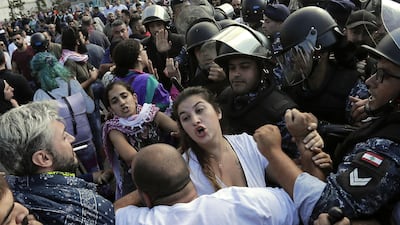
Lebanese security forces intervene between clashing demonstrators and counter-protesters in the centre of the capital Beirut during the 13th day of anti-government protests. AFP


By Tuesday evening, hundreds of protesters had returned to The Ring. Some played music while others distributed food to fellow demonstrators amid a festive atmosphere.
Protesters were unsure of what would happen next, but the mood was defiant. One woman, who asked to be anonymous, said: “We are living by the second. We did not know that we would be attacked today or that Hariri would resign. We do not know if the president will accept it or not.”
In a noticeable shift, protesters asked to remain anonymous, in fear of retaliation from Hezbollah.
Several hundred people also returned on Tuesday night to protest in front of Parliament and in Martyr’s Square, where they rebuilt the tents destroyed by Hezbollah and Amal supporters earlier that day.
However, numbers remained lower than at the height of the protests in mid-October. Some protesters The National spoke to blamed this on the fear of being attacked.

