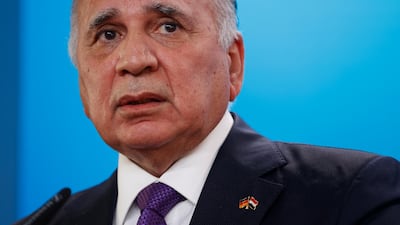
Iraqi Foreign Minister Fuad Hussein is on his first official visit to Tehran. Pool via AP, file

Iraqi foreign minister makes first trip to Iran


  • English
  • Arabic

Iraq’s foreign minister arrived in Tehran on Saturday for bilateral talks with senior Iranian officials, according to the state-run news agency.

IRNA reported that Fuad Hussein planned to meet his Iranian counterpart Mohammad Javad Zarif and President Hassan Rouhani during his first visit to the Iranian capital.

Mr Zarif visited Baghdad in mid-July and met with Mr Hussein and Iraqi Prime Minister Mustafa Al Kadhimi.

It was Mr Zarif’s first visit to Iraq since a US airstrike in January killed a top Iranian general, Maj Gen Qassem Suleimani, outside Baghdad’s international airport. The strike catapulted Iraq to the brink of a US-Iran proxy war that could have destabilised the Middle East.

After Mr Zarif’s trip, the Iraqi premier visited Iran in July.

The report did not elaborate on the main reasons behind the top Iraqi diplomat’s two-day trip to Tehran, but it comes days after Washington extended a sanctions waiver for Baghdad to continue buying gas from Iran. However, US officials said they expected to see progress by Baghdad in the next 60 days to reduce dependence and Iraq’s electricity minister has since said that work is being done in this regard.

Iran sees neighbouring Iraq as a possible route to bypass US sanctions that President Donald Trump re-imposed in 2018 after pulling the US out of the 2015 nuclear deal between Tehran and world powers.

Last year, Iran’s exports to Iraq amounted to nearly $9 billion (Dh33bn), the official IRNA news agency reported on Tuesday. It said the two nations will discuss increasing the amount to $20 billion.

Before the current global pandemic, millions of Iranian pilgrims visiting Iraq’s Shiite holy sites were a major source of revenue.

Iran has seen the worst outbreak in the region, with more than 443,000 thousand confirmed cases and at least 25,300 deaths.

The Associated Press quoted local media reporting that Iran cancelled all its flights to Iraqi cities until the religious holiday of Arbaeen, due to concerns over the coronavirus outbreak.


Ten tax points to be aware of in 2026

1. Domestic VAT refund amendments: request your refund within five years

If a business does not apply for the refund on time, they lose their credit.

2. E-invoicing in the UAE

Businesses should continue preparing for the implementation of e-invoicing in the UAE, with 2026 a preparation and transition period ahead of phased mandatory adoption. 

3. More tax audits

Tax authorities are increasingly using data already available across multiple filings to identify audit risks. 

4. More beneficial VAT and excise tax penalty regime

Tax disputes are expected to become more frequent and more structured, with clearer administrative objection and appeal processes. The UAE has adopted a new penalty regime for VAT and excise disputes, which now mirrors the penalty regime for corporate tax.

5. Greater emphasis on statutory audit

There is a greater need for the accuracy of financial statements. The International Financial Reporting Standards standards need to be strictly adhered to and, as a result, the quality of the audits will need to increase.

6. Further transfer pricing enforcement

Transfer pricing enforcement, which refers to the practice of establishing prices for internal transactions between related entities, is expected to broaden in scope. The UAE will shortly open the possibility to negotiate advance pricing agreements, or essentially rulings for transfer pricing purposes. 

7. Limited time periods for audits

Recent amendments also introduce a default five-year limitation period for tax audits and assessments, subject to specific statutory exceptions. While the standard audit and assessment period is five years, this may be extended to up to 15 years in cases involving fraud or tax evasion. 

8. Pillar 2 implementation 

Many multinational groups will begin to feel the practical effect of the Domestic Minimum Top-Up Tax (DMTT), the UAE's implementation of the OECD’s global minimum tax under Pillar 2. While the rules apply for financial years starting on or after January 1, 2025, it is 2026 that marks the transition to an operational phase.

9. Reduced compliance obligations for imported goods and services

Businesses that apply the reverse-charge mechanism for VAT purposes in the UAE may benefit from reduced compliance obligations. 

10. Substance and CbC reporting focus

Tax authorities are expected to continue strengthening the enforcement of economic substance and Country-by-Country (CbC) reporting frameworks. In the UAE, these regimes are increasingly being used as risk-assessment tools, providing tax authorities with a comprehensive view of multinational groups’ global footprints and enabling them to assess whether profits are aligned with real economic activity. 

Contributed by Thomas Vanhee and Hend Rashwan, Aurifer

History's medical milestones

1799 - First small pox vaccine administered

1846 - First public demonstration of anaesthesia in surgery

1861 - Louis Pasteur published his germ theory which proved that bacteria caused diseases

1895 - Discovery of x-rays

1923 - Heart valve surgery performed successfully for first time

1928 - Alexander Fleming discovers penicillin

1953 - Structure of DNA discovered

1952 - First organ transplant - a kidney - takes place 

1954 - Clinical trials of birth control pill

1979 - MRI, or magnetic resonance imaging, scanned used to diagnose illness and injury.

1998 - The first adult live-donor liver transplant is carried out