
Iraq's top Shiite cleric, Grand Ayatollah Ali Sistani, called on Friday for early elections to end the months of political paralysis that have gripped the protest-hit country.
"The quickest and most peaceful way out of the current crisis and to avoid plunging into the unknown, chaos or internal strife ... is to rely on the people by holding early elections," said a representative of Sistani, who never appears in public.
The revered 89-year-old cleric urged lawmakers to "form a new government as soon as possible" which should then speedily pave the way for new, free and fair elections, according to his representative, Abdel Mahdi Al Karbalai.
Iraq has been rocked by two months of anti-government protests, the worst wave of unrest since a US-led invasion ended the reign of dictator Saddam Hussein in 2003.
-

Iraqis ride a horse-drawn cart on Al Rashid street in the capital Baghdad amid ongoing anti-government demonstrations. AFP -

Shop owners throw out their burnt goods while cleaning their shops after clashes between security forces and anti-government protesters in Rasheed Street. AP -

Shops owners throw out their burnt goods while cleaning their shops after clashes between security forces and anti-government protesters in Rasheed Street. AP -
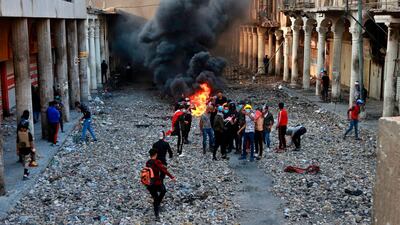
Anti-government protesters set fire while security forces close Rasheed Street during clashes in Baghdad, Iraq. AP -
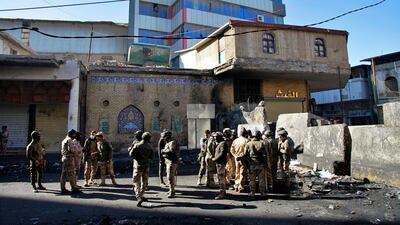
Iraqi security forces deploy in Al Rashid Street. AP -
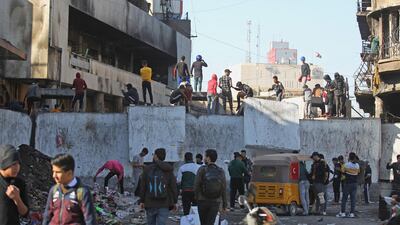
Iraqi protesters gather on Al Rashid street in the capital Baghdad amid ongoing anti-government demonstrations on December 19, 2019. AFP -
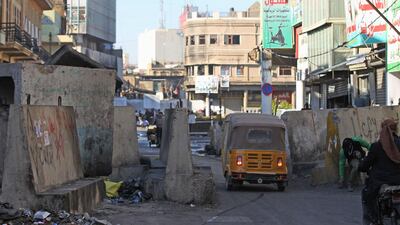
A tuk-tuk drives through a barricade at Al Rashid street in the Iraqi capital Baghdad amid ongoing anti-government demonstrations. AFP -
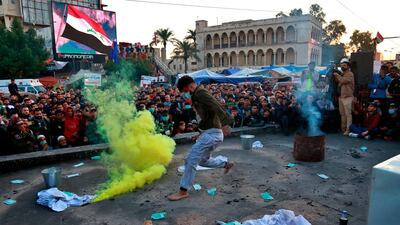
An Iraqi actor performs during a play titled "The revolution" during anti-government protests at Tahrir Square in Baghdad. AP -

Protesters stage a sit-in in Tahrir Square during anti-government demonstrations in Baghdad. AP -
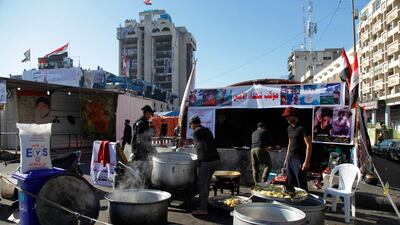
Volunteers prepare free food to anti-government protesters in Tahrir Square during ongoing protests in Baghdad. AP -

Iraqi women take selfies in front of a mural during ongoing anti-government protests in Tahrir square. AFP


The demonstrators, many of whom came of age after Saddam's death, have condemned the government for being inept, corrupt and beholden to powerful neighbour Iran and demanded the ouster of the entire political class.
About 460 people have been killed and 25,000 wounded in street clashes in Baghdad and across the Shiite-majority south.
Former premier Adel Abdel Mahdi quit in November in the face of the mass protests and after a sharp spike in deadly violence, and the deeply divided parliament has since struggled to find a replacement.
-

An ambulance arrives in Tahrir square after unidentified men attacked an anti-government protest camp in Baghdad. AFP (All photos taken on on December 6) -

Anti-government protesters throw stones while security forces close Rasheed Street during clashes in Baghdad. AP Photo -

Supporters of Iraqi Shiite group Popular Crowd Forces and Iraqi Shiite Muslim spiritual leader Grands Ali al-Sistani carry the Iraqi national flag as they take part in a demonstration at the Al Tahrir square in central Baghdad. EPA -

Iraqi security forces take pictures with a protester dressed as Santa Claus during ongoing protests on Rasheed Street in Baghdad. AP Photo -

Tribal elders from the southern Iraqi city of Basra take part in a march to support the the country's top Shiite cleric, Grand Ayatollah Ali Sistanion. AFP -

Tribal elders from the southern Iraqi city of Basra take part in a march to support the the country's top Shiite cleric, Grand Ayatollah Ali Sistani. AFP -

Supporters of Iraqi Shiite group Popular Crowd Forces and Iraqi Shiite Muslim spiritual leader Grands Ali al-Sistani carry the pictures of the victims of protests as they take part in a demonstration at the Al Tahrir square in central Baghdad. EPA -

Supporters of Iraqi Shiite group Popular Crowd Forces and Iraqi Shiite Muslim spiritual leader Grands Ali al-Sistani carry their flag, as they take part in a demonstration at the Al Tahrir square in central Baghdad. EPA -
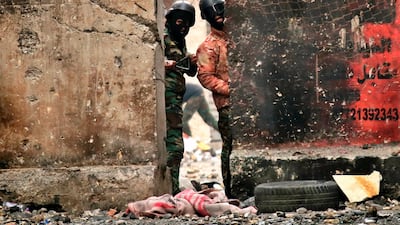
Policemen use slingshots to fire stones towards anti-government protesters during clashes on Rasheed Street in Baghdad. AP Photo -

Iraqi demonstrators carry a large banner that says in Arabic "peaceful, not destructive" as they take part in an anti-govenment demonstration in the capital Baghdad's Tahrir Square. AFP


Mr Sistani, who is said to have made and undone all Iraqi prime ministers since 2003, has been keeping his distance from the politicians who have been booed by protesters since the start of October.
Parliament had been due to propose a new candidate by the end of Thursday.
But with deep divisions remaining, authorities agreed to push the deadline back to Sunday, a source within the presidency said.
In Baghdad's Tahrir Square, the centre of the protest movement, demonstrators have put up large-format portraits of the official candidates with their faces crossed out in red.
"They can keep pushing the deadline back by one day, two days, even a year – we're still on the streets. It hurts them more than it hurts us," said a demonstrator called Ghassan, 35.
Talks have continued between parliamentary group leaders, party bosses and Iranian and UN envoys.
Outgoing higher education minister Qusay Al Suhail has for several weeks been presented by officials as the candidate of Iran.
A former key member of Shiite cleric Moqtada Al Sadr's movement, Suhail rejoined the State of Law Alliance of former premier Nuri Al Maliki, who is close to Iran and an enemy of Mr Al Sadr.
Other names are circulating, all of them former ministers or officials from the inner circle who are likely to be rejected on principle in the streets.
Once a name is proposed, lawmakers can submit it to President Barham Saleh for a vote in the 329-member parliament.
If that person fails to gain a majority, Mr Saleh has the right to put forward his own candidate.
If parliament rejects that candidate, the constitution stipulates that Mr Saleh would become the de facto head of the outgoing cabinet for 15 days.
Mr Saleh is betting on "a last-minute decision," an official told AFP, speaking on condition of anonymity.
If no party's candidate obtains a majority, the official said, the president intends to propose intelligence chief Mustafa Al Kazimi, who is seen to have US backing.
Angered by chronic youth unemployment, the young demonstrators have rallied against the entire political establishment and its institutions, especially the parliament headed by speaker Mohammed Al Halbusi.
On Friday they chanted: "Barham Saleh, Mohammed Al Halbusi, your turn has come."

