
Iran on Tuesday said it would execute a man for giving the US and Israel information that helped to kill a top Iranian general, after his conviction was upheld by the Supreme Court.
Mahmoud Majd was convicted of spying on Iran's armed forces, especially the Quds Force, and on the movement of its commander, Qassem Suleimani, judiciary spokesman Gholamhossein Esmaili said.
Mr Esmaili said Mr Majd was paid large sums by Israel's Mossad and the CIA for the information, which led to the assassination of Suleimani in a US drone attack in January.
"Majd's death sentence has been upheld by the Supreme Court and will be carried out soon," he said.
Suleimani led the Quds Force, which was the foreign operations arm of Iran's Islamic Revolutionary Guard Corps, until his death in Baghdad.
In February, Iran handed down a death sentence to Amir Rahimpour, another man convicted of spying for the US and conspiring to sell information on Iran's nuclear programme.
Tehran announced in December that it had arrested eight people "linked to the CIA" and involved in nationwide street protests that broke out in the previous month over a sudden rise in petrol prices.
In July 2019 it said that it had dismantled a CIA spy ring, arresting 17 suspects between March 2018 and March 2019 and sentencing some of them to death.
US President Donald Trump at the time dismissed the claim as "totally false".
-
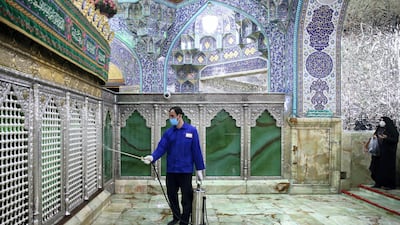
An Iranian sanitary worker disinfects Qom's Masumeh shrine on February 25, 2020 to prevent the spread of the coronavirus. AFP -
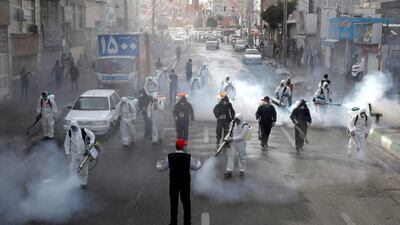
Iranian Firefighters disinfect streets in the capital Tehran in a bid to halt the wild spread of coronavirus on March 13, 2020. AFP -
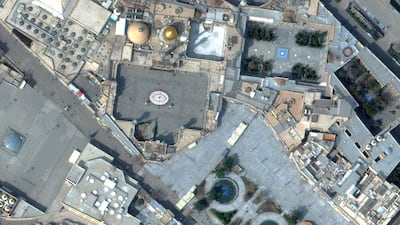
A nearly empty Hazrat Masumeh Shrine in Qom, Iran on March 1, 2020. AFP -
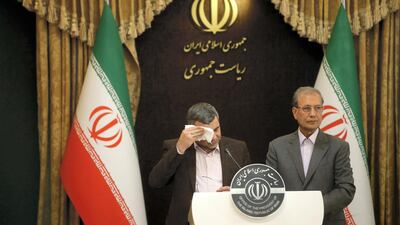
Iranian Deputy Health Minister Iraj Harirchi (left) wipes the sweat off his face, during a press conference with the Islamic republic's government spokesman Ali Rabiei in the capital Tehran on February 24, 2020. AFP -

An image grab of footage obtained from Iranian State TV IRINN on February 25, 2020, shows Iran's deputy health minister Iraj Harirchi speaking in a video apparently shot by himself, regarding being infected with coronavirus. AFP -
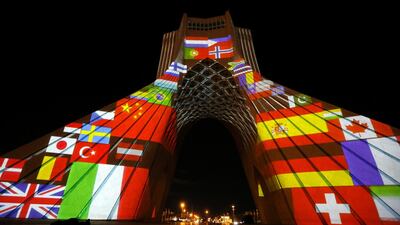
Iran's Azadi (Freedom) Tower is lit up with flags and messages of hope in solidarity with all the countries affected by the coronavirus pandemic, in Tehran on March 31, 2020. AFP -

Iranian workers set up a makeshift hospital inside the Iran Mall, northwest of Tehran, on March 21, 2020 amid the coronavirus outbreak. - Iran said that 123 more people had died from coronavirus, raising the official death toll to 1,556 in the Islamic republic, one of the world's worst affected countries. AFP -
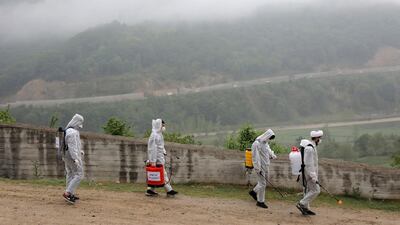
Volunteers wearing protective clothing, take part in disinfecting a village during the coronavirus outbreak, in the outskirts of the city of Ghaemshahr, in north of Iran, on Wednesday, April 29, 2020. AP Photo -
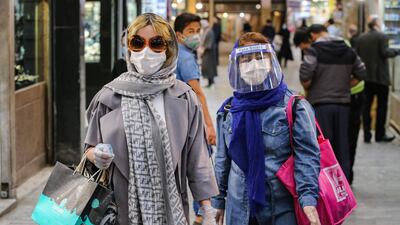
Shoppers clad in protective gear, including face masks and shields and latex gloves, due to the coronavirus pandemic, walk through the Tajrish Bazaar in Iran's capital Tehran on April 25, 2020. AFP -

A customer wears a protective masks at a pharmacy in the Iranian capital Tehran on February 24, 2020. AFP -

A Tehran Municipality worker cleans a bus to avoid the spread of Covid-19 on February 26, 2020. AFP -
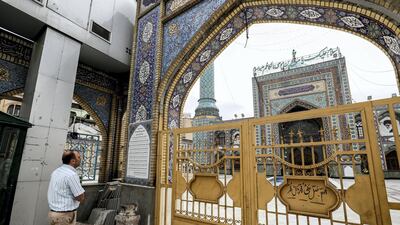
A man stands by the closed gate outside the Imamzadeh Saleh in the Iranian capital Tehran's Shemiran district on April 25, 2020 . AFP -

Labourers unloading medical equipment and coronavirus testing kits provided by the World Health Organisation, from a UAE military transport plane upon their arrival at Mehrabad International Airport in Iran's capital Tehran. AFP


Iran-US tension has soared in recent years as Mr Trump imposed a campaign of "maximum pressure" against America's sworn enemy.
Since withdrawing the US from a nuclear deal between Tehran and world powers in May 2018, he has hit it with sweeping sanctions.
The two sides appeared to come from the brink of direct conflict several times in the past two years.
Yet despite the tensions and having no formal diplomatic relations since 1980, Tehran and Washington have held several prisoner swaps.
The latest was on Monday when Iranian scientist Majid Taheri returned home as Iran released US Navy veteran Michael White, who had been detained since his arrest in July 2018.
Mr Taheri, an Iranian-American who had been working at a clinic in Tampa, Florida, was held in the US for 16 months over breaching US sanctions by sending a technical item to Iran.
Tehran had also exchanged The Washington Post reporter Jason Rezaian in January 2016 for seven Iranians held in the US, on the day the nuclear deal came into force.
In December, Iran freed Xiyue Wang, a US academic, in exchange for scientist Massoud Soleimani.
Americans and dual nationals known to be held by Iran include Siamak Namazi, his father Baquer, and Morad Tahbaz.
Two others, Gholam Reza Shahini and Karan Vafadari, have reportedly been released on bail.
Most of the Iranians held in the US are dual nationals charged with evading sanctions by exporting goods to Iran or using the US financial system.

