
The man dispatched by Iran to rally political factions in Iraq to solve the country’s political crisis has failed to persuade Islamist Shiite leaders in Baghdad to back his plan for resigned prime minister Adil Abdul Mahdi to remain in his post.
Secretary General of the Iranian Supreme National Security Council, Rear Admiral Ali Shamkhani, is in Baghdad meeting Shiite Islamist parties to build support for one of two proposals. First is to reinstate Mr Abdul Mahdi as a stop-gap until early elections and the second is for him to return as a straight consensus solution to end a political impasse that has paralyzed the government amid nationwide protests, Shiite political leaders in Iraq told The National.
Mr Abdul Mahdi stood down at the end of November after his position became untenable when Grand Ayatollah Ali Al Sistani withdrew support because security forces killed 32 protests in a matter of hours at a protest in the southern city of Nassiriya.
Militias and security forces have well over 500 protesters since mass uprisings began in October against years of ineffectual government, corruption, the dire economic situation and poor public services.
-
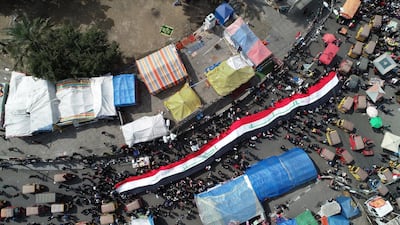
An aerial picture taken by a drone shows Iraqi protesters at the Al-Tahrir square in central Baghdad, Iraq. EPA -
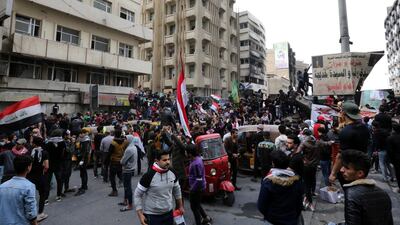
Iraqi protesters carry the Iraqi national flag as they gather on concret blocks which were used by security forces to close the Al-Khilani square in central Baghdad, Iraq. EPA -
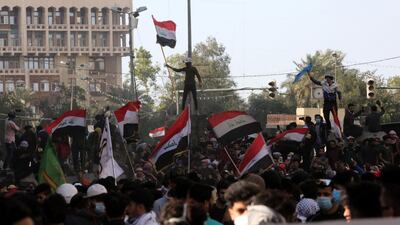
Iraqi protesters carry the Iraqi national flag as they gather on concreat blocks which were used by security forces to close the Al-Khilani square in central Baghdad, Iraq. EPA -
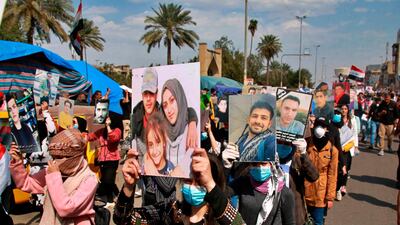
Anti-government protesters hold pictures of protesters who have been killed in anti-government demonstrations, during a rally in Baghdad, Iraq. AP Photo -
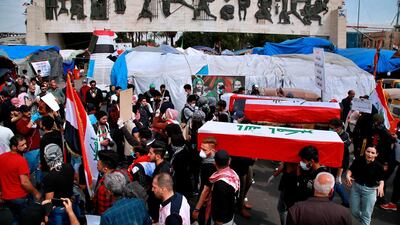
Protesters carry symbolic Iraqi flag-draped coffins of people who have been killed in anti-government protests, during a rally in Baghdad, Iraq. AP Photo -
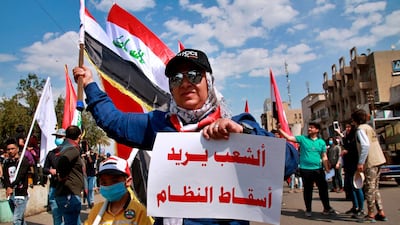
An anti-government protester holds a placard in Arabic that reads, "the people want to bring down the regime," during a rally in Baghdad, Iraq. AP Photo -
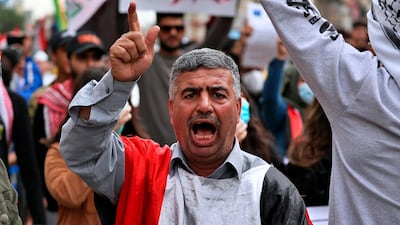
A protester chants anti-government slogans during a rally in Baghdad, Iraqs. AP Photo -
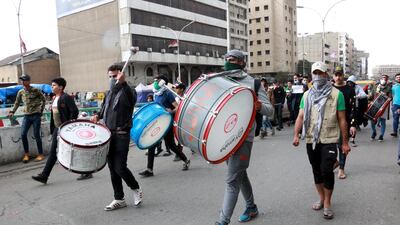
Iraqi protesters beat on the drums during a protest at the Al-khilani square in central Baghdad, Iraq. EPA -
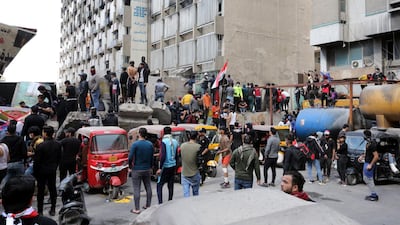
Iraqi protesters carry the Iraqi national flag as they gather on concret blocks which were used by security forces to close the Al-Khilani square in central Baghdad, Iraq. EPA -
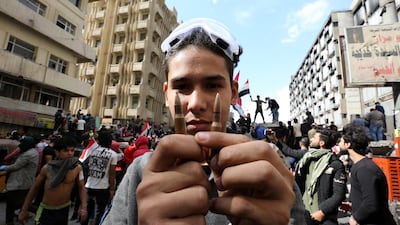
An Iraqi protester holds live ammunition which was allegedly used by security forces during clashes with protesters at the Al-Khilani square in central Baghdad, Iraq. EPA -
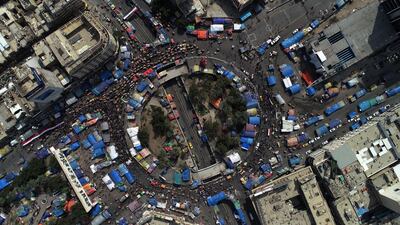
An aerial picture taken by a drone shows Iraqi protesters at the Al-Tahrir square in central Baghdad, Iraq. EPA


Veteran Shiite politician Muhammad Tawfiq Allawi was first tasked with forming a new administration but failure to get support from all of Iraq’s major sects meant that he withdrew his candidacy on March 3.
President Barham Salah said he would then nominate Mr Allawi’s successor but Shiite political forces are yet to present a consensus candidate.
Adm Shamkhani is the first high-level Iranian official to visit Iraq since a US strike killed the Islamic Republic’s Quds force leader Gen Qassim Suleimani, deputy head of Iraq’s Popular Mobilization Forces Abu Mahdi Al Muhandis and several others on January 3.
He arrived in Baghdad on Saturday in a bid to "reunite the Shiite forces" who have become divided since the killing of Sulimani and the resignation of Mr Abdel Mehdi, Shiite leaders who participated the meetings told The National.
As soon as he arrived, Adm Shamkhani met Shiite religious political blocs at the home of Ammar Al Hakim, an Iraqi cleric and politician who led Al Hikma bloc.
The meeting was attended by most of the prominent Shiite political leaders, including Nuri Al Maliki, former prime minister and head of the State of Law bloc; Haider Al Abadi, former prime minister and leader of Al Nassr bloc and Faleh Al Fayyad, the head of the PMF who also leads the Ataa Movement.
Hadi Al Amri, the leader of the Iranian backed bloc Al Fatteh, and representatives of the influential cleric Muqtada Al Sadr, the leader of Sairoon, did not attend, three of those who joint the meeting told The National.
Adm Shamkhani’s main suggestion, attendees said, was for Mr Abdul Mahdi to rescind his resignation or to be re-vote in by parliament with a major cabinet reshuffle "to gain time and unify efforts to confront the crises currently ravaging the country," one political source said. While parliament does not select the prime minister directly they vote to give confidence to the government.
But the proposal, the sources said, was rejected.
"Most of the Shiite political forces refused the continuation of the current government for many fundamental reasons," Fadi Al Shimary, the head of Al Hikma bloc, headed by Ammar Al Hakim, told The National.
"Among these reasons are the popular rejection [from the street], Najaf's rejection [from Mr Al Sistani], opposing international positions in addition to mismanagement and corruption that has spread in an unprecedented way,” he said. “This position was the basis for a vision agreed by the five Shiite forces [that attended the meeting] for the necessity of forming a new government headed by an independent prime minister who is politically and popularly capable of meeting the requirements of the stage”.
Adm Shamkhani held a follow-up meeting on Sunday that included Mr Abdul Mahdi as well as Mustafa Al Kadhimi, the director of the Iraqi National Intelligence Service. Mr Al Khadhimi’s name has been proposed although the Iran-backed Kataib Hezbollah militia said they would “demolish what is left of the country’ security” if he was nominated.
"Shamkhani's meeting with Al Kadhemi was a message to some Iraqi Shiite parties linked to Iran stating that Iran does not oppose the assumption of Al Kadhemi as prime minister in the next stage," a prominent Shiite leader familiar with the meetings told The National although he declined to be named.
“The Iranians are looking for personalities who preserve their interests. Al Kadhemi is a moderate figure and enjoys good relations with most Iranian institutions,” the source said. “The Iranian Foreign Ministry, Intelligence and some of the IRGC leaders tend to support Al Kadhemi as they are confident that he can play a major role in the restoration of Iranian-American relations.”
The political system in Iraq has been built on political quotas since 2005 giving each major faction ministries and positions based on the proportion of seats they win in the election.
The main factor that brought down Mr Allawi was his attempt to appoint ministers without factoring in the division of power in parliament.
The leaders of the major Shiite blocs have been in continuous meetings since Friday to agree on the tasks and roles the next prime minister must take on as well as the mechanism for selecting him.
Political sources said that this conversation was ongoing with more meetings scheduled to take place at Mr Al Amri’s house.
"What is required is a government that works in two directions: the first is to provide the required infrastructure for early elections and work with Parliament to address technical gaps in the election law, while the second is to confront the challenges of the coronavirus infection and prepare to face the repercussions of the economic crisis caused by the collapse of oil prices," Mr Al Shimari said.
He added that he is confident of a swift conclusion.
“The meetings have been going on for days, and we believe that the political forces will reach an agreement on the name of the candidate within 72 hours.”
For several weeks, political wrangling has delayed such resolutions despite leaders promising a conclusion soon.

