
German Foreign Minister Heiko Maas on Wednesday restated his government's view that Israel’s plans to annex parts of the occupied West Bank were illegal, but stopped short of threatening sanctions.
Mr Maas was speaking on a one-day trip to Israel to meet Prime Minister Benjamin Netanyahu, Foreign Minister Gabi Ashkenazi and Defence Minister Benny Gantz.
Israel’s new unity government next month intends to begin discussing annexation of its settlements in occupied land that Palestinians claim for a future independent state.
The plan has been criticised by Arab and European powers as likely to kill off a two-state solution to the Middle East conflict.
Israel says annexation would be in keeping with a plan announced by US President Donald Trump in Washington in January.
“I repeated here today the German position, as well as our serious concerns as a special friend of Israel of the possible consequences of such a step,” Mr Maas said alongside Mr Ashkenazi.
“We share these views with our European partners, and we are of the view that an annexation would not be compatible with international law, and we therefore continue to stand for an agreed and negotiated two-state solution.
“And to get closer to the goal of a negotiated agreement, it needs new creative impulses to revive talks.”
Mr Maas later met Mr Netanyahu, who told him any “realistic plan must recognise the reality of Israeli settlement in the territory and not foster the illusion of uprooting people from their homes”, the prime minister's office said.
It made no direct mention of annexation But it said Mr Netanyahu spoke of ensuring Israel’s “vital interests”, such as maintaining “full security control” over the West Bank.
Mr Maas will travel from Israel to Amman for separate talks with Jordanian officials and Palestinian leaders.
Last September, Germany was one of five European nations to say annexation would constitute a serious breach of international law.
“I did not set any price tags,” he said on Wednesday about whether he had discussed the EU imposing sanctions on Israel.
Palestinian-Israeli talks aimed at agreeing on a two-state solution collapsed in 2014.
Palestinian leaders have since boycotted the Trump administration over its perceived bias towards Israel.
Washington’s proposal envisages a Palestinian state in up to 70 per cent of the West Bank, but with overall Israeli security control.
Palestinians say that would leave them with an unviable country.
Palestinian Foreign Minister, Riyad Al Maliki, on Wednesday called on countries to form an international front to isolate “the Israeli colonial system”.
-
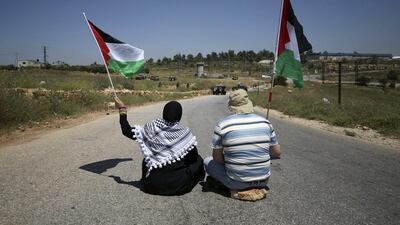
Palestinian protesters wave flags as Israeli troops take position during a protest against Jewish settlements in the West Bank village of Nabi Saleh, near Ramallah. Reuters -
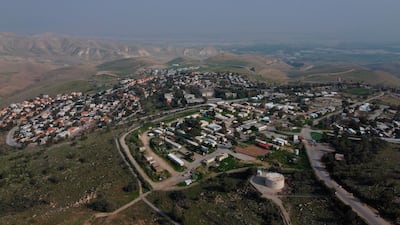
Now that Prime Minister Benjamin Netanyahu has secured a new term in office, there’s little to prevent him from annexing large parts of the West Bank as early as this summer. AP -
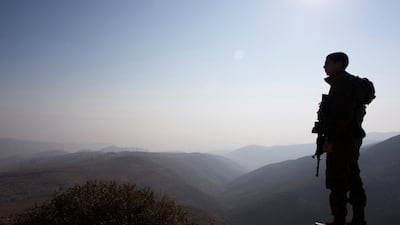
An Israeli soldier stands guard during a tour made by Israeli parliament members in the Jordan Valley near the Jewish settlement of Maale Efrayim. Reuters -
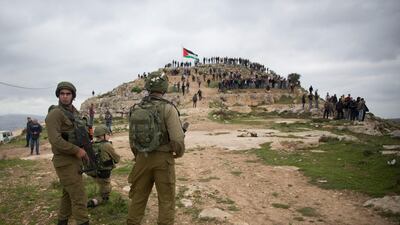
Israeli soldiers take position as Palestinian demonstrators gather during a protest against expansion of Israeli settlements in the West Bank. AP -
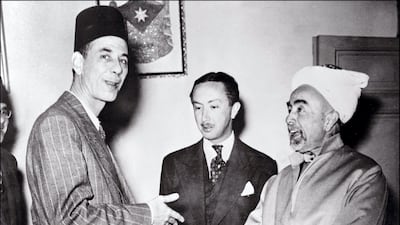
King Abdullah (r) of Transjordan on May 13, 1948 in Amman with Abed Al Rahman Azzam, the secretary general of the Arab League and Abd Al Elah Ibn Ali, the Prince Regent of Iraq, the day before the beginning of the first Arab-Israeli War. AFP -
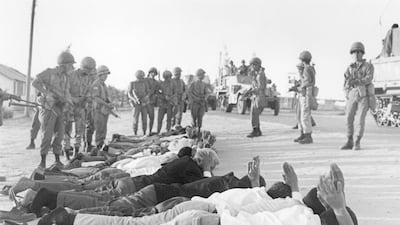
Palestinians surrender to Israeli soldiers in June 1967 in the occupied territory of the West Bank after Israel launched a pre-emptive attack on Egypt and Syria and seized the Gaza Strip, Sinai Peninsula and the Golan Heights in Syria as well as the West Bank and Arab East Jerusalem. AFP -
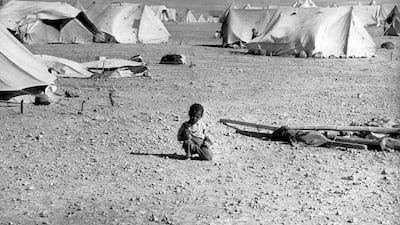
A Palestinian child plays in a refugee camp in Jordan on June 23, 1967. AFP -
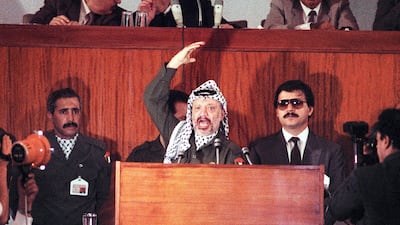
PLO chairman Yasser Arafat delivers a speech to the Palestine National Council meeting to make the historic proclamation of a Palestinian state in the Israeli-occupied territories and to recognize Israel in the Palace of Nations conference hall on November 12, 1988, in Algiers. AFP -

US President Bill Clinton stands between PLO leader Yasser Arafat and Israeli Prime Minister Yitzahk Rabin as they shake hands for the first time on September 13, 1993 at the White House. AFP -
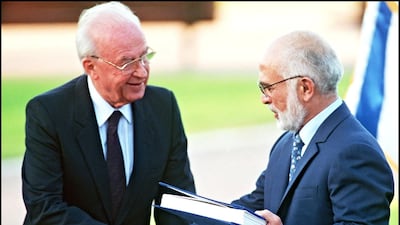
Hussein Ibn Talal, King of Jordan and Israeli Premier Yitzhak Rabin shake hands after they exchanged the documents of the Peace Treaty at Beit Gabriel conference centre on November 10, 1994 on the southern shore of the Sea of Galilee. AFP -
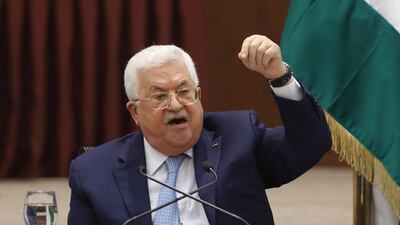
Palestinian President Mahmoud Abbas speaks during the Palestinian leadership meeting and threatened to end security coordination with Israel and the United States, saying Israeli annexation would ruin chances for peace. AFP -
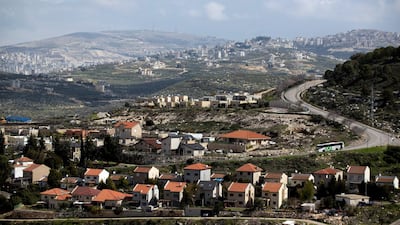
Houses in the Israeli settlement of settlement of Kedumim are seen in the foreground as part of the Palestinian city of Nablus is seen in the background (far left) in the Israeli-occupied West Bank. Reuters -
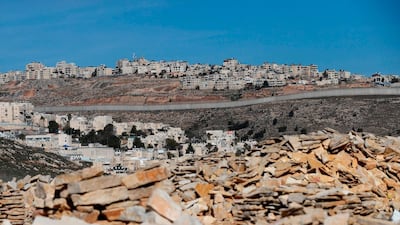
Israel's controversial concrete barrier (C) separating the Jewish settlement of Neve Yaakov (foreground) in the northern part of east Jerusalem and the Palestinian area of al-Ram (background) in the occupied West Bank. AFP -
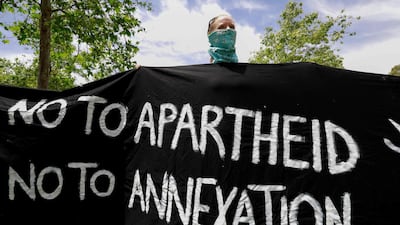
An Israeli activist holds a banner during a protest against the US peace plan for the Middle East, in front of the US ambassador's residence in Jerusalem, on May 15, 2020, as Palestinians commemorate the 72nd anniversary of the 1948 Nakba or "catastrophe". AFP -
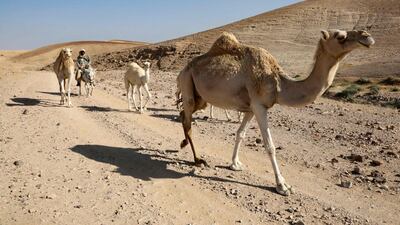
A Palestinian shepherd tends to his camels on arid land considered to be in "Area C" (under Israeli security and administrative control), southeast of Yatta town in the southern West Bank district of Hebron. AFP -
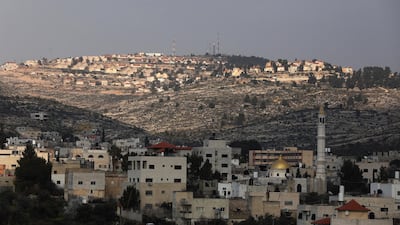
A general view of the Israeli settlement of Elon Moreh, as seen from the Palestinian village of Azmout near the West Bank City of Nablus. EPA -
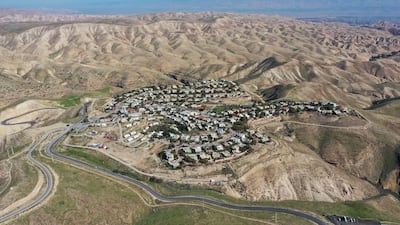
The West Bank Jewish settlement of Maale Michmash. AP


Speaking to an online meeting of the Organisation of Islamic Co-operation, he urged countries to boycott Israel, ban its products, and impose economic and political sanctions.
On Tuesday, Palestinian officials sent top mediators, including the UN, a response to the US peace plan.
The proposal demands the creation of a sovereign Palestinian state, independent and demilitarised, and some minor border changes.
The Palestinian Prime Minister, Mohammed Shtayyeh, said it was sent "a few days ago" to the UN, US, EU and Russia, which were mediating in the Palestinian-Israeli conflict.
Most countries regard settlements that Israel built on land captured in the 1967 Middle East war as illegal.

