

Lebanon's banking sector, once considered a pillar of the economy, has suffered a blow to its image in recent months, with protesters vandalising branches and chanting insults at the governor of Banque du Liban (BDL), the central bank.
Public anger has grown since banks started restricting access to dollars, used interchangeably with Lebanese pounds in the local market, last October. Since then the US currency has gradually disappeared from circulation and the pound has crashed to record lows, triggering massive inflation in a country dependent on imports. The Lebanese government is currently holding talks with the International Monetary Fund to secure billions in aid.
To shed light on the banking sector's role in the current state of affairs, The National spoke to Hicham Safieddine, author of Banking on the State: The Financial Foundations of Lebanon and an assistant professor in history of the modern Middle East at King's College, University of London.

Why was there little to no criticism of the Banque du Liban and banking sector in the Lebanese media until after outbreak of the crisis?
After the end of the civil war (1975-1990), the BDL emerged as the most stable state institution. Its longtime governor Riad Salameh helped stabilise the Lebanese exchange rate and eventually pegged the Lebanese pound to the dollar while portraying it as the hallmark of stability. Many Lebanese, weary of the war years of instability, readily bought into this portrayal.
Salameh further impressed himself on the national imagination when he managed to stave off any capital flight from Lebanon during the 2008-2009 financial crisis. His apparent diligence stood in sharp contrast to the bickering and corrupt sectarian leaders. All this while, however, Salameh oversaw the financing of the largest government debt in the country’s history. Much of this debt was held by local private banks in return for exorbitant interest rates that generated astronomical profits.

Over time, this symbiotic relationship between the BDL and the private banking sector, under the auspices of the Association of Banks in Lebanon (ABL), reinforced the untouchable stature of banks. They put their easily earned money to work by investing in public relations campaigns on billboards, TV ads, and even newspaper supplements, to polish their image. As long as the long-term structural instability was hidden – thanks to BDL accounting tactics and inflow of money from abroad – mainstream media parroted the bankers’ narrative and turned a blind eye to underlying instability waiting to explode. When it did, some media outlets threw down the gauntlet while others continued to rally behind the banking oligarchs.
How did the banking sector turn into “an organised political community largely immune to state authority" as you put it in your book?
Much credit for the emergence of Lebanese bankers as an organised political community in the 1950s goes to the brothers Raymond and Pierre Edde. The duo were the fruit of the marriage of money embodied in their maternal Sursok family and politics personified in their father and Lebanese “president” under French occupation, Emile Edde. Raymond was the architect of the banking secrecy law passed in 1956. His younger brother, Pierre, co-founded the Association of Banks in Lebanon in 1959.
The 1956 law created serialised banking accounts that were immune to state inspection, including the BDL. Coupled with banking deregulation as well as the influx of Palestinian capital fleeing Zionist persecution and petrodollars seeking safe haven, the law led to an unprecedented growth in the size of Lebanese banking sector, both in terms of total holdings and number of banks.
Three years later, Pierre, who had served as finance minister and became head of Bank Beirut Riyadh, spearheaded a campaign to establish a banker’s association. The ABL included local and international banks based in Lebanon. Its founding charter clearly stated its aim as the advocacy of the interests of the sector. ABL membership grew very rapidly in the face of calls for setting up a national central bank. ABL pressure succeeded in weakening the mandate of the new bank to regulate the profession, thereby consolidating the banking community into the most powerful, and by now, longest standing lobby in the country.
Why were the voices calling for a powerful central bank focused on economic development – as was conventional wisdom at the time – a minority when the BDL was established in 1964?
We know from a petition published in 1953 that many social movements and political parties called for establishing a national bank that would serve the country’s economy. While the petition was focused on the question of national versus foreign ownership, it was clear that economic development was high on the minds of its initiators. The problem was that this majority was less powerful than the oligarchy of financiers and import merchants who held sway in the corridors of power.
The ideology of laissez-faire propagated by this oligarchy was also pivotal in avoiding the centering of economic development as part of a BDL mandate. A group of influential economists at the American University of Beirut did push for more policies of balanced growth and stricter regulation of the banking sector. They made some inroads into policymaking in the 50s, but it took a major crisis in 1966 for serious reforms to take place.

To what extent did the Intra crisis in 1966 (the collapse of Lebanon’s largest bank which caused a political crisis) lead to reforms of the banking sector?
The Intra crisis led to major reforms of the sector. The government put a freeze on founding new banks, and oversaw an overhaul of existing ones through a series of liquidations and mergers. More significantly, it introduced legislation that created three regulatory institutions. The first was a deposit insurance scheme that protected customers with medium or low deposits in the case of bankruptcy. The other two were the Higher Banking Commission and the Banking Control Commission. They were entrusted with monitoring the private banking sector for bad practices as well as reporting and restructuring unhealthy banks under the supervision of the BDL. Additional legislation classified banks based on their credit policy. Incentives were put in place for long-term lending to encourage investment as opposed to mercantile banking.
Initially, these reforms led to a speedy recovery. The sector witnessed a rebound, and was celebrating a new “golden age” in the early 1970s. But it was short-lived. Soon, demands for deregulation grew again and the outbreak of the civil war destroyed hopes for reinstating Beirut as a stable financial hub. Another major problem was the reforms themselves. They granted the ABL formal decision-making powers within regulatory institutions. In other words, the private bankers became judge and jury. This undermined the push for transparency and accountability and sowed the seeds for another crisis like the one Lebanon is facing today.
-
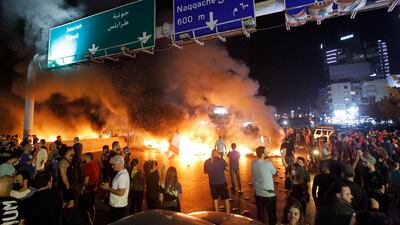
Protesters burn tyres on the highway in the Antelias area north of Beirut after a further drop in the unofficial exchange rate of the Lebanese pound triggered fresh anti-government demonstrations on June 11, 2020. EPA -

A protester waves the Lebanese on the highway in Jal El Dib area north of the Lebanese capital. EPA -

Demonstrators on motorcycles take part in the protests in Beirut. Reuters -

Lebanese soldiers shield themselves from stones thrown by as anti-government protesters in downtown Beirut. AP Photo -
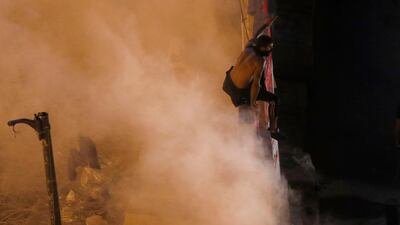
A protester flashes a victory sign from the top of a concrete security wall installed to prevent the demonstrators from reaching the government palace in downtown Beirut. AP Photo -

Protesters arrive on two-wheelers at a square near the government palace in Beirut. AP Photo -
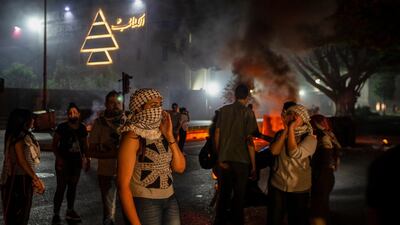
Protesters mobilised in Beirut under the slogan 'A revolution against hunger'. EPA -
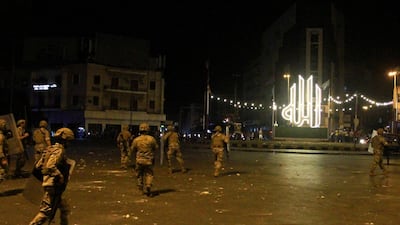
Lebanese soldiers are deployed in the northern city of Tripoli during protests against the fall in the currency and mounting economic hardship. Reuters -

A protester wears a face mask with the Lebanese flag as anger over the country's economic crisis triggered fresh demonstrations on June 11, 2020. EPA -
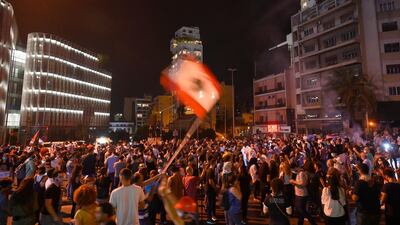
People gather in downtown Beirut to protest against economic conditions, the collapsing currency and rising prices. EPA -
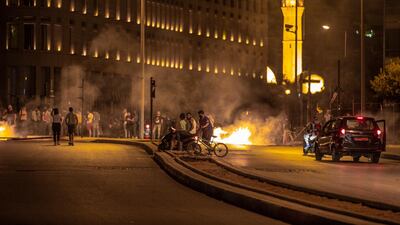
Protesters gather and close roads in Beirut and the suburbs during anti-government rallies on June 11, 2020. EPA -

Anti-government protesters shout slogans as they ride their scooters during a protest in Beirut against economic conditions. EPA -
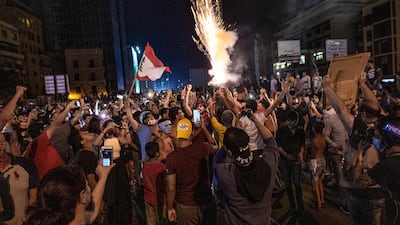
Protesters chant against the central bank as the currency fell to a new low against the USdollar on the black market. EPA -
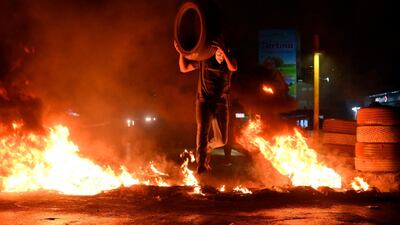
A protester throws a tyre on a fire lit by protesters to block the Dora highway in Beirut. EPA -

An anti-government protester chants slogans as she holds up a Lebanese flag in Beirut. AP Photo -
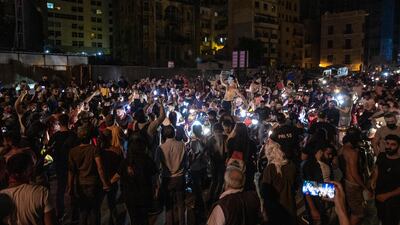
Protesters gather and close roads in Beirut. EPA


How similar or different is the current crisis to past ones?
Like today, crises in the past, top among them Intra, were a function of both economic structural weaknesses and geopolitics. On the structural front, the persistence of deregulation and an oversized services sector meant a negative trade balance highly dependent on hot capital inflow for its survival. Capital flows, in turn, were highly sensitive to the political climate.
The scale of today’s crisis, however, is unprecedented, and the prospects of recovery significantly lower. Financially, the entire banking sector is currently in lockdown and government debt is astronomical compared to pre-civil war levels. Politically, the ruling elite are much more corrupt and much less competent, or willing, to reform the system to save it in the long run.
Globally, the US was much more sympathetic to Lebanon in the 1960s and pushed for a swift recovery even if on its own terms. Back then, Washington saw Lebanon’s free-market model as a “living refutation” – to quote one diplomatic cable – compared to progressive socialist Arab countries like Syria or Egypt. Today, the crisis takes place amid a global recession. In addition, a blatantly pro-Israeli Washington is using financial sanctions and diplomatic threats to blackmail Lebanon into accepting its agenda for the region in return for any support. The degree to which IMF intervention will be used as a conduit for these pressures is to be seen.
What kind of concessions from Lebanon’s banking sector do you think the IMF will request? Will they succeed?
The IMF is focused on monetary and fiscal policy indicators like exchange rate value and government budget deficits rather than reforming the banking sector. They will seek to impose austerity measures like devaluation, cutting government support for essential goods, and privatising publicly owned assets to the detriment of the majority of the Lebanese. Given how entangled the banking sector is with all these variables, some restructuring of private banks will have to take place, including recapitalisation, liquidation, merging, and possibly foreign acquisition. A bail-in, whereby large depositors are turned into shareholders, is also on the table.

