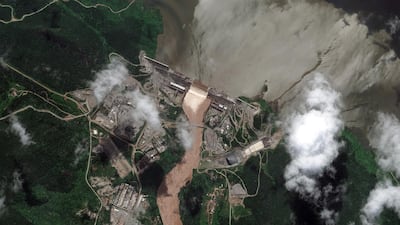
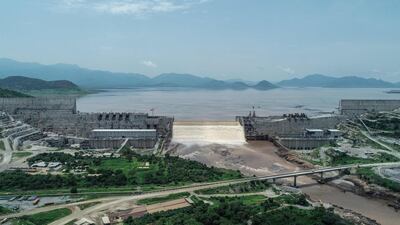
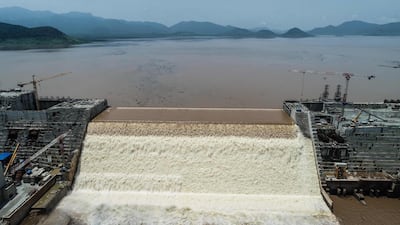
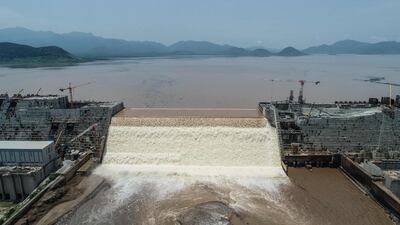
• A satellite image of the Grand Ethiopian Renaissance Dam on the Blue Nile river in the Benishangul-Gumuz region of Ethiopia. Maxar Technologies via AP
    A satellite image of the Grand Ethiopian Renaissance Dam on the Blue Nile river in the Benishangul-Gumuz region of Ethiopia. Maxar Technologies via AP
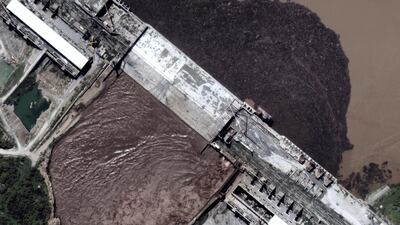
  • A satellite image of the Grand Ethiopian Renaissance Dam on the Blue Nile river in the Benishangul-Gumuz region of Ethiopia. Maxar Technologies via AP
    A satellite image of the Grand Ethiopian Renaissance Dam on the Blue Nile river in the Benishangul-Gumuz region of Ethiopia. Maxar Technologies via AP
  • A 2013 photo showing the Blue Nile river flowing near the site of the Grand Ethiopian Renaissance Dam near Assosa in the Benishangul-Gumuz region of Ethiopia. AP, File
    A 2013 photo showing the Blue Nile river flowing near the site of the Grand Ethiopian Renaissance Dam near Assosa in the Benishangul-Gumuz region of Ethiopia. AP, File
  • A general view of construction work at the site of the Grand Ethiopian Renaissance Dam near Assosa, Ethiopia. AP, File
    A general view of construction work at the site of the Grand Ethiopian Renaissance Dam near Assosa, Ethiopia. AP, File
  • A general view of construction work at the site of the Grand Ethiopian Renaissance Dam near Assosa, Ethiopia. AFP, File
    A general view of construction work at the site of the Grand Ethiopian Renaissance Dam near Assosa, Ethiopia. AFP, File
  • A general view of construction work at the site of the Grand Ethiopian Renaissance Dam near Assosa, Ethiopia. AFP, File
    A general view of construction work at the site of the Grand Ethiopian Renaissance Dam near Assosa, Ethiopia. AFP, File
  • Construction workers are seen at the site of the Grand Ethiopian Renaissance Dam near Assosa, Ethiopia. AFP, File
    Construction workers are seen at the site of the Grand Ethiopian Renaissance Dam near Assosa, Ethiopia. AFP, File
  • A general view of construction work at the site of the Grand Ethiopian Renaissance Dam near Assosa, Ethiopia. AFP, File
    A general view of construction work at the site of the Grand Ethiopian Renaissance Dam near Assosa, Ethiopia. AFP, File
  • A general view of construction work at the site of the Grand Ethiopian Renaissance Dam near Assosa, Ethiopia. AFP, File
    A general view of construction work at the site of the Grand Ethiopian Renaissance Dam near Assosa, Ethiopia. AFP, File
  • A view of construction work at the site of the Grand Ethiopian Renaissance Dam near Assosa, Ethiopia. AFP, File
    A view of construction work at the site of the Grand Ethiopian Renaissance Dam near Assosa, Ethiopia. AFP, File
  • A general view of construction work at the site of the Grand Ethiopian Renaissance Dam near Assosa, Ethiopia. AFP, File
    A general view of construction work at the site of the Grand Ethiopian Renaissance Dam near Assosa, Ethiopia. AFP, File
  • A general view of construction work at the site of the Grand Ethiopian Renaissance Dam near Assosa, Ethiopia. AFP, File
    A general view of construction work at the site of the Grand Ethiopian Renaissance Dam near Assosa, Ethiopia. AFP, File
  • Sudan's Minister of Irrigation and Water Resources Yasir Mohamed (C) takes part in a video meeting over the Grand Ethiopian Renaissance Dam on June 9, 2020. AFP
    Sudan's Minister of Irrigation and Water Resources Yasir Mohamed (C) takes part in a video meeting over the Grand Ethiopian Renaissance Dam on June 9, 2020. AFP
  • Egyptian Foreign Minister Sameh Shukry. AP
    Egyptian Foreign Minister Sameh Shukry. AP
  • The Nile in the Sudanese capital, Khartoum. AFP
    The Nile in the Sudanese capital, Khartoum. AFP
  • The Nile in the Sudanese capital, Khartoum. AFP
    The Nile in the Sudanese capital, Khartoum. AFP
  • The Nile in the Sudanese capital, Khartoum. AFP
    The Nile in the Sudanese capital, Khartoum. AFP
  • A pleasure boat carrying tourists and locals sails on the Nile at sunset in Aswan, Egypt. AP, file
    A pleasure boat carrying tourists and locals sails on the Nile at sunset in Aswan, Egypt. AP, file
  • Sayed Ahmed Abdoh poles his boat to check fish traps in the Nile, near Abu Al Nasr village, about 770 kilometres south of Cairo, in Egypt. AP, file
    Sayed Ahmed Abdoh poles his boat to check fish traps in the Nile, near Abu Al Nasr village, about 770 kilometres south of Cairo, in Egypt. AP, file
  • An aerial view shows the Nile before sunset in the Egyptian capital, Cairo. AFP
    An aerial view shows the Nile before sunset in the Egyptian capital, Cairo. AFP
  • An aerial view shows the Nile before sunset in the Egyptian capital, Cairo on June 20, 2020. AFP
    An aerial view shows the Nile before sunset in the Egyptian capital, Cairo on June 20, 2020. AFP

Filling of Ethiopian reservoir ‘probably seasonal rain' as Nile talks end without a deal


Hamza Hendawi
  • English
  • Arabic

Satellite images that appeared to show the reservoir behind Ethiopia’s disputed Nile Dam filling with water captured seasonal rain, experts said.

The photos were taken on July 9 and made public on Tuesday, the day after the latest round of talks on the operation of project ended without agreement.

Egypt, Ethiopia and Sudan wrapped up nearly two weeks of talks aimed at settling a long-running dispute over the $4.6 billion (Dh 16.8 billion) dam without a breakthrough, diminishing hopes that an agreement would be reached before Ethiopia began filling the dam this month.

Water into the reservoir photographed by the European Space Agency’s Sentinel-1 satellite on July 9, was likely to have been a “natural backing-up of water behind the dam” caused by rainy season conditions, International Crisis Group analyst William Davison said on Tuesday.

“So far, to my understanding, there has been no official announcement from Ethiopia that all of the pieces of construction that are needed to be completed to close off all of the outlets and to begin impoundment of water into the reservoir” had taken place, Mr Davison said.

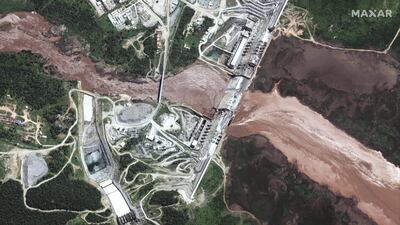
  • A satellite image shows the Grand Ethiopian Renaissance Dam on the Blue Nile river in the Benishangul-Gumuz region of Ethiopia on Tuesday, July 28, 2020. Maxar Technologies via AP
    A satellite image shows the Grand Ethiopian Renaissance Dam on the Blue Nile river in the Benishangul-Gumuz region of Ethiopia on Tuesday, July 28, 2020. Maxar Technologies via AP
  • A handout satellite image shows a closeup view of the Grand Ethiopian Renaissance Dam (GERD) and the Blue Nile River in Ethiopia June 26, 2020. Satellite image ©2020 Maxar Technologies via REUTERS ATTENTION EDITORS - THIS IMAGE HAS BEEN SUPPLIED BY A THIRD PARTY. MANDATORY CREDIT. NO RESALES. NO ARCHIVES. MUST NOT OBSCURE WATERMARK
    A handout satellite image shows a closeup view of the Grand Ethiopian Renaissance Dam (GERD) and the Blue Nile River in Ethiopia June 26, 2020. Satellite image ©2020 Maxar Technologies via REUTERS ATTENTION EDITORS - THIS IMAGE HAS BEEN SUPPLIED BY A THIRD PARTY. MANDATORY CREDIT. NO RESALES. NO ARCHIVES. MUST NOT OBSCURE WATERMARK
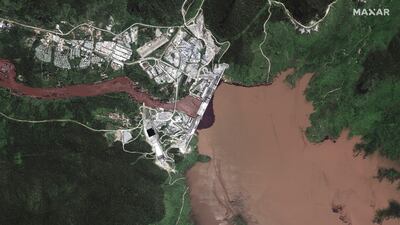
  • A satellite image of the Grand Ethiopian Renaissance Dam and reservoir behind it 16 days later on July 12, 2020. Maxar Technologies via Reuters
    A satellite image of the Grand Ethiopian Renaissance Dam and reservoir behind it 16 days later on July 12, 2020. Maxar Technologies via Reuters
  • The Grand Ethiopian Renaissance Dam and the Blue Nile River in Ethiopia on July 12, 2020. Maxar Technologies via Reuters
    The Grand Ethiopian Renaissance Dam and the Blue Nile River in Ethiopia on July 12, 2020. Maxar Technologies via Reuters
  • An aerial view Grand Ethiopian Renaissance Dam on the Blue Nile River in Guba, northwest Ethiopia, on the 20th July. AFP
    An aerial view Grand Ethiopian Renaissance Dam on the Blue Nile River in Guba, northwest Ethiopia, on the 20th July. AFP
  • An aerial view Grand Ethiopian Renaissance Dam on the Blue Nile River in Guba, northwest Ethiopia, on the 20th July. AFP
    An aerial view Grand Ethiopian Renaissance Dam on the Blue Nile River in Guba, northwest Ethiopia, on the 20th July. AFP
  • An aerial view Grand Ethiopian Renaissance Dam on the Blue Nile River in Guba, northwest Ethiopia, on the 20th July. AFP
    An aerial view Grand Ethiopian Renaissance Dam on the Blue Nile River in Guba, northwest Ethiopia, on the 20th July. AFP

On the talks, a statement by the Egyptian Irrigation Ministry said the three nations would now separately send their assessments of the situation to South African President Cyril Ramaphosa, whose country chairs the African Union.

He would later call for a summit of the three nations and others to decide on the next steps.

“Although there were progresses, no breakthrough deal was made,” Seleshi Bekele, Ethiopia’s Minister of Water, Irrigation and Energy, tweeted on Monday night.

The just-completed round of negotiations was the latest in nearly a decade of talks between the three African nations over the Grand Ethiopian Renaissance Dam, or Gerd. It promised to be the largest hydroelectric dam in Africa, producing some 6,000 megawatts. The talks were attended by representatives of the United States, the European Union and South Africa.

Egypt feared the dam would significantly reduce its vital share of the river’s waters, costing the most populous Arab nation hundreds of thousands of jobs and disrupting its food security.

Neighbouring Sudan was concerned that a breach of the dam could flood large parts of its territory and that without operational coordination, the dam could close its own hydroelectric dams.

But energy-starved Sudan also stood to gain through buying cheap electricity generated by the dam that lies about 20 kilometres from its border with Ethiopia.

Ethiopia sought to reassure Egypt and Sudan, saying the dam on the Blue Nile, the river’s largest tributary, was key to the alleviation of poverty in the Horn of Africa nation of nearly 110 million people and was meant to benefit, not harm, the two downstream countries as well as other Nile basin states when the project turned Ethiopia into a major electricity exporter.

But Egypt contended that Ethiopia refused to reach a legally binding deal on water use, and rejected proposals for a deal on the flow of the river during spells of persistent drought or a mechanism for resolving future disputes.

Egypt’s share of the river’s water was said by President Abdel Fatah El Sisi to be an existential issue.

The latest talks have taken added urgency because of Ethiopia’s repeated assertions that it would go ahead with filling the reservoir behind the dam regardless of whether a deal has been reached or not.

Egypt and Sudan opposed such a move, with Egyptian leaders on the record as saying Cairo would not accept the situation.

The amount of water Ethiopia said it intended to save behind the dam this and the next year was relatively insignificant, but Egypt and Sudan feared that starting to fill the dam without an agreement in place would set a dangerous precedent, since Ethiopia said it intended to build more dams on the Blue Nile.

Egyptian officials avoided reference to military action, but Mr El Sisi recently said without mentioning the dispute directly that his military was prepared to carry out missions outside the country.

Pro-government social media influencers have, in the meantime, urged the government use force on the dam before it is filled.

Military action by Egypt, however, would be difficult to justify to the international community as an act of self-defence and would entail dangers if the reservoir was even partially filled.

This led to speculation that an alternative and equally effective target could be power installations linked to the dam.

“At the end of the day, we realise that we must reach an agreement,” Egyptian Foreign Minister Sameh Shoukry said on television on Monday night.

“Not reaching an agreement will cause more tension and that’s what we are trying to avoid.”