
Archaeologists on Thursday unveiled an unusually large tomb on Luxor's west bank dated to ancient Egypt's 18th dynasty.
The 3,500-year-old, 450-square-metre tomb contains 18 entrance gates and is believed to have belonged to a nobleman named Shedsu-Djehuty.
The nobleman was the royal master of seals for ancient Egyptian kings of Upper and Lower Egypt, said Mostafa Waziri, secretary-general of Egypt's Supreme Council of Antiquities.
Egyptian workers started renovating the tomb upon its discovery in 2018, finding a huge yard, colourful floor tiles and wall paintings documenting activities including boat making and hunting.
The west bank of the River Nile at Luxor is home to the Valley of the Kings, where pharaohs and nobles of the New Kingdom were buried in tombs carved into the rock. The 18th dynasty was the first of the New Kingdom dynasties.
The tomb is the latest in a series unveiled by Egypt's ministry of antiquities, which says more excavation teams have been working as security has improved in Egypt in recent years.
Egypt has been trying to attract tourists, an important source of foreign currency, since visitor numbers fell steeply after the country's 2011 uprising.
-

An Egyptian archaeologist works inside one of the largest newly discovered pharaonic tombs 'Shedsu Djehuty' in Luxor, Egypt. Reuters -
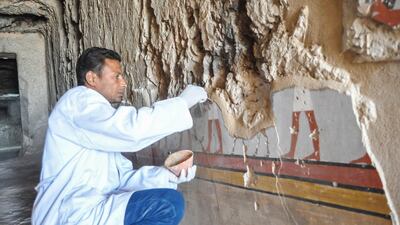
An Egyptian archaeologist works on a newly-discovered tomb of Shedsu-Djehuty at the Draa Abul Naga necropolis in Luxor's West Bank, 700km south of Cairo. AFP -

Egyptian archaeologists work inside a newly-discovered tomb of Shedsu-Djehuty at the Draa Abul Naga necropolis in Luxor's West Bank, 700km south of Cairo. AFP -
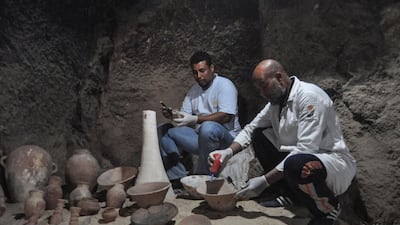
Egyptian archaeologists work on a newly-discovered tomb of Shedsu-Djehuty at the Draa Abul Naga necropolis in Luxor's West Bank, 700km south of Cairo. AFP -

An Egyptian archaeologist works on a newly-discovered tomb of Shedsu-Djehuty at the Draa Abul Naga necropolis in Luxor's West Bank, 700km south of Cairo. AFP -

Chief excavation worker Aly Farouk stands outside a newly discovered pharaonic tomb 'Shedsu Djehuty' in Luxor, Egypt. Reuters -
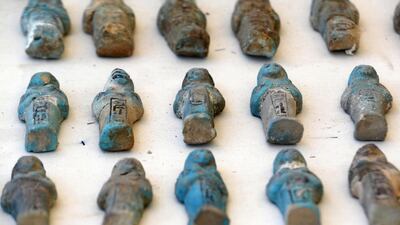
Statues are displayed outside a newly discovered pharaonic tomb 'Shedsu Djehuty' in Luxor, Egypt. Reuters -

An Egyptian archaeologist walks inside one of the largest newly discovered pharaonic tombs 'Shedsu Djehuty' in Luxor, Egypt. Reuters -

Workers standing inside the gates of one of the largest newly discovered tombs 'Shedsu Djehuty' in Luxor, Egypt. Reuters -
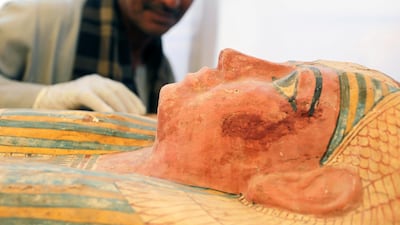
An Egyptian worker inspecting a sarcophagus outside a newly discovered pharaonic tomb 'Shedsu Djehuty' in Luxor, Egypt. Reuters -
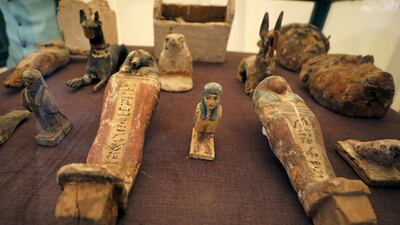
Statues on display outside a newly discovered pharaonic tomb 'Shedsu Djehuty' in Luxor, Egypt. Reuters -
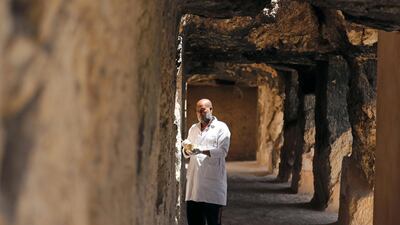
An Egyptian archaeologist works inside one of the largest newly discovered pharaonic tombs 'Shedsu Djehuty' in Luxor, Egypt. Reuters -
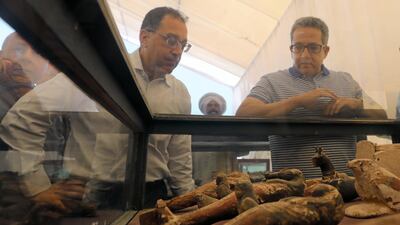
Egyptian Prime Minister Mostafa Madbouly and Minister of Antiquities Khaled El-Anany inspecting newly discovered artifacts on display outside 'Shedsu Djehuty' tomb in Luxor, Egypt. Reuters -
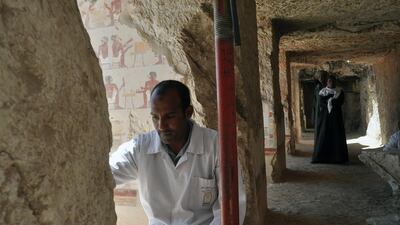
Egyptian archaeologists work inside the new tomb of Shedsu Djehuty in Luxor, 700km south of Cairo, Egypt. EPA



