

Half of Beirut’s traffic lights have stopped functioning in the past two months, dramatically increasing the number of fatal car accidents and heightening the sense of prevailing doom in cash-strapped Lebanon.
Figures shared by the Internal Security Forces with Lebanon’s traffic management centre show there were 33 fatalities caused by car accidents in the country in June, marking a 120 per cent increase compared to April, when traffic lights in Beirut still worked.
The outage has been caused by a struggle between the Beirut municipality and the Traffic and Vehicles Management Authority, a public institution supervised by the Interior Ministry.
The two bodies are fighting over control of the lucrative business of Beirut's parking meters, which generate around $6 million a year in revenue.
For over a decade, the Traffic and Vehicles Management Authority had been using part of this sum for the maintenance of the city’s traffic lights. But because of the disagreement with the municipality, which believes it should receive the profits generated from the city’s parking meters, the money stopped being collected in late 2019.
There was soon no money left to pay Duncan-NEAD, the American-Lebanese joint venture in charge of the upkeep of traffic lights. On May 1, its contract was not renewed.
-
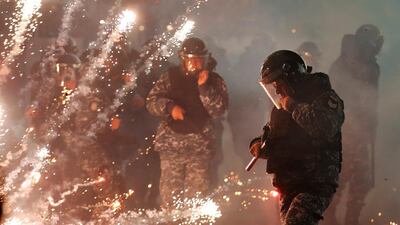
Lebanese riot policemen run from firecrackers fired by the supporters of the Shiite Hezbollah and Amal Movement groups. AP -
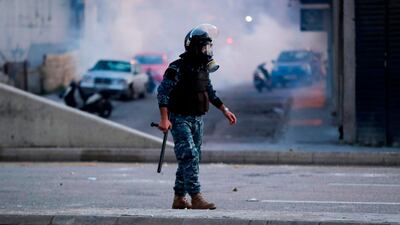
A member of the Lebanese riot police looks on after clashes with supporters of Lebanon's Shiite Hezbollah and Amal groups on December 14, 2019, in central Beirut. AFP -

Lebanese riot police react to fireworks thrown by supporters of Lebanon's Shiite Hezbollah and Amal groups during clashes on December 14, 2019 in central Beirut. AFP -
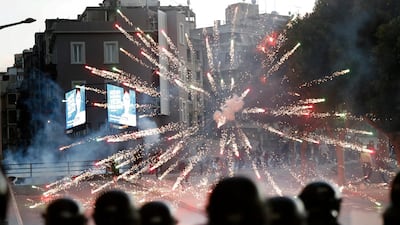
Supporters of the Shiite Hezbollah and Amal Movement groups, background, launch firecrackers at riot policemen as they try to attack anti-government protesters. AP -
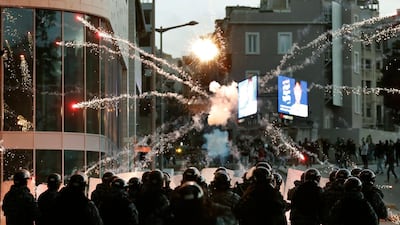
Lebanon has been facing its worst economic crisis in decades, amid nationwide protests that began on October 17 against the ruling political class that demonstrators accuse of mismanagement and corruption. AP -

A supporter of Lebanon's Shiite Hezbollah and Amal groups gestures towards riot police. AFP -
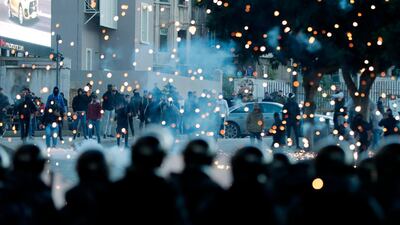
Supporters of Lebanon's Shiite Hezbollah and Amal groups (background) throw fireworks towards Lebanese riot police during clashes on December 14, 2019, in central Beirut. AFP -

A supporter of the Shiite Hezbollah and Amal Movement groups holds firecrackers to fire it at the riot police. AP -
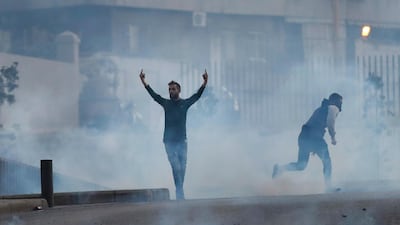
A supporter of the Shiite Hezbollah and Amal Movement groups stands in the smoke of tear gas and reacts to the riot police in downtown Beirut. AP -
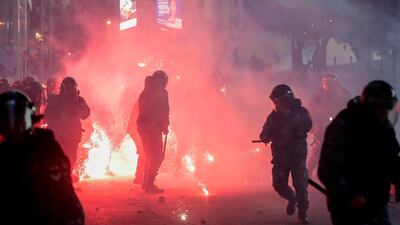
Lebanese riot police react to fireworks thrown by supporters of Lebanon's Shiite Hezbollah and Amal groups. AFP -
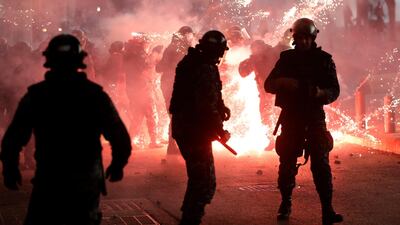
Lebanese riot policemen react to firecrackers that were fired by the supporters of the Shiite Hezbollah and Amal Movement groups. AP -
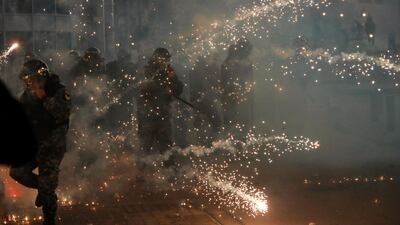
Lebanese riot policemen react to firecrackers that fired by the supporters of the Shiite Hezbollah and Amal Movement groups. AP -
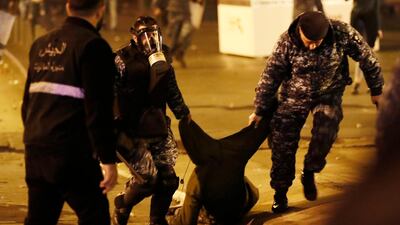
Riot police officers arrest an anti-government protesters trying to enter parliament square in downtown Beirut. AP -
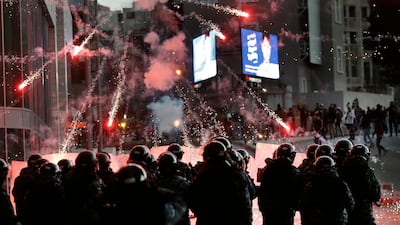
Lebanon has been facing its worst economic crisis in decades, amid nationwide protests that began on October 17 against the ruling political class which demonstrators accuse of mismanagement and corruption. AP -
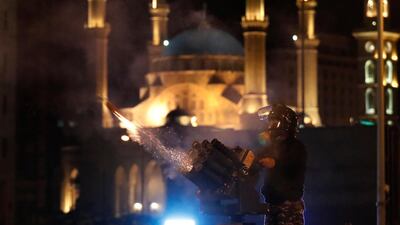
A riot police officer fires tear gas from a launcher against anti-government protesters trying to enter parliament square in downtown Beirut. AP -

Protesters wave the Lebanese flag in front of riot police during clashes in central Beirut. EPA -

Protesters flee tear gas after they threw stones at riot police during clashes in central Beirut. EPA -
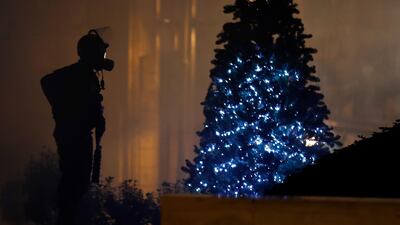
A riot police officer stands next of a Christmas tree during a protest. AP -

A riot police officer fires rubber bullets towards anti-government protesters. AP -
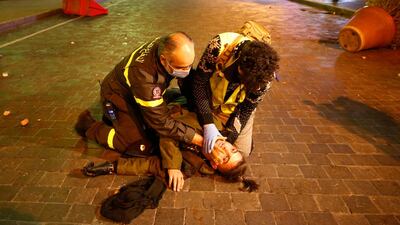
Civil defence workers treat injured protesters who were beaten by riot police. AP -
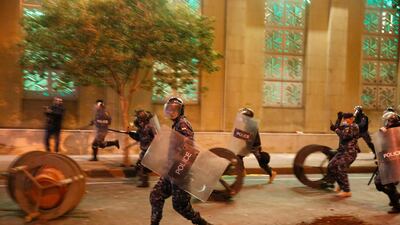
Riot policemen run after anti-government protesters trying to enter the parliament square. AP -
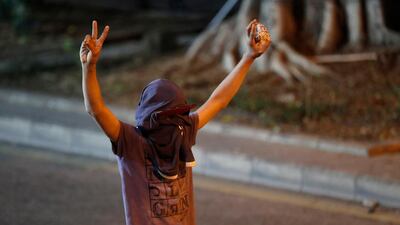
An anti-government protester holds stones, as he flashes victory signs during a protest near the parliament square. AP -
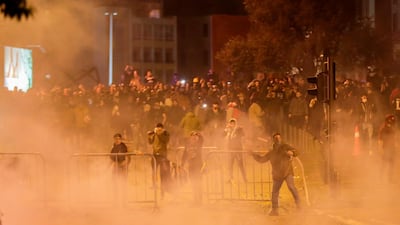
Lebanese demonstrators hurl rocks at riot police during clashes in the capital Beirut on December 14, 2019. AFP -
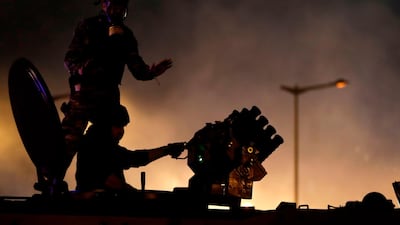
Lebanese riot police prepare to fire teargas canisters during clashes with anti-government demonstrators in the capital Beirut on December 14, 2019. AFP -

Riot police detain an anti-government demonstrator during clashes in the capital Beirut on December 14, 2019. AFP -
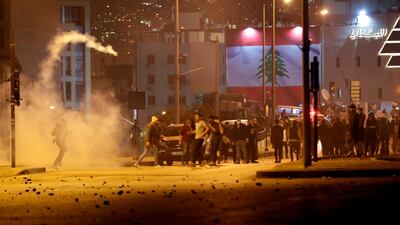
Lebanese demonstrators hurl tear-gas canisters back at riot police during clashes in the capital Beirut on December 14, 2019. AFP -
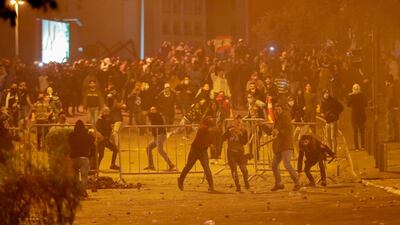
Lebanese demonstrators hurl tear-gas canisters back at riot police during clashes in the capital Beirut on December 14, 2019. AFP -
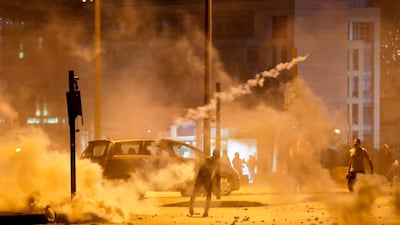
Lebanese demonstrators hurl tear-gas canisters back at riot police during clashes in the capital Beirut on December 14, 2019. AFP


Since then, about half of greater Beirut’s hundreds of traffic lights turned off due to lack of maintenance, said the company’s manager, Chafic Sinno.
This has caused accidents to spike. The ISF’s figures show that the number of car accidents in the country went up by 74 per cent and injuries increased by 76 per cent between April and June.
"We do not have the numbers for Beirut, but there is no way that numbers would have increased that much if it wasn't for the effect of traffic lights," TMC manager Jean El Dabagh told The National.
Compounded by the closure of many retail shops caused by Lebanon’s ongoing economic crisis and increasingly long power cuts, the outage has caused Beirut to be shrouded in darkness at night.
Many Lebanese expressed surprise and sadness on social media at seeing normally bustling streets shut down after sunset.
The breakdown of Beirut’s traffic lights also brought back harrowing memories of the country’s 1975-1990 civil war.
Elie Helou, an engineer at the Council for Development and Reconstruction, a public body that oversees most of Lebanon’s infrastructure development projects, said that when traffic lights were installed in 2008, many people hailed their return as “historic”.
"When we finished the installation of signals, we heard so many times that it was a historic moment, a turning page of the war," he told The National. "We had [traffic] lights prior to the war, but they were dismantled or demolished."
The construction of traffic lights was financed by a 2003 World Bank loan which included several big infrastructure projects and was worth over $100 million in total, according to Mr Helou.
At the time, the Beirut municipality and the Traffic and Vehicles Management Authority signed an agreement that states the latter would “pay for the operation, development, and maintenance expenses of the parking meters and of traffic lights, and deposit the rest of the money in the account of the treasury of the Beirut municipality.”
The municipality refused to renew the agreement in 2010, because it says that it never received its dues from the traffic management authority.
“We sent them many letters asking why they were not sending us the profits,” said Ghassan Elias, an engineer at the municipality. “We received no answer. We can’t continue like this. We’ve lost millions.”
To defend itself, the Traffic and Vehicles Management Authority points at the fact that the agreement specifies that this payment system would only be put in place “after repayment of the designated loan for these works”.
Here lies the core of the disagreement: the municipality believes that the Finance Ministry has paid back the World Bank’s loan, or at least the part concerning traffic lights and parking meters.
But the Traffic and Vehicles Management Authority says that the loan is still being repaid and that it is bound to a Lebanese law that gives it full authority over the management of parking meters.
A 2003 decree, voted in parallel to the World Bank loan, stipulates that the authority “collects the sums from paid parking and fines…and deposits them in the approved bank.”
Additionally, the Traffic and Vehicles Management Authority pointed out that it does not make enough profit to send to the municipality anyway.
The parking meters generate about 10 billion Lebanese pounds a year, or the equivalent of $6 million at Lebanon’s official exchange rate, which is hardly used since the local currency started depreciating nine months ago.
The money is then used for the parking meters’ upkeep, as well as maintenance of traffic lights and the traffic management centre.
This also costs about 10 billion Lebanese pounds, meaning there is no profit, said Ayman Abdel Ghafour, president of the car registration department at the Traffic and Vehicles Management Authority.
The dispute came to a boiling point when the Beirut municipality launched a lawsuit against the Traffic and Vehicles Management Authority last August. As a result, it stopped collecting money from greater Beirut’s 725 parking meters.
"We sent the contractual requirements to the municipality in late 2019 for a new tender, but they haven't done anything about it," Hoda Salloum, the authority's director, told The National. "There is a vacuum now."
Mr Elias said the municipality was working on updating the requirements.
When asked about the loan, the Finance Ministry referred The National to a recent press release that said that it had nothing to do with the dispute, which only concerns the Traffic and Vehicles Management Authority and the Beirut municipality.
The World Bank did not answer a request for comment before this story went to print.
Former Interior Minister Raya Al Hassan said that she tried to resolve the dispute in 2019. "We decided to launch a bid to basically get a new contractor to manage the parking meters," she told The National. "We agreed afterwards to give probably around 90 per cent to the municipality and 10 per cent to the Traffic and Vehicles Management Authority."
But this process was interrupted when Mrs Salloum was jailed for over a month in December over allegations of bribery in the car registration department. She returned to her job though she was then charged in February with squandering public funds in her management of Beirut’s parking meters.
Mrs Salloum denies the charges, which her supporters say are politically motivated. The current Interior Minister, Mohammad Fahmi, has defended her on social media.
Without proper mediation, the dispute will not be over soon, and the number of fatal car accidents will inevitably continue to rise on the city’s busy roads.
“I do not understand why they have not asked for an opinion from the Committee of Legislation and Consultations, whose job is to solve disputes between government agencies,” said one observer who asked to remain anonymous.
“They’re just hiding behind their desks and throwing eggs and potatoes at each other.”

