

A day after angry protesters smashed bank windows in one of Beirut’s main commercial streets, workers were busy repairing the damage on Wednesday morning.
Riots erupted in the neighbourhood of Hamra on Tuesday night in the worst spill-over of violence against financial institutions since banks started capping cash withdrawals in early November last year.
Frustration with banks is increasing as the country sinks deeper into its worst financial crisis in decades, sparking nation-wide protests in October.
Scenes of anger have multiplied as people have been forced to queue for hours to withdraw a few hundred dollars in cash. The scarcity of dollars has caused the local currency to lose around half of its value, severely impacting people’s spending power.
On Tuesday evening, dozens of masked men broke banks’ security cameras, ATMs and windows in Hamra. Someone had scrawled in red “complicit in murder” on the front of the once respected central bank.
Former Prime Minister Saad Hariri condemned the attacks, calling them “unacceptable”.
-
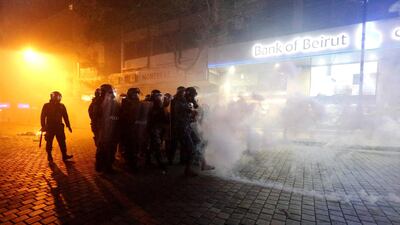
Riot police officers stand behind riot shields amid a cloud of tear gas during protests against the economic crisis outside a Bank of Beirut office in Beirut, Lebanon. Reuters -
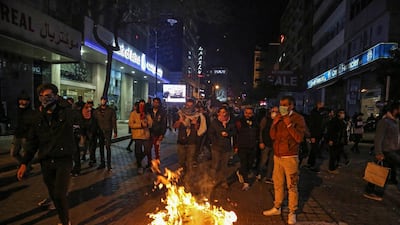
Anti-government protesters clash with riot police as they block a road and calling for 'the fall of the rule of the bank' during a protest in front of the Lebanese Central Bank headquarters at Hamra Street in Beirut, Lebanon. EPA -

Demonstrators take to the streets as they protest against what they say is economic hardship and a lack of new government in Beirut, Lebanon. Reuters -
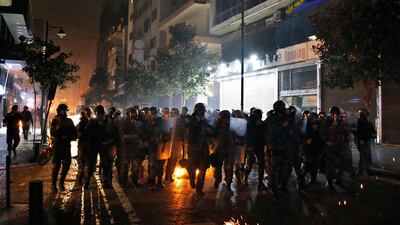
Riot police run toward anti-government protesters, during ongoing protests against the Lebanese central bank's governor and against the deepening financial crisis, at Hamra trade street, in Beirut, Lebanon. AP -

Anti-government protesters run to escape tear gas that fired by riot police, during ongoing protests against the Lebanese central bank's governor and against the deepening financial crisis, at Hamra trade street, in Beirut, Lebanon. AP -

Police keep watch along a street as protests against the government continue in Beirut, Lebanon. Reuters -
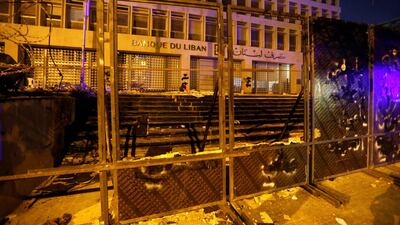
The Banque du Liban, the central bank of Lebanon, is seen as protests against the government continue in Beirut, Lebanon. Reuters -
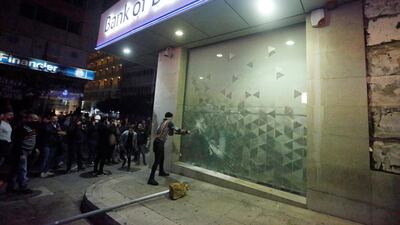
Protesters smash the window of a Bank of Beirut office as demonstrations against the government continue in Beirut, Lebanon. Reuters -
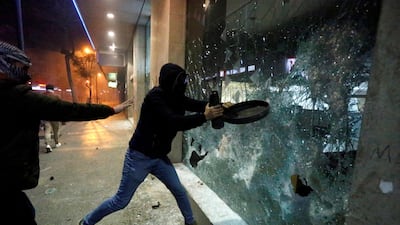
Protesters smash the window of a bank as demonstrations against the government continue in Beirut, Lebanon. Reuters -
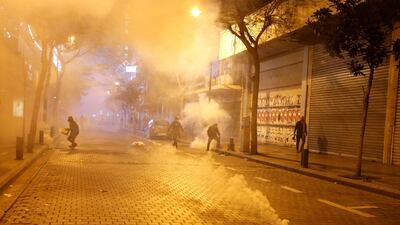
Protesters are seen amid a cloud of tear gas as protests against the economic crisis continue in Beirut, Lebanon. Reuters -
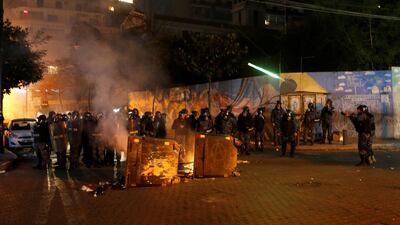
Riot police officers stand near burning garbage bins during protests against the economic crisis in Beirut, Lebanon. Reuters -
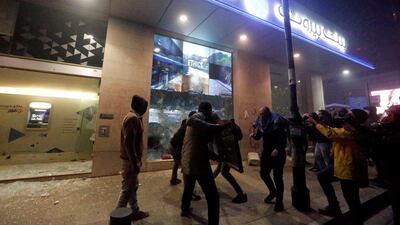
Protesters smash the window of a bank as demonstrations against the economic crisis continue in Beirut, Lebanon. Reuters -
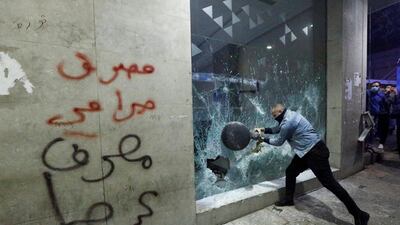
SENSITIVE MATERIAL. THIS IMAGE MAY OFFEND OR DISTURB An anti-bank message is seen on a wall as a protester smashes the window of a bank, as demonstrations against the economic crisis continue in Beirut, Lebanon January 14, 2020. REUTERS/Mohamed Azakir TPX IMAGES OF THE DAY


Despite the extensive damage, bystanders were sympathetic to demonstrators.
“People are forced to be aggressive,” said Khodr Saleh, as he watched repairmen at work.
“Even during the war, we did not see this. People are paying for the mistakes of corrupt politicians,” added Mr Saleh, who fled Lebanon’s civil war in 1985 and lives in Australia.
The store fronts of several currency exchange offices, where the dollar is sold for up to 2,400 Lebanese pounds instead of the official 1,500 Lebanese pounds, were also smashed on Tuesday.
One of the owners said that he would close his shop within the next month because he felt unsafe.
“I don’t think people attacked us spontaneously, because they have to come to us to get the dollars that banks won’t give them. I think they were manipulated by politicians,” he said, without giving names.
Sitting in a café nearby, Jessika Khazrik, 28, is working hard to hold banks accountable.
The Beirut Bar association highlighted in January that restricting cash withdrawals and overseas transfers is unlawful in the absence of a Parliament decision.
An artist and technology consultant, Ms Khazrik was arrested on January 10 because she refused to leave her local bank which would not give her more than $100 in cash despite urgent financial needs, including moving abroad for work. The bank made her wait in a small back room under the supervision of a private security guard before handing her over to police.
“I was just peacefully asking for my money and pointing out the illegality of the banks' practices,” she said. “Banks are abusing their power. The trust they have lost among the public will never be gained back.”
After her arrest, Fransabank closed her account and issued her a cheque with the remainder of her balance of several thousand dollars. However, she cannot cash it in elsewhere. All Lebanese banks impose limits on withdrawals and opening a new account is increasingly difficult.
Ms Khazrik is suing her bank for deprivation of freedom, mismanaging her funds, threatening her with physical violence and violating her privacy – employees read her Facebook posts out loud to intimidate her, she said. Fransabank, which is suing her for defamation and insults that she denies, did not respond to a request for comment.
Speaking anonymously because he did not have permission to talk to the media, a bank employee in Hamra told The National that banks are obliged to limit withdrawals because the central bank does not supply them with enough cash.
“It’s illegal, but we can’t do anything about it,” he said. “We try to help clients depending on their cases.”
On Sunday, the governor of the central bank (Banque du Liban) Riad Salameh asked for extra powers to standardise cash withdrawals as the government remains paralysed after the resignation of Saad Hariri on October 29.
In a severe rebuttal of the country’s ruling elite, Jan Kubis, the UN special co-ordinator for Lebanon tweeted on Wednesday that Lebanon was “truly unique - the BDL Governor requesting extraordinary powers to at least somehow manage the economy while those responsible watch it collapsing. Incredible.”

