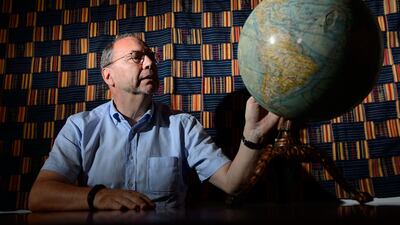

A top virologist and advisor on the pandemic to the European Union has called for the establishment of a global surveillance system modelled on the World Health Organisation to detect virus outbreaks.
Professor Peter Piot, the director of the London School of Hygiene & Tropical Medicine (LSHTM), told The National that global coordination of disease prevention should be the legacy of the pandemic.
The body envisaged by Prof Piot would provide a platform for cooperation between countries to ensure that both an early alert mechanism and the response was transparent, timely and uniform.
"I don't expect that the body would do the job instead of, say, the Abu Dhabi and the UK authorities but it would ensure there was sharing of information, carried out the task of making sure everybody knows and produce the right guidance in response," he said. "I think there needs to be multi-national institution and mechanism because we've seen so dramatically there's no borders to disease and no one country can fix this."
Renowned for his work as one of the virologists who discovered Ebola, Prof Piot, 71, was seriously ill earlier this year having contracted Covid-19. The experience of the longer term effects of Covid-19 on many of those who contract it makes him leery about the choices ahead as countries adjust to the virus threat.
The so-called second wave or recent rise in infections is coming earlier than he anticipated for a seasonally driven disease, which is a concern even if such a high proportion of those infected are younger and less likely to succumb.
"In the old days epidemics ended, there were no vaccines, there were no treatments and they didn't even know the concept of contagion," he told The National. "Now the question is how to we live alongside this virus. No restrictions means it spreads until there's not much left to infect but the cost would be very high in our societies because we have so many older people and that's too hard a decision for policymakers to take."
Having played a major role at UNAIDS addressing that disease and with his work in Congo and elsewhere on Ebola, Prof Piot takes encourage from the rapid progress in addressing the Covid-19 threats.
First there is the discovery of therapeutic treatments for patients trying to fight off the coronavirus. In particular the discovery of the effectiveness of Remdesivir in killing the virus if given early enough and the steroid Dexamethasone, which stops a immune system overload in the later stages of the infection.
He expects more therapies to be on stream by the end of the year.
While observing the test and trace system for suppressing the spread of coronavirus has been a "real fiasco" in Britain where he lives, Prof Piot is more encouraged by efforts to bring rapid result tests to a mass market. With hundreds of millions of tests on the production line countries could go some way to regimes of regular testing.
-
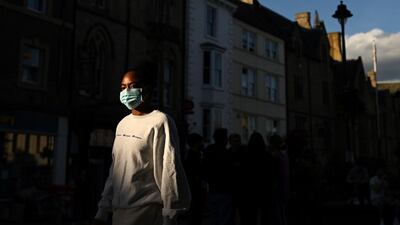
A woman wearing a face mask walks in the evening sunshine in Durham. AFP -

Men wear face masks as they pass decorated air vents as part of the London Mural Festival. AP Photo -
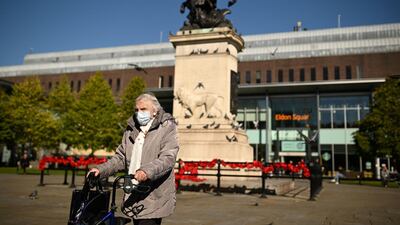
An elderly woman wearing walks in Newcastle after tighter restrictions were put in place to help mitigate the spread of Covid-19. AFP -

A Pantomime actor joins a demonstration to demand more support for the arts and theatre sector amid the Covid-19 coronavirus pandemic, in Central London. EPA -

Staff at Henderson Foodservice's food and grocery distribution centre stand socially distanced as they await the arrival of Britain's Prince Charles in Newtownabbey, near Belfast. AFP -
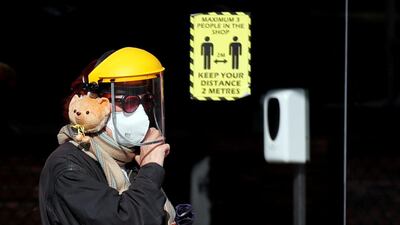
A woman wearing a face mask and a shield walks on a street in London. Reuters -

A sign limiting shoppers to one item per customer is displayed on near-empty shelves for toilet paper rolls in a supermarket in Birkenhead, Merseyside. AFP -

Britain's Prime Minister Boris Johnson stands alongside Britain's Chief Scientific Adviser Patrick Vallance Chief Medical Officer for England Chris Whitty. AFP -

A sign reading "New road layout for social distancing" stands in the Square Mile financial district in London. Bloomberg -
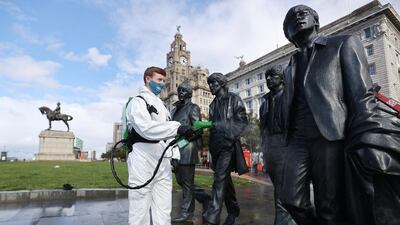
A man disinfects a statue of the Beatles in Liverpool. Reuters


"I think we will soon have point of care tests that will give results in 10-20 minutes," he said. "Testing is key. Having to wait two days for test results doesn't make sense. What we need is the ability for regular testing of everybody so that you detect infections early and that only works if you have immediate results."
Prof Piot cautions that development of a vaccine looks encouraging but won't be a "silver bullet" because the first vaccines may not be 100 per cent effective even as they ameliorate the worst effects of the disease.
"It needs to be safe first of all. We're going to inject biological materials into billions of people -- that's never been done at that scale and we don't want to take any risk there," he said. "I really welcome the statement by the main vaccine producers recently to say 'we will not take any short cuts'.
"It's really important that people will feel that have been no shortcuts for political reasons or whatever and they can trust."
Should the vaccines work that will not be the end of the journey, Prof Piot feels. The question of how long immunity will last, if there will need to be vaccine drives every year or two years or five years will have to be resolved.
And the long term legacies will not just be in public health but far more wide-ranging, including the possible demise of a handshake greeting. "That's just maybe one of the reasons Asian countries have really done better because they had made cultural changes already."

