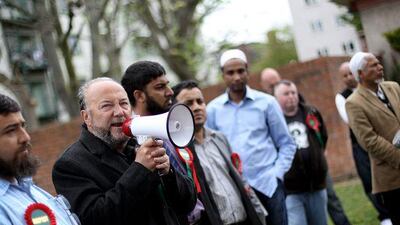
Politician George Galloway is set to stand in the Batley and Spen by-election.

George Galloway vows to oust UK’s opposition Labour Party at by-election


Nicky Harley
  • English
  • Arabic

Former UK MP George Galloway vowed to deliver another blow to the opposition Labour Party after throwing his hat into the ring in a hotly contested by-election in England.

The Batley and Spen by-election, scheduled for July 1, is expected to be a close campaign.

The seat has been held by Labour for decades, but the party recently suffered a series of defeats to UK Prime Minister Boris Johnson's Conservative Party in traditional Labour strongholds.

The party lost a by-election in the north English city of Hartlepool this month and defeat in Batley and Spen will be another major blow for leader Sir Keir Starmer.

In a bid to improve its chances at the polls, the party altered its membership rules to allow Kim Leadbeater, sister of murdered MP Jo Cox, to stand as its candidate. Cox held the seat before she was killed by a far-right extremist in 2016.

Now Mr Galloway, a former Labour MP who has been a thorn in the party's side since he was expelled in 2003 for bringing the party into disrepute, has announced his candidacy.

He previously ousted Labour from long-held seats in Bradford and Bethnal Green and hopes to make this a third triumph.

“I’m standing against Keir Starmer. If Keir Starmer loses this by-election it’s curtains for Keir Starmer,” Mr Galloway said in a video posted online.

“So if, for whatever reason, you think that the current leader of the Labour Party needs to be replaced, I’m your man.”

Mr Galloway, a supporter of Labour's former leader Jeremy Corbyn, is a vocal anti-war campaigner and supporter of the Palestinians.

Labour won the Batley and Spen seat in 2019 with a slim majority of 3,525.

A by-election was called after the appointment of its former MP, Tracy Brabin, as mayor for West Yorkshire.

If Mr Galloway, who lost his Bradford West seat to Labour's Naz Shah in the 2015 general election, and his Workers Party of Britain take votes away from Labour, the Conservatives could take the seat.

“The message is loud and clear – if you want to see the back of Sir Keir Starmer, George is your man,” the Workers Party said on Twitter.

Mr Galloway, an outspoken critic of Israel, has been campaigning in the area and a Labour source recently told The Times that they fear he could exploit the situation in Gaza and split the Labour vote.

"Even if he wins only 2,000 votes, they're coming straight off our pile," the source said.

There has been an increase in racial tensions in the area recently after a teacher showed pupils a satirical cartoon of the Prophet Mohammed, which led to protests by parents.

Far-right activists are focused on the area and Jayda Fransen, former deputy leader of far-right group Britain First, has been trying to galvanise support to stand in the by-election. Fransen was previously convicted of religiously aggravated harassment.

Dr Paul Stott, a research fellow at the Centre for the Response to Radicalisation and Terrorism at the Henry Jackson Society, told The National that he did not believe far-right groups would gain a foothold in the area.

“I do not think any party on the far right has any real chance of an electoral breakthrough in the constituency,” he said.

“I would say Kim Leadbeater is the favourite but there are so many different factors there.

“George Galloway, first he was Labour, then he took an anti-war stance, then he had his Respect Party and now his Workers Party.

"He is not necessarily going to move in the same circles as he did when he stood in Bradford and Bethnal Green but he is a skilled politician and will work on getting the momentum of the community leaders. That will only work against Labour.”

Mr Galloway has long courted criticism in British politics.

In 2019, an investigation by the Charity Commission into his aid group Viva Palestine, which ran convoys to Gaza, found "little or no evidence that humanitarian aid was distributed to those in need".

It came days after Mr Galloway was sacked from his UK radio show for sending an anti-Semitic tweet after the 2019 Champions League final.

But despite his chequered past, he is expected to threaten Labour's hopes of a victory at the polls.

Ten tax points to be aware of in 2026

1. Domestic VAT refund amendments: request your refund within five years

If a business does not apply for the refund on time, they lose their credit.

2. E-invoicing in the UAE

Businesses should continue preparing for the implementation of e-invoicing in the UAE, with 2026 a preparation and transition period ahead of phased mandatory adoption. 

3. More tax audits

Tax authorities are increasingly using data already available across multiple filings to identify audit risks. 

4. More beneficial VAT and excise tax penalty regime

Tax disputes are expected to become more frequent and more structured, with clearer administrative objection and appeal processes. The UAE has adopted a new penalty regime for VAT and excise disputes, which now mirrors the penalty regime for corporate tax.

5. Greater emphasis on statutory audit

There is a greater need for the accuracy of financial statements. The International Financial Reporting Standards standards need to be strictly adhered to and, as a result, the quality of the audits will need to increase.

6. Further transfer pricing enforcement

Transfer pricing enforcement, which refers to the practice of establishing prices for internal transactions between related entities, is expected to broaden in scope. The UAE will shortly open the possibility to negotiate advance pricing agreements, or essentially rulings for transfer pricing purposes. 

7. Limited time periods for audits

Recent amendments also introduce a default five-year limitation period for tax audits and assessments, subject to specific statutory exceptions. While the standard audit and assessment period is five years, this may be extended to up to 15 years in cases involving fraud or tax evasion. 

8. Pillar 2 implementation 

Many multinational groups will begin to feel the practical effect of the Domestic Minimum Top-Up Tax (DMTT), the UAE's implementation of the OECD’s global minimum tax under Pillar 2. While the rules apply for financial years starting on or after January 1, 2025, it is 2026 that marks the transition to an operational phase.

9. Reduced compliance obligations for imported goods and services

Businesses that apply the reverse-charge mechanism for VAT purposes in the UAE may benefit from reduced compliance obligations. 

10. Substance and CbC reporting focus

Tax authorities are expected to continue strengthening the enforcement of economic substance and Country-by-Country (CbC) reporting frameworks. In the UAE, these regimes are increasingly being used as risk-assessment tools, providing tax authorities with a comprehensive view of multinational groups’ global footprints and enabling them to assess whether profits are aligned with real economic activity. 

Contributed by Thomas Vanhee and Hend Rashwan, Aurifer

The National Archives, Abu Dhabi

Founded over 50 years ago, the National Archives collects valuable historical material relating to the UAE, and is the oldest and richest archive relating to the Arabian Gulf.

Much of the material can be viewed on line at the Arabian Gulf Digital Archive - https://www.agda.ae/en

THE BIO

Bio Box

Role Model: Sheikh Zayed, God bless his soul

Favorite book: Zayed Biography of the leader

Favorite quote: To be or not to be, that is the question, from William Shakespeare's Hamlet

Favorite food: seafood

Favorite place to travel: Lebanon

Favorite movie: Braveheart

Gifts exchanged
  • King Charles - replica of President Eisenhower Sword
  • Queen Camilla -  Tiffany & Co vintage 18-carat gold, diamond and ruby flower brooch
  • Donald Trump - hand-bound leather book with Declaration of Independence
  • Melania Trump - personalised Anya Hindmarch handbag
Gender pay parity on track in the UAE

The UAE has a good record on gender pay parity, according to Mercer's Total Remuneration Study.

"In some of the lower levels of jobs women tend to be paid more than men, primarily because men are employed in blue collar jobs and women tend to be employed in white collar jobs which pay better," said Ted Raffoul, career products leader, Mena at Mercer. "I am yet to see a company in the UAE – particularly when you are looking at a blue chip multinationals or some of the bigger local companies – that actively discriminates when it comes to gender on pay."

Mr Raffoul said most gender issues are actually due to the cultural class, as the population is dominated by Asian and Arab cultures where men are generally expected to work and earn whereas women are meant to start a family.

"For that reason, we see a different gender gap. There are less women in senior roles because women tend to focus less on this but that’s not due to any companies having a policy penalising women for any reasons – it’s a cultural thing," he said.

As a result, Mr Raffoul said many companies in the UAE are coming up with benefit package programmes to help working mothers and the career development of women in general. 

Mercer, the investment consulting arm of US services company Marsh & McLennan, expects its wealth division to at least double its assets under management (AUM) in the Middle East as wealth in the region continues to grow despite economic headwinds, a company official said.

Mercer Wealth, which globally has $160 billion in AUM, plans to boost its AUM in the region to $2-$3bn in the next 2-3 years from the present $1bn, said Yasir AbuShaban, a Dubai-based principal with Mercer Wealth.

Within the next two to three years, we are looking at reaching $2 to $3 billion as a conservative estimate and we do see an opportunity to do so,” said Mr AbuShaban.

Mercer does not directly make investments, but allocates clients’ money they have discretion to, to professional asset managers. They also provide advice to clients.

“We have buying power. We can negotiate on their (client’s) behalf with asset managers to provide them lower fees than they otherwise would have to get on their own,” he added.

Mercer Wealth’s clients include sovereign wealth funds, family offices, and insurance companies among others.

From its office in Dubai, Mercer also looks after Africa, India and Turkey, where they also see opportunity for growth.

Wealth creation in Middle East and Africa (MEA) grew 8.5 per cent to $8.1 trillion last year from $7.5tn in 2015, higher than last year’s global average of 6 per cent and the second-highest growth in a region after Asia-Pacific which grew 9.9 per cent, according to consultancy Boston Consulting Group (BCG). In the region, where wealth grew just 1.9 per cent in 2015 compared with 2014, a pickup in oil prices has helped in wealth generation.

BCG is forecasting MEA wealth will rise to $12tn by 2021, growing at an annual average of 8 per cent.

Drivers of wealth generation in the region will be split evenly between new wealth creation and growth of performance of existing assets, according to BCG.

Another general trend in the region is clients’ looking for a comprehensive approach to investing, according to Mr AbuShaban.

“Institutional investors or some of the families are seeing a slowdown in the available capital they have to invest and in that sense they are looking at optimizing the way they manage their portfolios and making sure they are not investing haphazardly and different parts of their investment are working together,” said Mr AbuShaban.

Some clients also have a higher appetite for risk, given the low interest-rate environment that does not provide enough yield for some institutional investors. These clients are keen to invest in illiquid assets, such as private equity and infrastructure.

“What we have seen is a desire for higher returns in what has been a low-return environment specifically in various fixed income or bonds,” he said.

“In this environment, we have seen a de facto increase in the risk that clients are taking in things like illiquid investments, private equity investments, infrastructure and private debt, those kind of investments were higher illiquidity results in incrementally higher returns.”

The Abu Dhabi Investment Authority, one of the largest sovereign wealth funds, said in its 2016 report that has gradually increased its exposure in direct private equity and private credit transactions, mainly in Asian markets and especially in China and India. The authority’s private equity department focused on structured equities owing to “their defensive characteristics.”
