Bahrain’s Prime Minister Prince Khalifa bin Salman has died, the Royal Palace announced on Wednesday.
“The Royal Court mourns His Royal Highness Prince Khalifa bin Salman, the Prime Minister, who passed away this morning at the Mayo Clinic, US,” the state-run Bahrain News Agency reported.
The statement did not indicate the treatment Prince Khalifa, 84, had been undergoing.
“The burial ceremony will take place after the arrival of his body, and will be limited to a specific number of relatives,” the court said.
King Hamad bin Isa announced a week of mourning with flags flown at half-staff and the closure of government departments for three days from Thursday.
Prince Khalifa had served the country as Prime Minister since a year before independence in 1971, making him the longest-serving head of government in the world.
-

Bahrain’s Prime Minister Prince Khalifa bin Salman looks before receiving the 2006 Special Citation and Habitat Scroll of Honor on the sideline of the first annual ministerial review of the Economic and Social Council on July 2, 2007 at the United Nations office in Geneva. AFP -
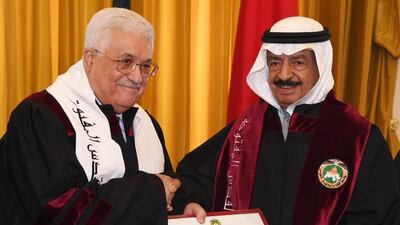
Palestinian leader Mahmud Abbas shakes hands with Bahrain’s Prime Minister Prince Khalifa bin Salman in Manama on April 11, 2017. AFP -
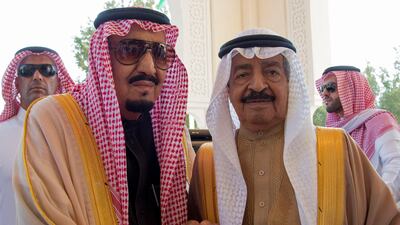
Saudi King Salman holds hands with Bahrain’s Prime Minister Prince Khalifa bin Salman at the Al-Sakhir Palace in Manama on December 8, 2016. AFP -
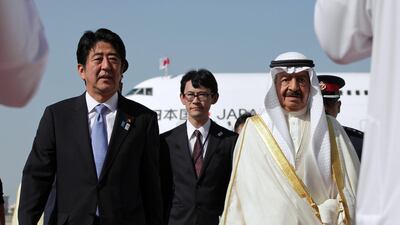
Japanese Prime Minister Shinzo Abe is welcomed by Bahrain’s Prime Minister Prince Khalifa bin Salman upon his arrival at the Bahraini airport in Muharraq, on August 24, 2013. AFP -
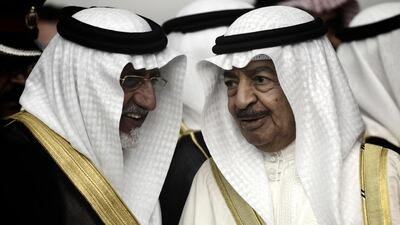
Bahrain’s Prime Minister Prince Khalifa bin Salman speaks to an unidentified man as he attends the opening ceremony of the Bahrain National Theatre in capital Manama on November 12, 2012. AFP -
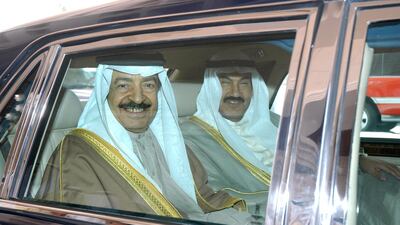
Kuwaiti Prime Minister Sheikh Nasser al-Mohammad Al-Ahmad Al-Sabah leaves Kuwait international airport after welcoming his Bahraini counterpart Prince Khalifa bin Salman on April 15, 2007 in Kuwait City. AFP -

Bahrain’s Prime Minister Prince Khalifa bin Salman casts his vote at a polling station in Manama, November 25, 2006. AFP -

United Nations Secretary-General Ban Ki-moon gives to Bahrain’s Prime Minister Prince Khalifa bin Salman the 2006 Special Citation and Habitat Scroll of Honor on the sideline of the first annual ministerial review of the Economic and Social Council (ECOSOC), on July 2, 2007 at the United Nations office in Geneva. AFP -
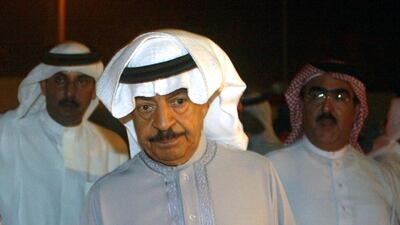
Bahrain’s Prime Minister Prince Khalifa bin Salman listens to a briefing of rescue teams March 31, 2006, after a ferry carrying up to 150 people sank off the coast of Bahrain. AFP -
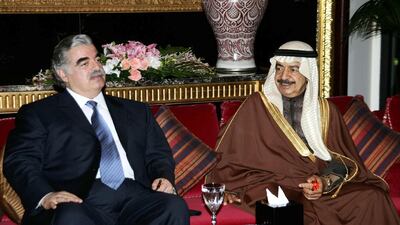
Lebanese former PM Rafiq Hariri meets with Bahrain’s Prime Minister Prince Khalifa bin Salman in Manama February 4, 2005. AFP -
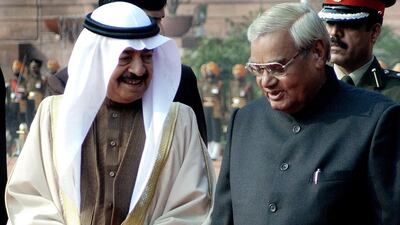
Bahrain’s Prime Minister Prince Khalifa bin Salman speaks with Indian Prime Minister Atal Behari Vajpayee at the Presidential palace in New Delhi on January 13, 2004. AFP -
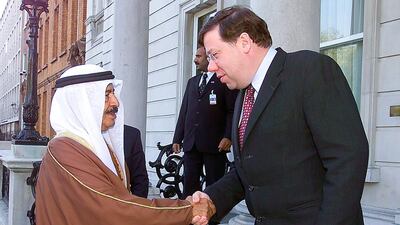
Irish Minister for Foreign Affairs Brian Cowen welcomes Bahrain’s Prime Minister Prince Khalifa bin Salman on the occasion of his two day official visit to Ireland October 2, 2003. AFP -
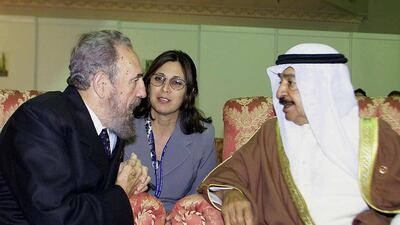
Cuban President Fidel Castro meets with Bahrain’s Prime Minister Prince Khalifa bin Salman on February 24, 2003, in Kuala Lumpur, during the Non Aligned Movement summit. AFP -
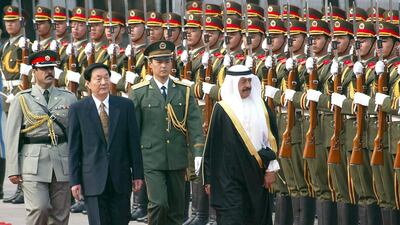
Chinese Premier Zhu Rongji accompanies Bahrain’s Prime Minister Prince Khalifa bin Salman as they review a guard-of-honour during a welcoming ceremony on Tiananmen Square, outside the Great Hall of the People in Beijing, May 16, 2002. AFP -

Philippine President Gloria Arroyo confers the Order of Sikatuna award to Bahrain’s Prime Minister Prince Khalifa bin Salman at the Malacanan presidential palace November 7, 2001. AFP -
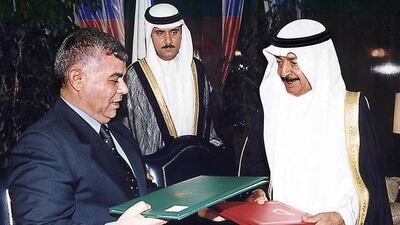
Syrian Prime Minister Mohammed Mustafa Miro and Bahrain’s Prime Minister Prince Khalifa bin Salman exchange a cooperation agreement they signed in Manama September 21, 2000. AFP -
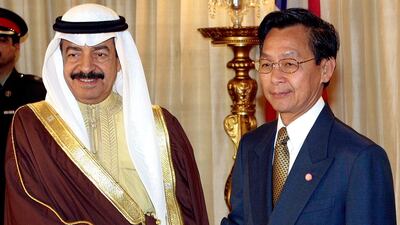
Thai Prime Minister Chuan Leekpai shakes hands with Bahrain’s Prime Minister Prince Khalifa bin Salman at the Government house in Bangkok on February 1, 2001. AFP -
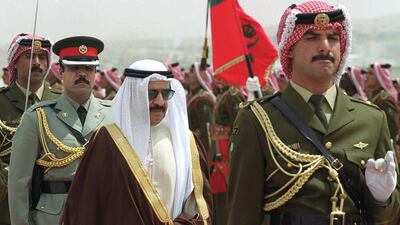
Bahrain’s Prime Minister Prince Khalifa bin Salman reviews the honor guard upon his arrival at Amman airport on April 18, 2000. AFP -

Thai Prime MInister Chuan Leekpai welcomes Bahrain’s Prime Minister Prince Khalifa bin Salman at the Government House in Bangkok October 13, 1999. AFP -

Bahrain’s Prime Minister Prince Khalifa bin Salman attends the first meeting of the government following the death of Bahraini Emir Sheikh Issa ibn Salman al-Khalifa, on March 14, 1999 in Manama. AFP -

Egyptian President Hosni Mubarak, on his way back from a summit of the G-15 states in Kuala Lumpur, meets with Bahrain’s Prime Minister Prince Khalifa bin Salman on November 7, 1997 in Manama. AFP


The Mayo Clinic has a long history of treating high-ranking Gulf officials, including Sheikh Sabah of Kuwait, who died at the Rochdale hospital on September 29 at the age of 91.
The Khalifa family has ruled Bahrain for more than two centuries and Prince Khalifa was the son of former ruler Sheikh Salman bin Hamad, who led from 1942 to 1961.
The prince learnt governance at his father’s side as the island remained a British protectorate. He was also the paternal uncle of King Hamad.
Alongside his brother Sheikh Isa bin Salman, who took power in 1961 and served as monarch when the nation gained its independence from Britain in 1971, Prince Khalifa helped to forge a modern Bahrain.
Under an informal arrangement, Sheikh Isa handled the island’s diplomacy and ceremonial duties while Prince Khalifa ran the government and economy.
In the years that followed independence, Bahrain developed rapidly as it sought to move beyond its dependence on its small oil reserves.
At that time, Manama was a regional financial, service and tourism centre.
The opening of the King Fahd Causeway in 1986 gave Bahrain its first land link with Saudi Arabia.
Prince Khalifa was regarded as representing a more traditionalist idea of rule.
His involvement in front-line politics waned as he developed health problems, being admitted to hospital in November 2015 but later released.
He also travelled to South-East Asia for medical appointments.
In late November 2019, he travelled to Germany for undisclosed medical treatments, remaining there for several months.
Prince Khalifa was married and has three surviving children, sons Ali and Salman and daughter Lulwa. Another son, Mohammed, died.
Sheikh Mohammed bin Rashid, Vice President and Ruler of Dubai, mourned Bahrain's loss.
"Our condolences to our brother, the King of Bahrain... and to our beloved Bahraini people on the death of Prince Khalifa bin Salman ... who served his country for a very long time and witnessed its developmental journey that contributed to shaping Bahrain's modern history," Sheikh Mohammed said.
Sheikh Mohamed bin Zayed, Crown Prince and Deputy Commander of the UAE Armed Forces, paid tribute to Prince Khalifa on Twitter, calling him one of the "architects of modern Bahrain".
The UAE's Minister of State for Foreign Affairs, Dr Anwar Gargash, described Prince Khalifa as a "man of solid principles and attitudes".
"The late, great Prince Khalifa bin Salman Al Khalifa is a historical stature whose name was associated with the modern development of Bahrain and the Arabian Gulf," Dr Gargash tweeted.
"He is a man of solid principles and attitudes. And a model of the historical men who contributed to crystallising the modern Gulf."

