
Spain’s Prime Minister has rejected a call by ousted Catalan leader Carles Puigdemont to meet after separatists won a parliamentary majority in crucial regional polls.
"The person I should be meeting with is with the one who won the elections, and that is Mrs Arrimadas," Mariano Rajoy said on Friday, replying to a journalist who asked whether he would respond to Mr Puigdemont's invitation for a meeting.
Mr Rajoy was referring to centrist, anti-independence candidate Ines Arrimadas, whose Ciudadanos party won the best individual result in Thursday's poll – even as the bloc of separatist parties maintained its absolute majority.
Earlier on Friday, Mr Puigdemont had called on Mr Rajoy to hold talks following the election results.
He said he wanted them to take place in Brussels, where he has sought self-imposed exile, or anywhere else in Europe - barring Spain, where he faces arrest.
But the Prime Minister appeared to reject the idea.
-
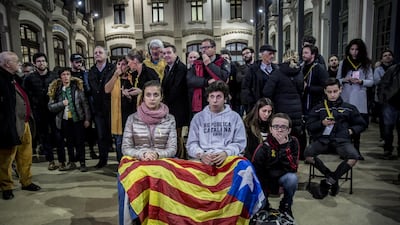
People hold a Catalan flag while following election results at the Esquerra Republicana de Catalunya ERC party headquarters in Barcelona. Angel Garcia / Bloomberg -
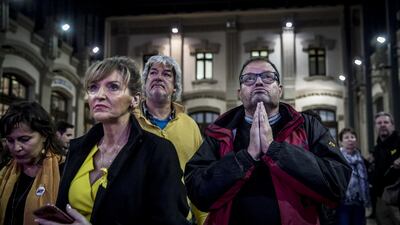
Pro-independence parties won back control of Catalonia in Thursday’s regional election. Angel Garcia / Bloomberg -

Confetti flies as supporters wave flags at the Ciudadanos party headquarters. Angel Garcia / Bloomberg -
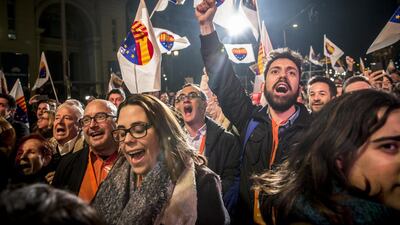
With turnout at a record high and over 90 percent of the ballots counted, the election handed a mandate back to the region's ousted separatist leaders. Angel Garcia / Bloomberg -

Together for Catalonia – the party led by deposed Catalan president, Carles Puigdemont – took 34 seats, the Catalan Republican Left (ERC) took 32 and the far-left, anti-capitalist Popular Unity Candidacy took four. Guillem Sartorio / Bloomberg -

The Spanish government called the election after it took the unprecedented step of stripping Catalonia of its treasured autonomy. Angel Garcia / Bloomberg


Mr Rajoy also warned that the new Catalan government should fully respect the law.
This statement was a reference to the former government's defiance on October 1, when it went held a referendum on independence despite a constitutional ban.
Catalan lawmakers went on to declare independence, prompting Madrid to sack Mr Puigdemont's government and dissolve the parliament.
It was then that Mr Rajoy's government called snap polls in Catalonia.
Mr Rajoy said that he was ready for "open, constructive and realistic dialogue" - but "always within the limits of legality".
Thursday’s poll has plunged the region into further uncertainty after the failed independence bid rattled Europe and triggered Spain's worst political crisis in decades.
With turnout at a record high, the election handed a mandate back to the region's ousted separatist leaders in a major upset for Mr Rajoy’s government.
Together for Catalonia – the party led by Mr Puigdemont – took 34 seats, the Catalan Republican Left took 32 and the far-left, anti-capitalist Popular Unity Candidacy took four.
Meanwhile, Mr Rajoy's conservative Popular Party recorded its worst ever result.
A jubilant Mr Puigdemont termed the results a victory for “the Catalan republic”.
_______________
Read more:
Catalan separatists win absolute parliamentary majority
The town where independence for Catalonia took root
Year in review: The stakes are high but the use of referenda is on the rise
_______________
"Catalonia wants to be an independent state," he said, speaking in Belgium on Friday. "This is the wish of the Catalan people. I think the plan of Mariano Rajoy is not working, so we have to find new ways to tackle this crisis."
The three separatist parties will have enough seats to reassemble the parliamentary majority that put them into office after the 2015 elections if they can agree a new coalition.
For Catalans on both sides of the divide the day had been a moment of truth, following weeks of upheaval and protests unseen since democracy was reinstated following the death in 1975 of dictator Francisco Franco.
At stake was the economy of a region that has seen its tourism sector suffer and more than 3,100 companies – including the largest banks, utilities and insurers – move their legal headquarters out of Catalonia since the referendum.
The judiciary had also pressed charges of rebellion, sedition and misuse of funds against the secessionist leaders, forcing them to campaign from exile and behind bars.
Mr Puigdemont, who had fled to Belgium where he tried to rally international support for the separatist cause, has not since returned to Spain.
His former deputy Oriol Junqueras and three other separatist leaders stayed behind, and were remanded in custody on November 2.
"Practically and emotionally, it has been a very difficult election campaign. We didn't have our candidate here, President Puigdemont was in exile in Brussels, and number two on the list, Jordi Sanchez, was in prison," said Elsa Artadi, Mr Puigdemont's Together for Catalonia campaign manager.
Sergi Sebria, spokesman for Mr Junqueras's ERC party, said his party had had to face the election "in the worst conditions, in absolutely unequal conditions, with its candidate in prison until the last day.
"Despite this we have done everything with hope," he said, adding that "a high turnout legitimises the election result".
Crucially, the pro-independence camp is not expected to attempt another breakaway from Spain but rather try to enter into negotiations with Madrid.

