


More than 90 per cent of Germany’s most seriously ill Covid-19 patients come from a migrant background, the head of a German lung hospital is reported as saying.
On a conference call with other experts last month, Prof Lothar Wieler – president of the Robert Koch Institute – said Muslims comprised more than 50 per cent of those in intensive care, despite making up less than 5 per cent of Germany’s population.
According to Bild newspaper, Thomas Voshaar of the Lung Clinic at the Bethanien Hospital in Moers, western Germany, said the perils of Covid-19 were not getting through to communities with migrant populations.
-

A hairdresser cuts the hair of a client in Dortmund, surrounded by screens and social distance reminders. AFP -

Hairdresser Sadiye Kisin cuts the hair of her first customer as members of the press gather around just after midnight in Duisburg. EPA -

Staff members launch a confetti cannon at their hair salon in Dortmund. AFP -
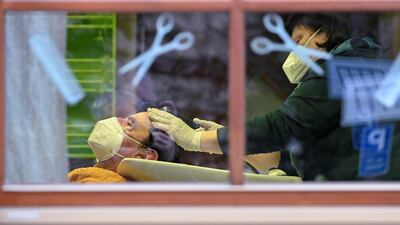
Hairdresser Manuela Friedl serves a customer as her salon reopens after a months-long lockdown, in Haselbachtal. Reuters -
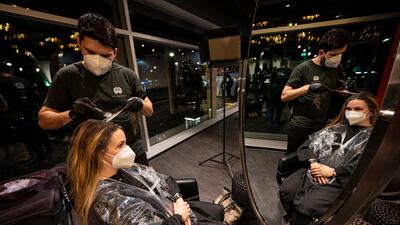
The first customer of Shan Rahimkhan's barbershop gets her hair cut and colored after the reopening in Berlin. AP Photo -

Muhammet 'Memo' Akbas cuts Aleksandar Petrovic's hair in a barber shop in Freiburg. AP Photo -

Hairdresser Marco Trapani colours the hair of a client at his hair salon reopening in Dortmund. AFP -

Hairdresser Manuela Friedl cuts their hair of a customer in Haselbachtal. The sign reads: "Sincerely welcome, please knock - I will open, wear a mask? no symptoms? Now it finally starts, I am happy". Reuters


His statements were based on statistics collected from intensive care wards at the end of last year and the beginning of 2021, which he said were shared with Health Minister Jens Spahn.
“According to my analysis, more than 90 per cent of the intubated, most seriously ill patients always had a migrant background,” he reportedly said on the conference call on February 14.
“We agreed among ourselves that we should describe these people as 'patients with communications barriers'. We don't seem to be getting through to them.”
Prof Wieler said the findings were a "real problem".
“There are parallel societies in our country. You can only put that right with proper outreach work in the mosques, but we're not getting through. And that sucks,” he said.
When contacted by Bild he said the conference call was a "private, informal exchange".
Separately, Chancellor Angela Merkel held talks with state governors about plotting the country's way out of lockdown, which is largely expected to be extended until the end of March.
Although many primary schools have welcomed back pupils and hairdressers reopened on Monday, most shops have been closed since December 16 and restaurants since November 2.
Possible changes to restrictions could involve different households being able to mix with more people, depending on local virus numbers in a country that has recorded more than 71,000 deaths linked to Covid-19.
About 5.3 per cent of the Germany’s population have been given at least once vaccine dose but the government has been criticised for not doing more.
The authorities are also under pressure to reverse a decision not to use the AstraZeneca vaccine on over-65s amid fears about its effectiveness.
It has led to a build-up of unused doses of the AstraZeneca vaccine, with about two thirds of the 1.4 million delivered still in storage.

