
Chancellor Angela Merkel said Germany was "basically in a new pandemic" as she extended the country's lockdown measures to mid-April to try and break a third wave fuelled by the Covid-19 variant first detected in the UK.
During talks that continued late into the night, Mrs Merkel pushed the leaders of Germany's 16 states to take a tougher stance to fight the pandemic, reversing plans for a gradual re-opening of the economy agreed to earlier this month amid a sharp rise in the infection rate.
She said the country was in a race against time to vaccinate its population before new coronavirus variants took over.
"We are now basically in a new pandemic. The British mutation has become dominant," she said.
"Fundamentally, we face a new virus of the same kind but with very different characteristics. More deadly, more infectious, and infectious for longer."
In neighbouring France, doctors said the health system faced an "unprecedented violent shock" in about three weeks if the country failed to contain Covid-19 cases.
"The epidemic is gathering pace, and the figures are exploding," the French hospital federation's Frederic Valletoux said.
Last week, France imposed a month-long lockdown on Paris and parts of the north after a faltering vaccine programme and spread of highly contagious coronavirus variants forced President Emmanuel Macron to shift course.
Official data on Monday showed the tally of new Covid-19 cases in France had accelerated, with the number of people in intensive care at a new four-month high.
France reported 15,792 new coronavirus cases on Monday, more than double the 6,471 reported last Monday.
Germany started cautiously easing restrictions earlier this month. But the spread of more infectious variants of the virus pushed up cases, prompting concerns that hospitals could soon be overstretched without further curbs.
The number of cases per 100,000 people over a week stood at 107 on Monday, above the level at which intensive care units are likely to be overwhelmed.
On Tuesday, the death toll rose by 250 to 74,964, while infections tally increased by 7,485 to 2,674,710.
“We are now in a very, very serious situation,” Mrs Merkel said.
“The case numbers are rising exponentially and intensive care beds are filling up again.”
The country will enter an even stricter lockdown from April 1 to April 5, over the Easter holiday period.
In the radical Easter shutdown – one of the toughest in Germany since the start of the pandemic – all shops will be closed from April 1 for five days, apart from food stores, which will only open on April 3. Mrs Merkel had pushed for all shops, including grocery stores, to close for the full five days.

Big family gatherings will be banned over the holidays, with no more than two households, or up to five people, allowed to meet. The government will ask churches to hold Easter services online to avoid gatherings.
Talks dragged on for hours as Mrs Merkel and state leaders were at loggerheads over whether to ease restrictions on domestic travel over the Easter holiday season.
Germans can travel freely even amid the pandemic, but hotels and holiday resorts in the country are not allowed to rent rooms to tourists. That leaves travel abroad as the only option for those who are desperate to go on holidays.
"We advise against all travel abroad," Ms Merkel said.
Airlines will now be responsible for ensuring all travellers and crew are tested for the coronavirus prior to departure to Germany, regardless of the infection rate in the country they have visited.
But Mrs Merkel and the state leaders stopped short of imposing mandatory quarantine for all returning travellers, a relief for holiday destinations such as Spain's Mallorca that are banking on a boost from Easter travel business.
Only 9 per cent of Germans have received at least one shot of a Covid-19 vaccine, but the pace of vaccinations is expected to pick up next month.
"Things are tough longer than we had expected, but there is very clearly light at the end of the tunnel," Mrs Merkel said.
Coronavirus in Europe - in pictures
-
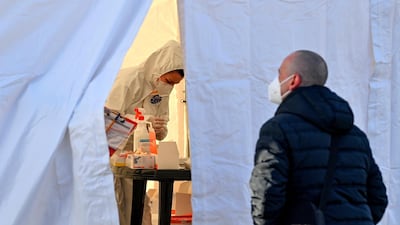
A Polish commuter waits for a coronavirus test at the Stadtbruecke border crossing between Germany and Poland. Poland is classified as a 'high risk' area by German authorities. AP Photo -
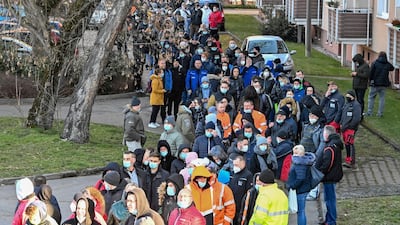
Polish commuters queue for a coronavirus test at the Stadtbruecke border crossing. AP Photo -
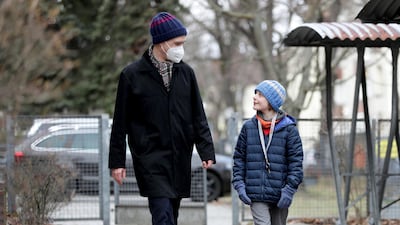
Teacher Michael G. Gromotka and his son Georg. Amid pressure to relax the lockdown, Germany agreed last month to gradually begin reopening schools - then the number of coronavirus cases increased, prompting some regional authorities to put those plans on hold. AP Photo -
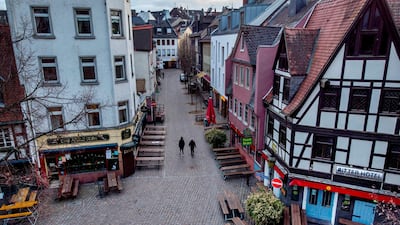
People walk through the quiet Alt Sachsenhausen district in Frankfurt, Germany. AP Photo -
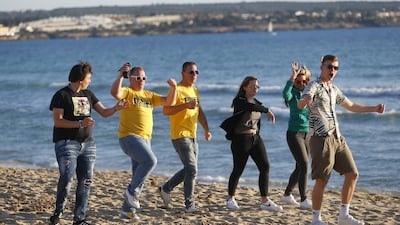
Tourists from Germany dance on El Arenal beach in Palma de Mallorca, Spain, following Berlin's lifting of quarantine requirements for travellers returning from the Balearic Islands. Reuters -
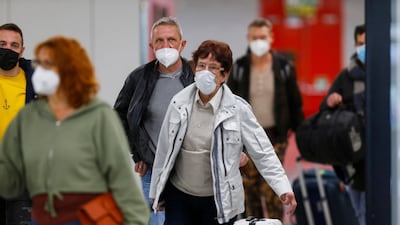
Tourists from Germany arrive at Palma de Mallorca Airport in Spain. Reuters -
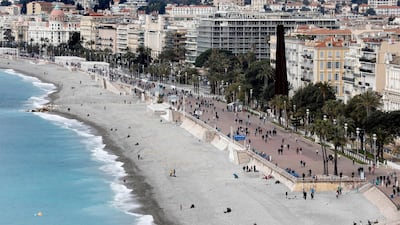
People walk on the Promenade des Anglais during lockdown in Nice, southern France. EPA -
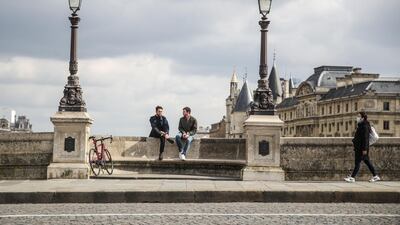
People on Pont Neuf bridge next to the river Seine in Paris, France. New lockdown measures include the closure of non-essential businesses, but people are allowed outdoors within a 10-kilometre radius of one's home without time restrictions. EPA -
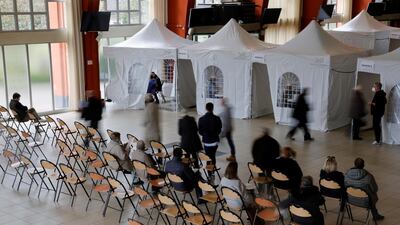
People wait to receive a dose of Moderna's Covid-19 vaccine in Marcq-en-Baroeul, France. Reuters -
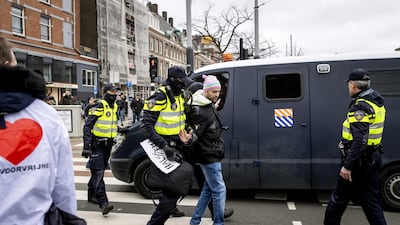
Police start clearing the area of protesters during an anti-lockdown demonstration in Amsterdam, the Netherlands. EPA -
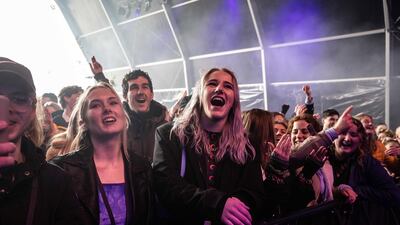
Music fans at a pop festival enjoy the event in Biddinghuizen, the Netherlands. The festival is part of a series of trial events in which researchers of the Fieldlab programme are investigating how large public events can take place safely during the pandemic. EPA -
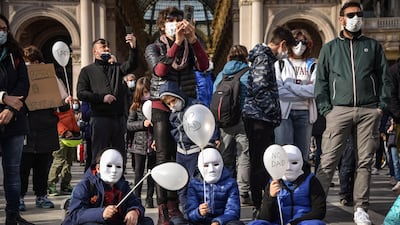
People take part in a demonstration against distanced learning in Duomo square, Milan, northern Italy. EPA -
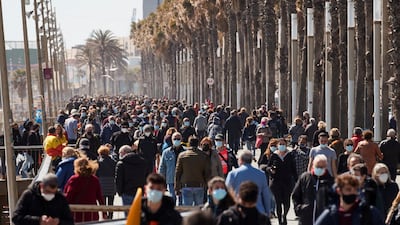
People walk along a promenade in Barcelona, Spain. EPA



