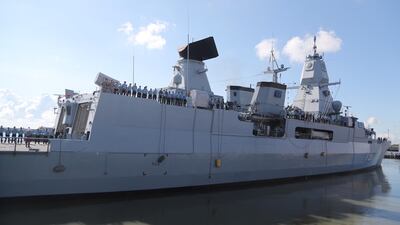
Crew members stand on deck as the Hamburg gets ready to join Operation Irini. EPA

German frigate joins EU's troubled Operation Irini


  • English
  • Arabic

A German navy frigate and 250 sailors have left port to join the EU mission enforcing the long-flouted weapons embargo on Libya.

The Hamburg  left Wilhelmshaven on the North Sea on Tuesday morning and is due to arrive in the Mediterranean by the middle of the month.

It is set to join the operation for five months and take a leading role in steering the EU mission.

In that time, the ship is expected to remain almost entirely at sea so its personnel are not exposed to the coronavirus.

The 143-metre vessel is the German navy's first contribution to Operation Irini, which began in early May.

The mission, one of the main parts of Brussels' plan to decrease growing violence on the EU's doorstep in Libya, has been plagued by infighting and a lack of resources.

Fighters loyal to the Libyan Government of National Accord (GNA) secure Abu Qurain. AFP

Before the Hamburg  arrives, the mission's only listed operational assets have been the Greek frigate Spetsai, a German P-3C Orion maritime-patrol aircraft and one small reconnaissance aircraft, provided by Luxembourg and Poland.

Irini has rarely had more than one vessel operating at any time, with the French destroyer Jean Bart  and the Greek frigate Hydra  being sent together for two weeks from mid-May.

Before joining the operation, the German navy highlighted the politically sensitive nature of the mission.

Commandant Jan Fitschen said the Hamburg  would be operating in "difficult political and operational terrain".

"We are facing an operation that will pose unknown challenges to the ship and crew in several ways," he told the German press agency DPA.

The Government of National Accord in Tripoli and its Turkish backers have regularly railed against Irini, saying the EU mission favoured the rival Libyan National Army led by Field Marshal Khalifa Haftar, blocking the flow of weapons to the country.

The Hamburg,  an F124-class frigate, is a multipurpose vessel with an emphasis on air defence. Its radar can monitor air space to a range of 400 kilometres, Greek press reported.

The argument between France and Turkey has shone a spotlight on NATO's struggles. AP

Ankara in the ascendancy

Ankara has turned the tide of Libya’s civil war in recent months, delivering air support and thousands of Syrian mercenaries to the GNA to end a year-long offensive against the LNA.

After victories in western Libya, the country’s eastern LNA and western GNA are facing off around the city of Sirte, near Libya’s central coast.

Ankara’s backing of the GNA has put it on a collision course with France, a central Nato and EU member.

Turkey has regularly accused Paris of backing Field Marshal Haftar, though French officials have denied this.

Relations between the two Nato allies reached a new low point after a naval incident in June in the eastern Mediterranean.

Paris said its frigate, the Courbet,  part of a Nato mission there, was harassed by Turkish vessels as it tried to inspect a Tanzanian-flagged cargo ship suspected of being used by Turkey to flout Libya's arms embargo.

Ankara has denied that the Cirkin  was supplying weapons to the GNA, claiming the vessel was carrying medical supplies.

Germany has increasingly found itself drawn in as a referee in the region, where nine years of instability in Libya have mixed with decades-old disputes over maritime boundaries and access to water rich in natural gas deposits.

At the end of July, German Chancellor Angela Merkel made an 11th-hour diplomatic intervention to stop a confrontation between Greece and Turkey.

Athens placed its military in the Mediterranean on high alert after Turkey announced its research ship, the Oruc Reis,  would conduct gas exploration near the Greek island of Kastellorizo.

Last December the GNA in Libya confirmed a new maritime border deal with Ankara in the Mediterranean in exchange for military co-operation.

The UAE, Egypt, France, Cyprus and Greece condemned the agreements, which would give Turkey access to potentially lucrative natural gas reserves in the area.


In numbers: China in Dubai

The number of Chinese people living in Dubai: An estimated 200,000

Number of Chinese people in International City: Almost 50,000

Daily visitors to Dragon Mart in 2018/19: 120,000

Daily visitors to Dragon Mart in 2010: 20,000

Percentage increase in visitors in eight years: 500 per cent

Ten tax points to be aware of in 2026

1. Domestic VAT refund amendments: request your refund within five years

If a business does not apply for the refund on time, they lose their credit.

2. E-invoicing in the UAE

Businesses should continue preparing for the implementation of e-invoicing in the UAE, with 2026 a preparation and transition period ahead of phased mandatory adoption. 

3. More tax audits

Tax authorities are increasingly using data already available across multiple filings to identify audit risks. 

4. More beneficial VAT and excise tax penalty regime

Tax disputes are expected to become more frequent and more structured, with clearer administrative objection and appeal processes. The UAE has adopted a new penalty regime for VAT and excise disputes, which now mirrors the penalty regime for corporate tax.

5. Greater emphasis on statutory audit

There is a greater need for the accuracy of financial statements. The International Financial Reporting Standards standards need to be strictly adhered to and, as a result, the quality of the audits will need to increase.

6. Further transfer pricing enforcement

Transfer pricing enforcement, which refers to the practice of establishing prices for internal transactions between related entities, is expected to broaden in scope. The UAE will shortly open the possibility to negotiate advance pricing agreements, or essentially rulings for transfer pricing purposes. 

7. Limited time periods for audits

Recent amendments also introduce a default five-year limitation period for tax audits and assessments, subject to specific statutory exceptions. While the standard audit and assessment period is five years, this may be extended to up to 15 years in cases involving fraud or tax evasion. 

8. Pillar 2 implementation 

Many multinational groups will begin to feel the practical effect of the Domestic Minimum Top-Up Tax (DMTT), the UAE's implementation of the OECD’s global minimum tax under Pillar 2. While the rules apply for financial years starting on or after January 1, 2025, it is 2026 that marks the transition to an operational phase.

9. Reduced compliance obligations for imported goods and services

Businesses that apply the reverse-charge mechanism for VAT purposes in the UAE may benefit from reduced compliance obligations. 

10. Substance and CbC reporting focus

Tax authorities are expected to continue strengthening the enforcement of economic substance and Country-by-Country (CbC) reporting frameworks. In the UAE, these regimes are increasingly being used as risk-assessment tools, providing tax authorities with a comprehensive view of multinational groups’ global footprints and enabling them to assess whether profits are aligned with real economic activity. 

Contributed by Thomas Vanhee and Hend Rashwan, Aurifer