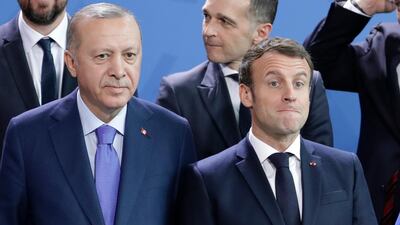
Turkey's President Recep Tayyip Erdogan, left and French President Emmanuel Macron stand, during a group photo at a conference on Libya at the chancellery in Berlin, Germany in January. AP

France accuses Turkey of stoking hate and using ‘slanderous propaganda’


  • English
  • Arabic

French Foreign Minister Jean-Yves Le Drian on Sunday accused Turkey of "trying to whip up hatred" against France, continuing a war of words over Islam between the Nato allies.

France said on Saturday that it was recalling its ambassador to Turkey after unacceptable comments by President Recep Tayyip Erdogan, who questioned Emmanuel Macron’s mental health and his attitude towards Islam.

Paris and Ankara were already at odds over issues including maritime rights in the Eastern Mediterranean, conflicts in Libya and Syria, and most recently the fighting between Armenia and Azerbaijan over Nagorno-Karabakh.

The two sides have now fallen out over domestic policies, and Mr Le Drian described the “insults” against Mr Macron as “unacceptable conduct” from an ally.

Turkey's "hateful, slanderous propaganda against France" revealed a desire to "whip up hate against us and in our midst", he said.

Ankara is angered by a campaign championed by Mr Macron to protect France’s secular values against extremism, a campaign given impetus by the beheading of a schoolteacher who showed his class cartoons of the Prophet Mohammed.

Mr Macron praised the teacher, Samuel Paty, as a "silent hero" who upheld France's secular values.

He pledged that the country would "not give up our cartoons", which incensed Mr Erdogan.

"We will always be on the side of human dignity and universal values," Mr Macron said in a message written in Arabic on Twitter late on Sunday.

The EU’s foreign affairs commissioner, Josep Borrell, on Sunday criticised Mr Erdogan’s comments.

"The remarks by President Recep Tayyip Erdogan regarding President Emmanuel Macron are unacceptable," Mr Borrell tweeted in French.

"I call to Turkey to cease this dangerous spiral of confrontation."

A French presidential official said on Saturday that “excess and rudeness” should not be used in international relations.

“President Erdogan’s comments are unacceptable,” the official told AFP.

“We demand that Erdogan change the course of his policy because it is dangerous in every respect.”

In an unusual move, the official said the French ambassador to Turkey was being recalled for consultation and would meet Mr Macron to discuss the situation.

The Elysee official said France had noted “the absence of messages of condolence and support” from Mr Erdogan after the beheading of Mr Paty near Paris on October 16.

Mr Le Drian repeated the complaint on Sunday.

Mr Erdogan criticised Mr Macron over his policies towards France’s large Muslim minority, saying that he needed “mental checks”.

“What’s the problem of the individual called Macron with Islam and with the Muslims?” Mr Erdogan asked.

“Macron needs mental treatment."

He indicated that he did not expect Mr Macron to win the 2022 elections.

Mr Erdogan has frequently taken aim at Mr Macron, referring to him as “brain dead” last year after the French leader used the term to describe the state of Nato.

The Elysee official said Mr Erdogan had two months to reply to the demands for a change in stance, and that it ended its “dangerous adventures” in the Eastern Mediterranean and “irresponsible conduct” over Nagorno-Karabakh, where Ankara is backing Azerbaijan.

“Measures need to be taken by the end of the year,” the official said.

Turkey showed little sign of backing down on Sunday, with a senior official claiming that offensive caricatures were being used to intimidate Muslims under the guise of freedom of expression.

European attitudes demonising Muslims were reminiscent of how the Jews in Europe were treated in the 1920s, said Fahrettin Altun, spokesman for the Turkish presidency.

The latest dispute has sparked renewed debates online over boycotting Turkish products and France's counter-extremism policy.

Several Saudi companies have announced that they will no longer stock Turkish produce.

Hassan Sajwani, a UAE Twitter personality, said that he was sorry that a boycott could gather steam and that Turks would again be affected by their president’s actions.

Others criticised France for allowing the satirical magazine Charlie Hebdo  to run cartoons of the Prophet Mohammed.

UK%20record%20temperature
%3Cp%3E38.7C%20(101.7F)%20set%20in%20Cambridge%20in%202019%3C%2Fp%3E%0A
The%C2%A0specs%20
%3Cp%3E%3Cstrong%3EEngine%3A%20%3C%2Fstrong%3E4.4-litre%2C%20twin-turbo%20V8%0D%3Cbr%3E%3Cstrong%3ETransmission%3A%20%3C%2Fstrong%3Eeight-speed%20auto%0D%3Cbr%3E%3Cstrong%3EPower%3A%20%3C%2Fstrong%3E617hp%0D%3Cbr%3E%3Cstrong%3ETorque%3A%20%3C%2Fstrong%3E750Nm%0D%3Cbr%3E%3Cstrong%3EPrice%3A%20%3C%2Fstrong%3Efrom%20Dh630%2C000%0D%3Cbr%3E%3Cstrong%3EOn%20sale%3A%20%3C%2Fstrong%3Enow%3C%2Fp%3E%0A
Email sent to Uber team from chief executive Dara Khosrowshahi

From: Dara

To: Team@

Date: March 25, 2019 at 11:45pm PT

Subj: Accelerating in the Middle East

Five years ago, Uber launched in the Middle East. It was the start of an incredible journey, with millions of riders and drivers finding new ways to move and work in a dynamic region that’s become so important to Uber. Now Pakistan is one of our fastest-growing markets in the world, women are driving with Uber across Saudi Arabia, and we chose Cairo to launch our first Uber Bus product late last year.

Today we are taking the next step in this journey—well, it’s more like a leap, and a big one: in a few minutes, we’ll announce that we’ve agreed to acquire Careem. Importantly, we intend to operate Careem independently, under the leadership of co-founder and current CEO Mudassir Sheikha. I’ve gotten to know both co-founders, Mudassir and Magnus Olsson, and what they have built is truly extraordinary. They are first-class entrepreneurs who share our platform vision and, like us, have launched a wide range of products—from digital payments to food delivery—to serve consumers.

I expect many of you will ask how we arrived at this structure, meaning allowing Careem to maintain an independent brand and operate separately. After careful consideration, we decided that this framework has the advantage of letting us build new products and try new ideas across not one, but two, strong brands, with strong operators within each. Over time, by integrating parts of our networks, we can operate more efficiently, achieve even lower wait times, expand new products like high-capacity vehicles and payments, and quicken the already remarkable pace of innovation in the region.

This acquisition is subject to regulatory approval in various countries, which we don’t expect before Q1 2020. Until then, nothing changes. And since both companies will continue to largely operate separately after the acquisition, very little will change in either teams’ day-to-day operations post-close. Today’s news is a testament to the incredible business our team has worked so hard to build.

It’s a great day for the Middle East, for the region’s thriving tech sector, for Careem, and for Uber.

Uber on,

Dara

Milestones on the road to union

1970

October 26: Bahrain withdraws from a proposal to create a federation of nine with the seven Trucial States and Qatar. 

December: Ahmed Al Suwaidi visits New York to discuss potential UN membership.

1971

March 1:  Alex Douglas Hume, Conservative foreign secretary confirms that Britain will leave the Gulf and “strongly supports” the creation of a Union of Arab Emirates.

July 12: Historic meeting at which Sheikh Zayed and Sheikh Rashid make a binding agreement to create what will become the UAE.

July 18: It is announced that the UAE will be formed from six emirates, with a proposed constitution signed. RAK is not yet part of the agreement.

August 6:  The fifth anniversary of Sheikh Zayed becoming Ruler of Abu Dhabi, with official celebrations deferred until later in the year.

August 15: Bahrain becomes independent.

September 3: Qatar becomes independent.

November 23-25: Meeting with Sheikh Zayed and Sheikh Rashid and senior British officials to fix December 2 as date of creation of the UAE.

November 29:  At 5.30pm Iranian forces seize the Greater and Lesser Tunbs by force.

November 30: Despite  a power sharing agreement, Tehran takes full control of Abu Musa. 

November 31: UK officials visit all six participating Emirates to formally end the Trucial States treaties

December 2: 11am, Dubai. New Supreme Council formally elects Sheikh Zayed as President. Treaty of Friendship signed with the UK. 11.30am. Flag raising ceremony at Union House and Al Manhal Palace in Abu Dhabi witnessed by Sheikh Khalifa, then Crown Prince of Abu Dhabi.

December 6: Arab League formally admits the UAE. The first British Ambassador presents his credentials to Sheikh Zayed.

December 9: UAE joins the United Nations.

Frankenstein in Baghdad
Ahmed Saadawi
​​​​​​​Penguin Press

The specs

Common to all models unless otherwise stated

Engine: 4-cylinder 2-litre T-GDi

0-100kph: 5.3 seconds (Elantra); 5.5 seconds (Kona); 6.1 seconds (Veloster)

Power: 276hp

Torque: 392Nm

Transmission: 6-Speed Manual/ 8-Speed Dual Clutch FWD

Price: TBC

Conflict, drought, famine

Estimates of the number of deaths caused by the famine range from 400,000 to 1 million, according to a document prepared for the UK House of Lords in 2024.
It has been claimed that the policies of the Ethiopian government, which took control after deposing Emperor Haile Selassie in a military-led revolution in 1974, contributed to the scale of the famine.
Dr Miriam Bradley, senior lecturer in humanitarian studies at the University of Manchester, has argued that, by the early 1980s, “several government policies combined to cause, rather than prevent, a famine which lasted from 1983 to 1985. Mengistu’s government imposed Stalinist-model agricultural policies involving forced collectivisation and villagisation [relocation of communities into planned villages].
The West became aware of the catastrophe through a series of BBC News reports by journalist Michael Buerk in October 1984 describing a “biblical famine” and containing graphic images of thousands of people, including children, facing starvation.

Band Aid

Bob Geldof, singer with the Irish rock group The Boomtown Rats, formed Band Aid in response to the horrific images shown in the news broadcasts.
With Midge Ure of the band Ultravox, he wrote the hit charity single Do They Know it’s Christmas in December 1984, featuring a string of high-profile musicians.
Following the single’s success, the idea to stage a rock concert evolved.
Live Aid was a series of simultaneous concerts that took place at Wembley Stadium in London, John F Kennedy Stadium in Philadelphia, the US, and at various other venues across the world.
The combined event was broadcast to an estimated worldwide audience of 1.5 billion.
