

The European Union has pledged an extra 170 million euros to vulnerable people in Syria, including 60 million euros to the humanitarian crisis in Idlib.
A recent surge in violence in Idlib in the north-west of the country has led to nearly a million displaced people fleeing towards Turkey’s southern border with Ankara complaining it has been left to fend for itself.
Thousands of migrants have been massing on Turkey’s western frontier with Europe after President Recep Tayyip Erdogan opened its borders in a move that has been described as not helpful.
His threats have led to emergency meetings between senior European officials with President of the European Council, Charles Michel and EU foreign affairs chief Josep Borrell holding talks with Mr Erdogan in Ankara in an effort to soothe tensions.
A 2016 Turkish-EU deal saw Ankara stopped people on its soli heading to Europe in return for billions of Euros in aid for the 3.5 million Syrian refugees in Turkey, which is backing rebels in Syria.
After Russian-backed Syrian government forces killed Turkish soldiers in an air strike in Syria last week, Ankara signalled it would walk away from its pact with the EU altogether.
“We have a common interest and that is to end the conflict in Syria,” Mr Borrell said.
-

A migrant speaks to a Greek policeman during minor clashes at the port of Mytilene after locals block access to the Moria refugee camp, on the northeastern Aegean island of Lesbos, Greece. AP Photo -

Migrants travel on a horse carriage near the Turkey's Pazarkule border crossing with Greece's Kastanies, near Edirne, Turkey. REUTERS -
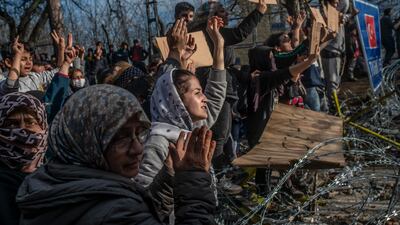
Migrants hold placards as they demonstrate, waiting at the buffer zone in front of the Pazarkule border crossing to Greece, in Edirne. AFP -

An aerial view shows refugees on road at Turkey's Pazarkule border crossing with Greece's Kastanies, southwest of Edirne. REUTERS -
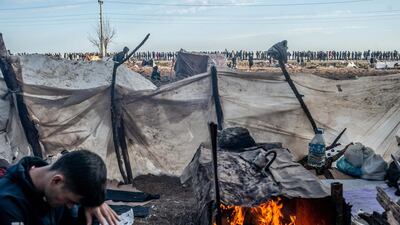
A migrant sits next to a bonfire as others wait for a food distribution in front of the Pazarkule border crossing to Greece, in Edirne. AFP -
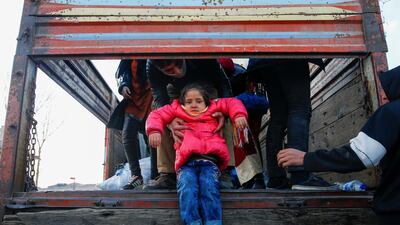
A migrant child is passed from a truck near the Turkey's Pazarkule border crossing with Greece's Kastanies, near Edirne, Turkey. REUTERS -
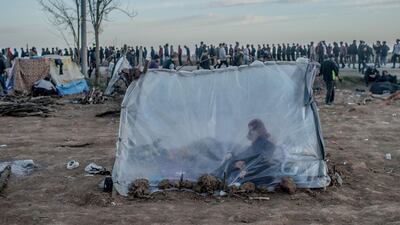
A Syrian woman sits in a tent with her son as others wait for food distribution in front of the Pazarkule border crossing to Greece, in Edirne. AFP -
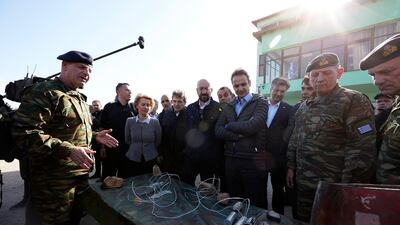
Greek Prime Minister Kyriakos Mitsotakis (4-R) with European Council President Charles Michel (C), European Commission President Ursula von der Leyen (3-L), European Parliament President David Sassoli (2-L) and Croatian Prime Minister Andrej Plenkovic (3-R) during a visit at the Greek-Turkish border in northern Greece. EPA -
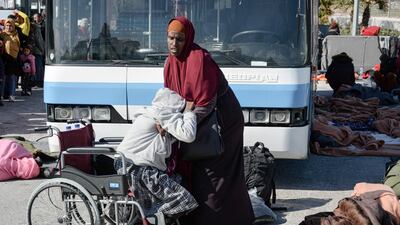
An elderly migrant woman is helped out of a wheelchair at the port of Mytilene on the northeastern Aegean island of Lesbos, Greece. AP Photo -
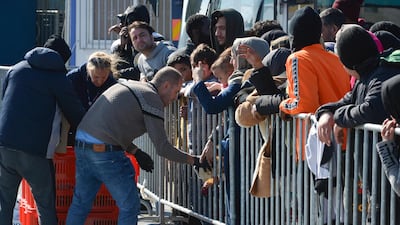
Migrants wait in line for food and water distribution at the port of Mytilene on the northeastern Aegean island of Lesbos, Greece. AP Photo -

Greek police in riot gear advance to push migrants away after minor clashes at the port of Mytilene on the northeastern Aegean island of Lesbos, Greece. AP Photo -

Greek police in riot gear stand before minor clashes with migrants at the port of Mytilene on the northeastern Aegean island of Lesbos, Greece. AP Photo


“Only in this way will we be able to bring to an end the suffering of the civilian population and contribute to address the most significant challenges Turkey is currently facing. Increased pressure at EU-Turkey border and unilateral actions will not provide answers.”
He said the build up at the border would only create problems and make the situation worse, with refugees and migrants paying the biggest price.
Addressing the aid situation in Idlib, Mr Borrell said: The problem there is not funding, the problem is logistics, the problem is how to reach through the border, in a situation which is in the middle of the war, making every day more difficult to bring help to the people who need it.”
The EU’s relatively measured response has contrasted with that of some countries in the bloc. Turkey’s neighbour Greece has been highly critical of Mr Erdogan’s move while France’s Foreign Minister Jean-Yves Le Drian said the EU would not give into “blackmail”.
French President Emmanuel Macron and UK Prime Minister Boris Johnson also spoke on Wednesday over the phone.
“They discussed the coronavirus epidemic and the Prime Minister updated the President on the UK’s four strand approach to contain the virus, delay its spread, research its origins and cure and mitigate the impact should the virus become more widespread," a Downing Street spokesperson said.
“The two leaders agreed to work together on an international response to combat the spread of coronavirus.
“The Prime Minister and President Macron also discussed the current situation in Syria and what could be done to bring an end to the conflict and suffering of the Syrian people, particularly in Idlib," they added.
On Thursday in Zagreb, Croatia the EU’s foreign ministers will meet to discuss the situation in Idlib and Turkey further.

