Antonio Guterres said not enough common ground was found to allow for the resumption of formal negotiations. Reuters

Cyprus settlement talks fall flat as common ground hard to find


Jamie Prentis
  • English
  • Arabic

Cyprus's rival leaders failed to find sufficient common ground to resume formal peace negotiations, UN Secretary General Antonio Guterres said after hosting three days of talks in Geneva.

The Turkish and Greek-Cypriot administrations fundamentally disagree on a lasting solution for the divided island, 47 years after it split.

"We have not yet found enough common ground to allow for the resumption of formal negotiations in relation to the settlement of the Cyprus problem," Mr Guterres said.

"But I do not give up. My agenda is strictly to fight for the security and wellbeing of the Cypriots – of the Greek-Cypriots and the Turkish-Cypriots – that deserve to live in peace and prosperity together."

The talks were attended by Greek-Cypriot leader Nicos Anastasiades, Turkish-Cypriot leader Ersin Tatar, and the foreign ministers of Greece, Turkey and Britain – the three guarantors of the island's 1960 independence.

Mr Guterres said the Turkish-Cypriot side, whose breakaway administration is recognised only by Turkey, continues to support a two-state solution. In comparison, the internationally recognised Greek-Cypriot government wants a federal system with political equity.

"Nobody should expect us to be patched onto a unitary, single state. We are negotiating for a two-state solution," Turkish Cypriot leader Ersin Tatar said.

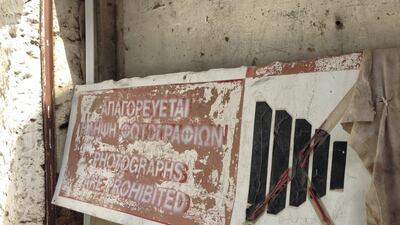
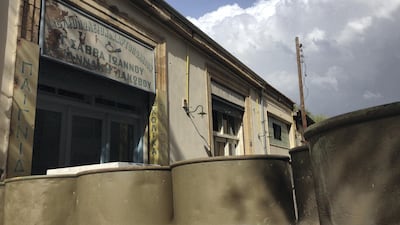
  • Nicosia in Cyprus is the last divided capital city in Europe. Today marks the date in 1983 when the Turkish Republic of Northern Cyprus declared independence, nine years after Turkish forces landed on the island. The TRNC remains unrecognised by the international community, apart from Turkey. Declan McVeigh / The National
    Nicosia in Cyprus is the last divided capital city in Europe. Today marks the date in 1983 when the Turkish Republic of Northern Cyprus declared independence, nine years after Turkish forces landed on the island. The TRNC remains unrecognised by the international community, apart from Turkey. Declan McVeigh / The National
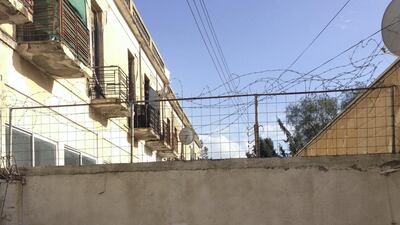
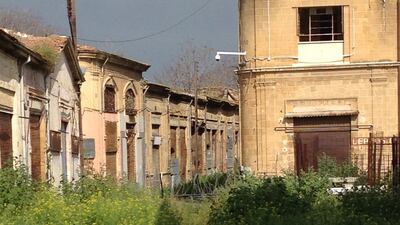
  • A shot of no-man’s-land in Nicosia from the Turkish side of the divided Cyprus capital. Declan McVeigh / The National
    A shot of no-man’s-land in Nicosia from the Turkish side of the divided Cyprus capital. Declan McVeigh / The National
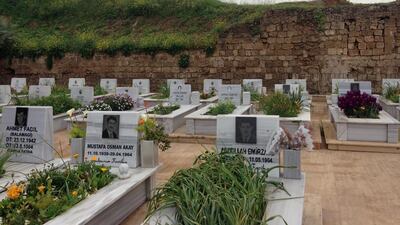
  • Turkish Cypriot graves near Famagusta on the island's east coast. Declan McVeigh / The National
    Turkish Cypriot graves near Famagusta on the island's east coast. Declan McVeigh / The National
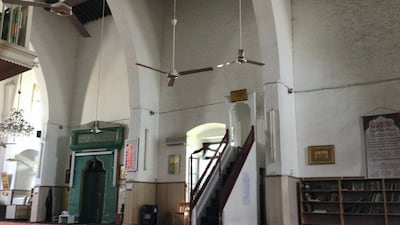
  • Omeriye Mosque is the only Muslim place of worship open on the Greek side of Nicosia. Declan McVeigh / The National
    Omeriye Mosque is the only Muslim place of worship open on the Greek side of Nicosia. Declan McVeigh / The National
  • A shot of no-man’s-land, taken from the Greek sector of Nicosia. Local people refer to this UN buffer area - established in 1964 and expanded 10 years later - as the "dead zone". Here ceasefire lines are sometimes just metres apart. Declan McVeigh / The National
    A shot of no-man’s-land, taken from the Greek sector of Nicosia. Local people refer to this UN buffer area - established in 1964 and expanded 10 years later - as the "dead zone". Here ceasefire lines are sometimes just metres apart. Declan McVeigh / The National
  • The UN's Green Line cuts 180 kilometres across the island of Cyprus and divides the capital, Nicosia, in two. Cyprus has endured this partition since 1974. Declan McVeigh / The National
    The UN's Green Line cuts 180 kilometres across the island of Cyprus and divides the capital, Nicosia, in two. Cyprus has endured this partition since 1974. Declan McVeigh / The National
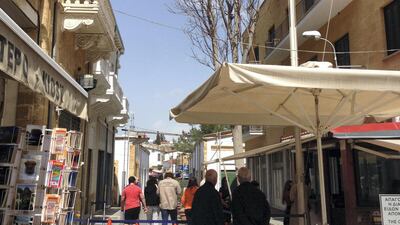
  • Ledra Street is the only foot crossing between the Turkish and Greek sectors of Nicosia. Visitors will have their passports stamped with 90-day visas by TRNC officials upon entering Northern Cyprus. There is a building nearby that acts as a watchtower for general public and tourists. Declan McVeigh / The National
    Ledra Street is the only foot crossing between the Turkish and Greek sectors of Nicosia. Visitors will have their passports stamped with 90-day visas by TRNC officials upon entering Northern Cyprus. There is a building nearby that acts as a watchtower for general public and tourists. Declan McVeigh / The National
  • Part of the UN's Green Line which cuts 180 kilometres across the island of Cyprus and divides its capital, Nicosia, in two. Visitors can walk down Nicosia's busy shopping streets, take a few turns, and be confronted by barricades dividing north from south. Declan McVeigh / The National
    Part of the UN's Green Line which cuts 180 kilometres across the island of Cyprus and divides its capital, Nicosia, in two. Visitors can walk down Nicosia's busy shopping streets, take a few turns, and be confronted by barricades dividing north from south. Declan McVeigh / The National
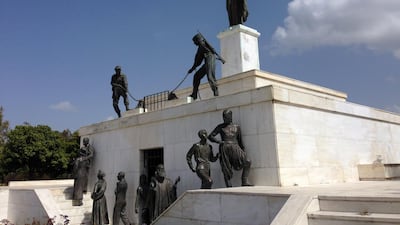
  • Nicosia is dotted with memorials to past conflicts. The 1973 Liberty Monument in the city's Greek zone honours paramilitary fighters of Ethniki Organosis Kyprion Agoniston, who fought British forces between 1955 and 1959. Declan McVeigh / The National
    Nicosia is dotted with memorials to past conflicts. The 1973 Liberty Monument in the city's Greek zone honours paramilitary fighters of Ethniki Organosis Kyprion Agoniston, who fought British forces between 1955 and 1959. Declan McVeigh / The National
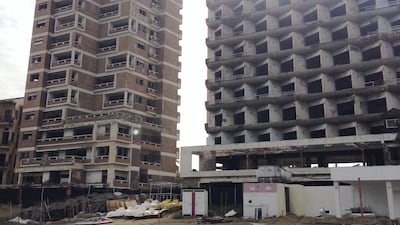
  • Famagusta beach with abandoned hotels and buildings form a 'ghost town' since Turkish forces landed on the island in 1974. Declan McVeigh / The National
    Famagusta beach with abandoned hotels and buildings form a 'ghost town' since Turkish forces landed on the island in 1974. Declan McVeigh / The National
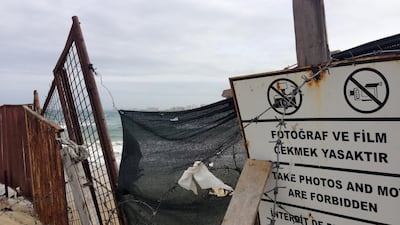
  • Much of Famagusta beach in eastern Cyprus and its ghost town remain off-limits. Turkey continues to station thousands of troops on the divided island. Declan McVeigh / The National
    Much of Famagusta beach in eastern Cyprus and its ghost town remain off-limits. Turkey continues to station thousands of troops on the divided island. Declan McVeigh / The National

Turkish Foreign Minister Mevlut Cavusoglu said the Greek Cypriot side had brought no new proposals to Geneva and had sounded "like a broken record".

He said there was "no common ground to restart negotiations", but added that Turkey would support unofficial meetings that sought to find a way through the impasse.

"There must be a new negotiations process between two states rather than two communities," Mr Cavusoglu said.

Mr Anastasiades said the Greek Cypriot side would continue to work to find a solution to reunite Cyprus based on a bi-zonal federation.

Mr Guterres said all parties would meet again in the next two or three months "with the objective to move in the direction of reaching common ground to allow for formal negotiations to start".

"We are determined to do everything we can to make this dialogue move on and to make this dialogue ... reach positive results."

Britain's Foreign Secretary Dominic Raab said he welcomed the "commitment by all sides to meet again in the near future".

Cyprus has been divided since 1974, when Turkey occupied the northern third in response to a coup orchestrated by an Athens-backed junta seeking to annex the island to Greece.


MATCH INFO

Syria v Australia
2018 World Cup qualifying: Asia fourth round play-off first leg
Venue: Hang Jebat Stadium (Malacca, Malayisa)
Kick-off: Thursday, 4.30pm (UAE)
Watch: beIN Sports HD

* Second leg in Australia scheduled for October 10

UAE currency: the story behind the money in your pockets
Ten tax points to be aware of in 2026

1. Domestic VAT refund amendments: request your refund within five years

If a business does not apply for the refund on time, they lose their credit.

2. E-invoicing in the UAE

Businesses should continue preparing for the implementation of e-invoicing in the UAE, with 2026 a preparation and transition period ahead of phased mandatory adoption. 

3. More tax audits

Tax authorities are increasingly using data already available across multiple filings to identify audit risks. 

4. More beneficial VAT and excise tax penalty regime

Tax disputes are expected to become more frequent and more structured, with clearer administrative objection and appeal processes. The UAE has adopted a new penalty regime for VAT and excise disputes, which now mirrors the penalty regime for corporate tax.

5. Greater emphasis on statutory audit

There is a greater need for the accuracy of financial statements. The International Financial Reporting Standards standards need to be strictly adhered to and, as a result, the quality of the audits will need to increase.

6. Further transfer pricing enforcement

Transfer pricing enforcement, which refers to the practice of establishing prices for internal transactions between related entities, is expected to broaden in scope. The UAE will shortly open the possibility to negotiate advance pricing agreements, or essentially rulings for transfer pricing purposes. 

7. Limited time periods for audits

Recent amendments also introduce a default five-year limitation period for tax audits and assessments, subject to specific statutory exceptions. While the standard audit and assessment period is five years, this may be extended to up to 15 years in cases involving fraud or tax evasion. 

8. Pillar 2 implementation 

Many multinational groups will begin to feel the practical effect of the Domestic Minimum Top-Up Tax (DMTT), the UAE's implementation of the OECD’s global minimum tax under Pillar 2. While the rules apply for financial years starting on or after January 1, 2025, it is 2026 that marks the transition to an operational phase.

9. Reduced compliance obligations for imported goods and services

Businesses that apply the reverse-charge mechanism for VAT purposes in the UAE may benefit from reduced compliance obligations. 

10. Substance and CbC reporting focus

Tax authorities are expected to continue strengthening the enforcement of economic substance and Country-by-Country (CbC) reporting frameworks. In the UAE, these regimes are increasingly being used as risk-assessment tools, providing tax authorities with a comprehensive view of multinational groups’ global footprints and enabling them to assess whether profits are aligned with real economic activity. 

Contributed by Thomas Vanhee and Hend Rashwan, Aurifer

David Haye record

Total fights: 32
Wins: 28
Wins by KO: 26
Losses: 4

The burning issue

The internal combustion engine is facing a watershed moment – major manufacturer Volvo is to stop producing petroleum-powered vehicles by 2021 and countries in Europe, including the UK, have vowed to ban their sale before 2040. The National takes a look at the story of one of the most successful technologies of the last 100 years and how it has impacted life in the UAE.

Read part three: the age of the electric vehicle begins

Read part two: how climate change drove the race for an alternative 

Read part one: how cars came to the UAE

How to watch Ireland v Pakistan in UAE

When: The one-off Test starts on Friday, May 11
What time: Each day’s play is scheduled to start at 2pm UAE time.
TV: The match will be broadcast on OSN Sports Cricket HD. Subscribers to the channel can also stream the action live on OSN Play.

Friday's schedule at the Etihad Airways Abu Dhabi Grand Prix

GP3 qualifying, 10:15am

Formula 2, practice 11:30am

Formula 1, first practice, 1pm

GP3 qualifying session, 3.10pm

Formula 1 second practice, 5pm

Formula 2 qualifying, 7pm

ALRAWABI%20SCHOOL%20FOR%20GIRLS
%3Cp%3ECreator%3A%20Tima%20Shomali%3C%2Fp%3E%0A%3Cp%3EStarring%3A%C2%A0Tara%20Abboud%2C%C2%A0Kira%20Yaghnam%2C%20Tara%20Atalla%3C%2Fp%3E%0A%3Cp%3ERating%3A%204%2F5%3C%2Fp%3E%0A
Sanju

Produced: Vidhu Vinod Chopra, Rajkumar Hirani

Director: Rajkumar Hirani

Cast: Ranbir Kapoor, Vicky Kaushal, Paresh Rawal, Anushka Sharma, Manish’s Koirala, Dia Mirza, Sonam Kapoor, Jim Sarbh, Boman Irani

Rating: 3.5 stars

How Islam's view of posthumous transplant surgery changed

Transplants from the deceased have been carried out in hospitals across the globe for decades, but in some countries in the Middle East, including the UAE, the practise was banned until relatively recently.

Opinion has been divided as to whether organ donations from a deceased person is permissible in Islam.

The body is viewed as sacred, during and after death, thus prohibiting cremation and tattoos.

One school of thought viewed the removal of organs after death as equally impermissible.

That view has largely changed, and among scholars and indeed many in society, to be seen as permissible to save another life.