
Police in Barcelona closed down access to a large area of the city’s beaches on Saturday after too many sunbathers ignored authorities’ request to stay at home amid a new wave of surging coronavirus infections.
Spain’s Covid-19 outbreak is one of Europe’s worst, with more than 260,00 cases and over 28,000 deaths, according to data from Johns Hopkins University.
Health authorities are trying to halt this week’s spike in cases, which has led to four million people around Barcelona being asked to stay home for 15 days.
Police blocked more people from entering the beach and used loudspeakers to recommend that the crowds already on the sand disperse because they were too closely packed and could spread the virus.
Barcelona and other areas of Spain’s northeastern Catalonia region have experienced the largest outbreaks in the country since a strict three-month nationwide lockdown ended only four weeks ago.
Catalan health authorities on Saturday reported more than 1,200 new cases – 894 in the Barcelona metropolitan area.
The new outbreaks have forced regional officials from Saturday to prohibit gatherings of over 10 people in Barcelona. Officials also urged residents of Barcelona and neighboring municipalities only leave home for work or necessary errands.
Residents of the Catalonian capital are also unable to visit nursing homes. Authorities have also moved to close nightclubs and gyms, and restrictions have been put in place on bars and restaurants, suspension of cultural activities and recreational sport.
-
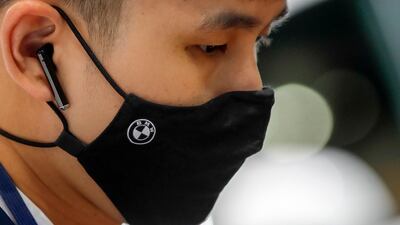
A BMW worker wears a protective face mask at the 41st Bangkok International Motor Show 2020 in Bangkok, Thailand. EPA -
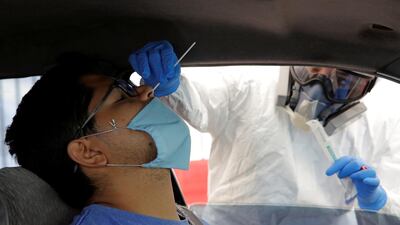
A healthcare worker collects a swab sample for Covid-19 at a drive-thru testing site in Ciudad Juarez, Mexico. Reuters -

A nurse prepares her personal protective equipment before going to the isolation ward to treat patients infected with Covid-19 in the intensive care unit at Saint Petros Hospital in Addis Ababa, Ethiopia. AFP -
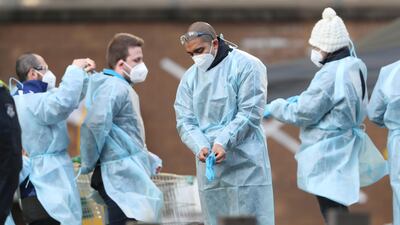
Medical workers are seen at a Government Commission tower which remains under strict lockdown in Melbourne, Australia. EPA -
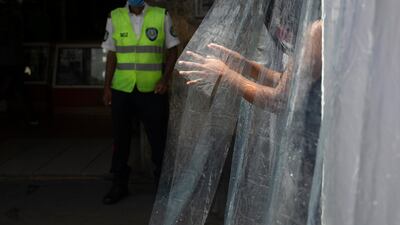
A woman wearing a protective face mask walks through a decontamination chamber in the neighborhood of Petare in Caracas, Venezuela. AP Photo -
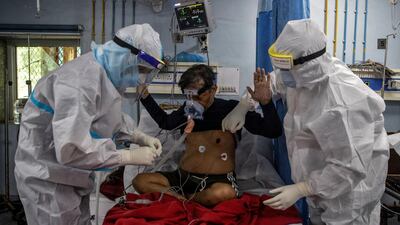
Medical workers wearing PPE tend to a patient suffering from Covid-19 in the ICU at Lok Nayak Jai Prakash hospital, in New Delhi, India. Reuters -
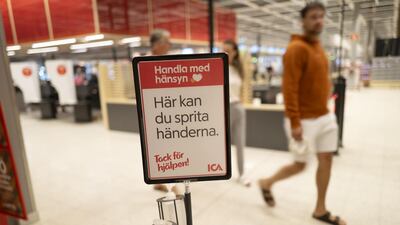
Hand sanitisers are placed in the aisles of a supermarket in Gotland, Sweden. Getty Images -
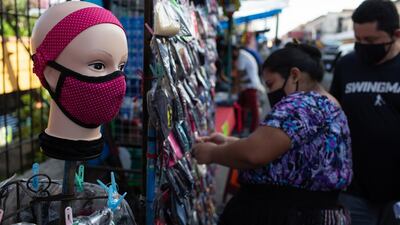
People wearing protective masks sell masks outside the Central Market in Guatemala City, Guatemala. Bloomberg -

Brianda Mendivil and Christian Reyes wear face masks as they are married by Jacob Jurado in front of of Griffith Observatory in Los Angeles, California, USA. AFP -
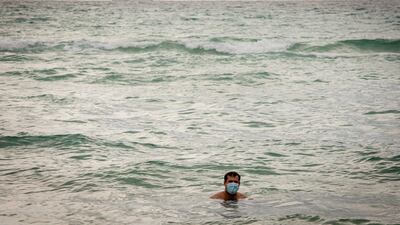
A person wears a protective mask while swimming in the ocean at a beach in Miami Beach, Florida, USA. Bloomberg -
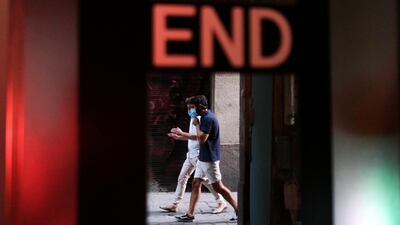
Men wearing face masks are reflected in a mirror, after Catalonia's regional authorities and the city council announced restrictions to contain the spread of the Covid-19 in Barcelona, Spain. Reuters


Spanish Health Minister Salvador Illa urged Barcelona residents to follow the guidelines issued by the regional Catalan authorities.
The mandatory use of face masks is rapidly spreading across Spain as officials grapple with more than 180 active outbreaks, most of them in Catalonia and the neighboring Aragon region.
New French Prime Minister Jean Castex is reviewing the situation in Catalonia “closely” and is mulling closing borders with Spain after new outbreaks have been reported. More than 30,000 people in France have died of Covid-19.
Overall, Europe has seen over 199,000 virus deaths, according to a tally by Johns Hopkins University. The true number is higher than that, due to limited testing and other reasons.

