

Charities are being hard hit by the Covid-19 lockdown with directors warning the bodies need help to survive before the pandemic is brought under control.
Sector experts warn that hardly any UK charity will come out of the coronavirus lockdown unscathed.
Almost £4 billion has been wiped from charity fundraising, according to early estimates.
Daniel Fluskey, head of Policy and External Affairs at The Institute of Fundraising NCVO, said: "There may be some individuals that have success but no charity will be unscathed.
"Most charities see approaching a huge financial hole and anything raised is mitigation against that."

The Institute of Fundraising is the professional membership body for UK charitable giving. It has more than 600 organisational members who raise more than £10 billion in income for good causes annually.
Key funding closed
As coronavirus sweeps the country some charities are in the front line of health care using resources.
Others are losing employed staff and volunteers as the country begins another three weeks of lockdown.
Other charities will be needed after the pandemic to help in a country that is likely very different from what it was before the pandemic.
Pretty much every charity is losing support from volunteers who cannot leave their homes or making employees redundant. They have also seen fundraising efforts have ground to a near-halt.

The Charity Commission says it is working with organisations to try to be flexible as they face the unprecedented difficulties of operating in a pandemic.
Mr Fluskey said: “The main areas for charities are closed, from local shops where doors are shut to big events like the London marathon or the Great North Run.
“The cancellations of these events will have put a big hole in the charity reserves.
“It’s not just the fundraising on the day. It’s also the ability to build up a relationship with fundraisers and get them to become regular givers.
“On top of that, community events in local areas are on hold everywhere once the lockdown happened.
“Some are trying virtual events but it is an exercise in mitigation rather than getting sums of money in."
Charities are 'fundamental'
Despite high profile success stories like Captain Tom Moore’s inspirational £20 million fundraiser from his back garden, the charity world is reeling.
-

FRANCE: In this handout photo provided by the National Orchestra of France on April 1, 2020, musicians are shown in the screenshot as a patchwork, each performing parts of "Bolero" alone in lockdown. National Orchestra of France via AP -

NETHERLANDS: A salesperson in a converted ice cream parlour, sells his FFP2 face masks at 9 euros a piece, or 3 for 25 euros, as protection against the coronavirus in Amsterdam, on April 19, 2020. AP Photo -

BELGIUM: Customers wait in line outside a Brico hardware store in Brussels, on April 18, 2020, on the first day of it's re-opening. From April 18, onwards gardening and hardware stores are allowed to receive costumers, as Belgium is in its fifth week of lockdown to stop the spread of coronavirus. AFP -

LITHUANIA: A dog looks at cats through the window of the "Cat Cafe" which remains closed in Vilnius, Lithuania on April 19, 2020. In Lithuania, cafes and restaurants were closed to limit the spread of coronavirus. AFP -

SLOVENIA: People ride their bicycles as a photograph by local photographer Ciril Jazbec is projected on a facade in Ljubljana on April 16, 2020, amid the outbreak of coronavirus. Galleries are closed due to the outbreak, so a group of photographers decided to exhibit their works in a slideshow projected on facades and other public spaces. AFP -
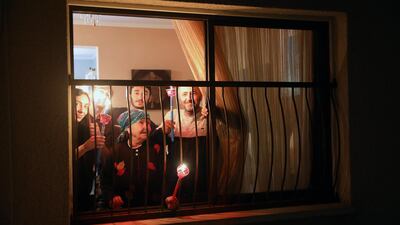
CYPRUS: A family hold lighten candles symbolizing the Holy Light at the window of their apartment, as people are not allowed to attend the Orthodox Easter midnight mass, in Nicosia, on April 19, 2020. EPA -

CROATIA: Two girls watch online on their computer streaming live a global concert 'One World Together at home' in Zagreb, on April 18, 2020. EPA -

GERMANY: People hold a banner reading: "Everything prohibited except working" as they protest for the evacuation of refugees from camps in Greece, as the spread of coronavirus continues in Berlin, on April 19, 2020. Reuters -

FINLAND: Violinist Teppo Ali-Mattila performs in an empty concert hall during the coronavirus outbreak, in Helsinki, on April 14, 2020. Reuters -

SWEDEN: Erik Nyrenius during a training session with his football team in Lerum, Sweden, on April 18, 2020. Sweden has adopted more relaxed measures in response to the coronavirus outbreak in comparison to other areas of the EU. EPA -

ITALY: Migrants are being transferred form the NGO boat Aita Mari to the Italian ship Rubattino, to be quarantined because of the coronavirus outbreak, off the coast of Palermo, on April 19, 2020. Reuters -
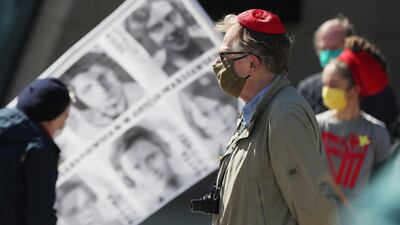
POLAND: A man wears a face mask in Warsaw, on April 19, 2020, during an anniversary ceremony for the ill-fated struggle of the 1943 Warsaw Ghetto Uprising. AP Photo -

SPAIN: A handout photo from the Spanish Government showing Spanish Health Minister Salvador Illa speaking during a press conference at Moncloa Presidential Palace in Madrid on April 19, 2020. EPA -
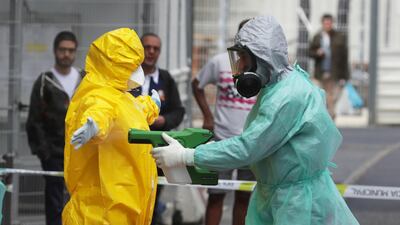
PORTUGAL: Members of the National Institute for Medical Emergency and the Public Security Police (PSP) conduct an evacuation operation at a hostel in Lisbon, on April 19, 2020. EPA -

FRANCE: The Ukrainian Antonov An-225 Mriya aeroplane lands at Paris-Vatry airport from China to deliver 8,6 million face masks and 150 tonnes of sanitary equipment ordered by a private customer, in Bussy Lettree, on April 19, 2020. AFP


The £4 billion estimated lost revenue includes income from big annual events like the London Marathon as well as the small weekly community events, sales in now closed shops and corporate sponsorship.
Mr Fluskey said that charities are coming up with virtual fundraisers and innovative online events but it is a drop in the ocean to the lost millions.
He said government needs to step in to help the charity world.
Mr Fluskey said he is hoping the £750 million already promised to the sector will be increased to a billion-pound-plus, and change to some laws that prevent charities taking on as volunteers people they have made redundant.
He also said the funding needs to be in place so that charities can survive the economic crisis of the pandemic and be able to offer their services in the post-pandemic environment.
That will , he says, include a nation in recession, more unemployment, and less security as the fallout of the outbreak.
“Nobody is expecting the charity sector to sail through this unscathed. We are in crisis [but] charities are a fundamental part of our society, not just a nice idea.”

