Alone in the city? Maybe not, but post-Covid changes are coming


  • English
  • Arabic

When Marcello Duarte joined BT in April as lead agile coach he was, like many professionals, forced to work from home.

This week, he had his first day in the office at the telecom giant’s central London HQ, and was met by the sound of silence, the tapping on his laptop audible in the atrium of the near-empty glass-roofed building.

His experience is similar to that of many workers creeping back to headquarters as companies work out how they will operate in a post-covid world.

As well as short-term measures such as one-way systems, room limits and the persistent aroma of hand sanitiser, businesses are wrestling with more long-term considerations.

Allowing staff to continue working from home, downsizing premises, or relocating entirely are all up for grabs.

So, what will change?

The workplace

While home-working was a necessity, seen as mostly successful across the board, negative effects are now being felt by many, no matter how much staff protest a return to the office.

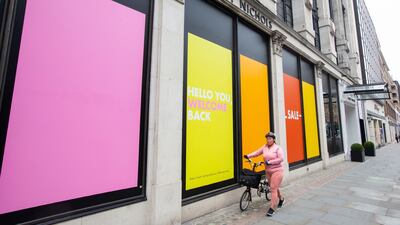
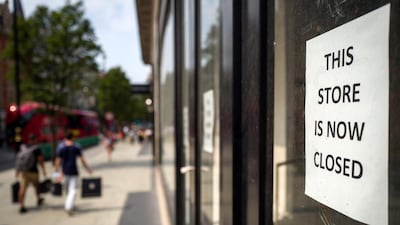
  • A shuttered Harvey Nichols in London Knightsbridge. Mark Chilvers for The National
    A shuttered Harvey Nichols in London Knightsbridge. Mark Chilvers for The National
  • A lone commuter on an empty street in Canary Wharf, London, as workers are being encouraged to return to their offices, with a Government PR blitz commencing this week reminding people about the efforts taken to make workplaces "Covid-secure"
    A lone commuter on an empty street in Canary Wharf, London, as workers are being encouraged to return to their offices, with a Government PR blitz commencing this week reminding people about the efforts taken to make workplaces "Covid-secure"
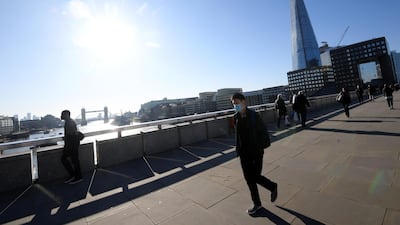
  • Commuters walk over London bridge during the morning rush hour, as the spread of the coronavirus disease (COVID-19) continues, in London. Reuters
    Commuters walk over London bridge during the morning rush hour, as the spread of the coronavirus disease (COVID-19) continues, in London. Reuters
  • Empty shelves from a Sainsbury's supermarket in London, UK, as shoppers in the British capital stockpile goods in advance of strict lockdown measures to fight coronavirus. Emma Sky for The National
    Empty shelves from a Sainsbury's supermarket in London, UK, as shoppers in the British capital stockpile goods in advance of strict lockdown measures to fight coronavirus. Emma Sky for The National
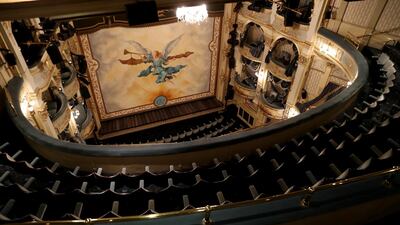
  • Empty seats at London's Wyndham's Theatre. London's theatre district has been dealt a blow by the coronavirus crisis. Getty Images
    Empty seats at London's Wyndham's Theatre. London's theatre district has been dealt a blow by the coronavirus crisis. Getty Images
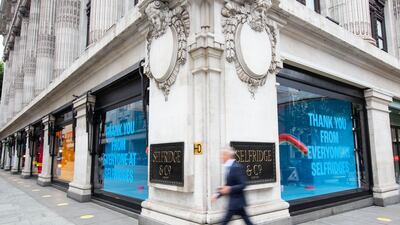
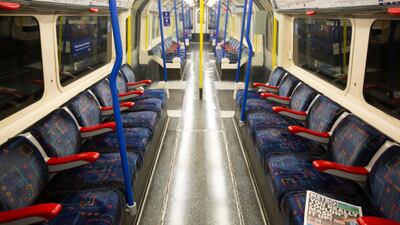
  • The London underground is still much less busy following the coronavirus lockdown. Selfridges on Oxford Street popular with international shoppers. Mark Chilvers for The National
    The London underground is still much less busy following the coronavirus lockdown. Selfridges on Oxford Street popular with international shoppers. Mark Chilvers for The National
  • European cities, including London, are home to Muslim immigrants from all over the world. Mark Chilvers for The National
    European cities, including London, are home to Muslim immigrants from all over the world. Mark Chilvers for The National
  • The London underground is still much less busy following the coronavirus lockdown. Mark Chilvers for The National
    The London underground is still much less busy following the coronavirus lockdown. Mark Chilvers for The National
  • An empty bus is driven through the quiet streets outside the Bank of England in the early hours, as lockdown continues in London. Reuters
    An empty bus is driven through the quiet streets outside the Bank of England in the early hours, as lockdown continues in London. Reuters
  • A cyclist passes St Paul's Cathedral in London as life in Britain continues over the Easter weekend, during the nationwide lockdown to combat the novel coronavirus pandemic. AFP
    A cyclist passes St Paul's Cathedral in London as life in Britain continues over the Easter weekend, during the nationwide lockdown to combat the novel coronavirus pandemic. AFP
  • Stay-at-home orders wiped out 20 per cent of the British economy in the first half of 2020. AFP
    Stay-at-home orders wiped out 20 per cent of the British economy in the first half of 2020. AFP
  • The City of London has become a much emptier place since the Covid-19 pandemic started. Reuters
    The City of London has become a much emptier place since the Covid-19 pandemic started. Reuters

The initial surge in energy seen when people were first dispatched to their home office has lapsed, according to Ruth Penfold of BP’s business-builder Launchpad. There is, she points out, a degree of video-calling fatigue.

There is also the issue of productivity. The US’s biggest bank, JP Morgan Chase, found younger employees’ productivity dropped on Mondays and Fridays and has now ordered senior staff back to base with other workers encouraged to return.

Barclays bank chief executive Jes Staley wants his employees back, but has also conceded that flexible working locations could become the norm.

Industry giants such as Facebook and Google have already signalled that they believe some form of working from home will become commonplace.

Google's European headquarters in Dublin, Ireland. AFP

Catherine McGuiness, the City of London’s policy chief, expects some of the patterns of working that have been developing to continue.

She expects people to work from home two or three days a week then come into the office for the other days, but use it more for get-togethers and meetings.

“That’s what we’re hearing and what we’re expecting,” she said. “We are very confident from the signals we’re hearing that people still want to continue coming into a central place.”

Catherine McGuinness, Chairman of the Policy and Resources Committee of the City of London Corporation, expects some of the patterns of working that have been developing to continue. REUTERS

Office space

Professor David Burney, who served as the commissioner of New York City’s department of design and construction when Michael Bloomberg was mayor, says that even when a Covid-19 vaccine comes, some of the changes that have been brought in during 2020 will not necessarily disappear.

"One of them is the whole issue of will you need offices at all and this is just the pandemic exacerbating a trend that was already underway," he told The National.

“There are obviously times when you want a face to face. I can see office design changing from a series of cubicles to really a series of conference rooms.”

Savvy entrepreneurs were already thinking long-term.

A startup called Homework has positioned itself as an incubator of working from home, pitching itself as a firm that can create an office-like set up in people’s homes. They point out that you wouldn’t sit with a laptop on your knees for eight hours in the office, so you shouldn’t at home.

Prof Burney added: “Businesses already have the bug of homeworking, they’ve had a taster of it this summer and realised that – maybe not 100 per cent shift to home working – but there’s certainly financial gains to be made.”

Architecture and construction

Amanda Levete, a Stirling-prize winning British architect and principal of AL A, told the BBC’s Rethink programme that cities must change.

“Offices have traditionally been erected with no thought for whomever is inside them or even the institution; the only consideration has been the developer and profit,” she said.

“The workplace needs to move away from monolithic faceless blocks where you don’t know who is working there or what they do. It’s important that whatever we design responds to the geography of the place.

Architect Amanda Levete speaks in Lisbon on October 3, 2016. AFP

"The pandemic has brought to the fore how important nature is,” Ms Levete said. “We have to meet in person but we don’t need to come together all the time. Otherwise we are just teams working on projects, we are not an office.”

Impact

In London, despite a government campaign to persuade people it's safe to return to the office and the much-maligned rail network now running at 90 per cent normal service, the city remains far from capacity. According to a survey by Morgan Stanley in August, just 34 per cent of UK employees had returned to their offices, lower than European levels. Three-quarters trooped in in Germany and elsewhere while in France it was as high as 83 per cent.

There are green shoots. London business owner Joao Rocha, who feared his corporate flower and Christmas tree business, Storm Flowers, would not survive the pandemic, has noticed signs of recovery. "There were offices with 1,000 staff that reduced to 60 key people or less so they didn't need flowers in reception," said Mr Rocha. In response, he created a line of desk plants that companies could send to staff at home as a motivational tool. Now, he has noticed slightly more activity in Central London offices.

Joao Rocha, owner of Storm Flowers London. Rob Greig for The National

He said: “In early August, we saw people start mentioning going back to the office. It got to the point where people wanted a change of scene.”

Many businesses have already been forced into action.

Lloyds Banking Group is reviewing its office space and among those reportedly mulling selling up are BP from its £300m London headquarters and British American Tobacco from its eight-storey £250m base in Westminster.

The uncertainty over the future suggests a chaotic few years. Indeed, the world is on the cusp of a new era that will be characterised initially by disorder, according to Deutsche Bank’s Long-Term Asset Return Study 2020.

It argues that 2020 marks the beginning of a new “structural super-cycle” of the kind that “shapes everything from economies to asset prices, politics, and our general way of life. The team, led by strategist Jim Reid, predict an “Age of Disorder” – which is hastened, but not caused by, the coronavirus.

They highlight how big cities have been major winners in the globalisation era, but this could now change. 
"Will this trend reverse post-Covid? If it does, this will have a major disorderly impact on society as we currently know it," the report said. "It will also have major implications for cities, transport, residential and commercial property, workers and many ancillary sectors and general activities we've taken for granted over the last several decades."

Cities are still standing because they provide possibilities, options, ways of surviving and eating, and being with others. Why should they not exist?

At a panel discussion on the future of work during London Tech Week last week, Adam Sweetman of Intel described the pandemic as a “catalytic event”. As businesses consider restructuring, the question, he said, is whether work culture can catch up quickly enough to match expectation. Requests he has received from staff wishing to relocate to Barbados may take some mulling over.

He added: "If this is an opportunity to decentralise hotspots of cost and talent, we will be looking at the opportunities that presents. Our real estate planners are very excited about the possibilities given cheaper office space.

“But the process of change is years. This is a long road.”

However, Saskia Sassen, author of The Global City, believes that cities will still thrive, regardless of changing patterns. “Cities are still standing because they provide possibilities, options, ways of surviving and eating, and being with others. Why should they not exist?”

She says the interconnectivity of city life means there is a “survival option”. Out of the city, “By God, you’re alone.”


Profile of Bitex UAE

Date of launch: November 2018

Founder: Monark Modi

Based: Business Bay, Dubai

Sector: Financial services

Size: Eight employees

Investors: Self-funded to date with $1m of personal savings

David Haye record

Total fights: 32
Wins: 28
Wins by KO: 26
Losses: 4

MATCH INFO

Tottenham Hotspur 1
Kane (50')

Newcastle United 0

Porsche Taycan Turbo specs

Engine: Two permanent-magnet synchronous AC motors

Transmission: two-speed

Power: 671hp

Torque: 1050Nm

Range: 450km

Price: Dh601,800

On sale: now

Globalization and its Discontents Revisited
Joseph E. Stiglitz
W. W. Norton & Company

Ten tax points to be aware of in 2026

1. Domestic VAT refund amendments: request your refund within five years

If a business does not apply for the refund on time, they lose their credit.

2. E-invoicing in the UAE

Businesses should continue preparing for the implementation of e-invoicing in the UAE, with 2026 a preparation and transition period ahead of phased mandatory adoption. 

3. More tax audits

Tax authorities are increasingly using data already available across multiple filings to identify audit risks. 

4. More beneficial VAT and excise tax penalty regime

Tax disputes are expected to become more frequent and more structured, with clearer administrative objection and appeal processes. The UAE has adopted a new penalty regime for VAT and excise disputes, which now mirrors the penalty regime for corporate tax.

5. Greater emphasis on statutory audit

There is a greater need for the accuracy of financial statements. The International Financial Reporting Standards standards need to be strictly adhered to and, as a result, the quality of the audits will need to increase.

6. Further transfer pricing enforcement

Transfer pricing enforcement, which refers to the practice of establishing prices for internal transactions between related entities, is expected to broaden in scope. The UAE will shortly open the possibility to negotiate advance pricing agreements, or essentially rulings for transfer pricing purposes. 

7. Limited time periods for audits

Recent amendments also introduce a default five-year limitation period for tax audits and assessments, subject to specific statutory exceptions. While the standard audit and assessment period is five years, this may be extended to up to 15 years in cases involving fraud or tax evasion. 

8. Pillar 2 implementation 

Many multinational groups will begin to feel the practical effect of the Domestic Minimum Top-Up Tax (DMTT), the UAE's implementation of the OECD’s global minimum tax under Pillar 2. While the rules apply for financial years starting on or after January 1, 2025, it is 2026 that marks the transition to an operational phase.

9. Reduced compliance obligations for imported goods and services

Businesses that apply the reverse-charge mechanism for VAT purposes in the UAE may benefit from reduced compliance obligations. 

10. Substance and CbC reporting focus

Tax authorities are expected to continue strengthening the enforcement of economic substance and Country-by-Country (CbC) reporting frameworks. In the UAE, these regimes are increasingly being used as risk-assessment tools, providing tax authorities with a comprehensive view of multinational groups’ global footprints and enabling them to assess whether profits are aligned with real economic activity. 

Contributed by Thomas Vanhee and Hend Rashwan, Aurifer

COMPANY%20PROFILE
%3Cp%3E%3Cstrong%3EName%3A%20%3C%2Fstrong%3EEjari%3Cbr%3E%3Cstrong%3EBased%3A%20%3C%2Fstrong%3ERiyadh%2C%20Saudi%20Arabia%3Cbr%3E%3Cstrong%3EFounders%3A%20%3C%2Fstrong%3EYazeed%20Al%20Shamsi%2C%20Fahad%20Albedah%2C%20Mohammed%20Alkhelewy%20and%20Khalid%20Almunif%3Cbr%3E%3Cstrong%3ESector%3A%20%3C%2Fstrong%3EPropTech%3Cbr%3E%3Cstrong%3ETotal%20funding%3A%20%3C%2Fstrong%3E%241%20million%3Cbr%3E%3Cstrong%3EInvestors%3A%20%3C%2Fstrong%3ESanabil%20500%20Mena%2C%20Hambro%20Perks'%20Oryx%20Fund%20and%20angel%20investors%3Cbr%3E%3Cstrong%3ENumber%20of%20employees%3A%20%3C%2Fstrong%3E8%3C%2Fp%3E%0A

Various Artists 
Habibi Funk: An Eclectic Selection Of Music From The Arab World (Habibi Funk)
​​​​​​​

The five pillars of Islam

1. Fasting

2. Prayer

3. Hajj

4. Shahada

5. Zakat 

Sarfira

Director: Sudha Kongara Prasad

Starring: Akshay Kumar, Radhika Madan, Paresh Rawal 

Rating: 2/5

Libya's Gold

UN Panel of Experts found regime secretly sold a fifth of the country's gold reserves. 

The panel’s 2017 report followed a trail to West Africa where large sums of cash and gold were hidden by Abdullah Al Senussi, Qaddafi’s former intelligence chief, in 2011.

Cases filled with cash that was said to amount to $560m in 100 dollar notes, that was kept by a group of Libyans in Ouagadougou, Burkina Faso.

A second stash was said to have been held in Accra, Ghana, inside boxes at the local offices of an international human rights organisation based in France.

How to apply for a drone permit
  • Individuals must register on UAE Drone app or website using their UAE Pass
  • Add all their personal details, including name, nationality, passport number, Emiratis ID, email and phone number
  • Upload the training certificate from a centre accredited by the GCAA
  • Submit their request
What are the regulations?
  • Fly it within visual line of sight
  • Never over populated areas
  • Ensure maximum flying height of 400 feet (122 metres) above ground level is not crossed
  • Users must avoid flying over restricted areas listed on the UAE Drone app
  • Only fly the drone during the day, and never at night
  • Should have a live feed of the drone flight
  • Drones must weigh 5 kg or less
The specs

Engine: 2.0-litre 4cyl turbo

Power: 261hp at 5,500rpm

Torque: 405Nm at 1,750-3,500rpm

Transmission: 9-speed auto

Fuel consumption: 6.9L/100km

On sale: Now

Price: From Dh117,059

Griselda
%3Cp%3E%3Cstrong%3EDirector%3A%3C%2Fstrong%3E%C2%A0Andr%C3%A9s%20Baiz%3C%2Fp%3E%0A%3Cp%3E%3Cstrong%3EStarring%3A%C2%A0%3C%2Fstrong%3ESof%C3%ADa%20Vergara%2C%20Alberto%20Guerra%2C%20Juliana%20Aiden%20Martinez%3C%2Fp%3E%0A%3Cp%3E%3Cstrong%3ERating%3A%3C%2Fstrong%3E%204%2F5%3C%2Fp%3E%0A
Defence review at a glance

• Increase defence spending to 2.5% of GDP by 2027 but given “turbulent times it may be necessary to go faster”

• Prioritise a shift towards working with AI and autonomous systems

• Invest in the resilience of military space systems.

• Number of active reserves should be increased by 20%

• More F-35 fighter jets required in the next decade

• New “hybrid Navy” with AUKUS submarines and autonomous vessels

Ferrari 12Cilindri specs

Engine: naturally aspirated 6.5-liter V12

Power: 819hp

Torque: 678Nm at 7,250rpm

Price: From Dh1,700,000

Available: Now

South Africa squad

Faf du Plessis (captain), Hashim Amla, Temba Bavuma, Quinton de Kock (wicketkeeper), Theunis de Bruyn, AB de Villiers, Dean Elgar, Heinrich Klaasen (wicketkeeper), Keshav Maharaj, Aiden Markram, Morne Morkel, Wiaan Mulder, Lungi Ngidi, Vernon Philander and Kagiso Rabada.