• A panoramic view of the Horsehead Nebula, captured by the European Space Agency's Euclid telescope. All photos: AP
    A panoramic view of the Horsehead Nebula, captured by the European Space Agency's Euclid telescope. All photos: AP
  • Euclid’s view of the spiral galaxy IC 342, nicknamed the 'hidden galaxy'
    Euclid’s view of the spiral galaxy IC 342, nicknamed the 'hidden galaxy'
  • One thousand galaxies belong to the Perseus Cluster
    One thousand galaxies belong to the Perseus Cluster
  • The irregular dwarf galaxy called NGC 6822 is 1.6 million light-years from Earth
    The irregular dwarf galaxy called NGC 6822 is 1.6 million light-years from Earth
  • Located about 7,800 light-years from Earth, NGC 6397 is the second-closest globular cluster to us
    Located about 7,800 light-years from Earth, NGC 6397 is the second-closest globular cluster to us

First spectacular images released from Euclid telescope


Simon Rushton
  • English
  • Arabic

Spectacular images from the Euclid space telescope, including the Horsehead Nebula and a hidden galaxy, have been released for the first time.

There are five images, described by Euclid scientist Jean-Charles Cuillandre, as “a range of objects from the galactic zoo in terms of diversity, colours and shapes”.

Some of the locations have been seen before but Euclid provides better quality “razor-sharp astronomical images across such a large patch of the sky, and looking so far into the distant universe,” the European Space Agency (ESA) said.

The images spanned four areas of the relatively nearby universe, including 1,000 galaxies belonging to the massive Perseus cluster, about 240 million light-years away, and more than 100,000 galaxies spread out in the background, the ESA said.

Scientists believe vast, seemingly organised structures such as Perseus could only have formed if dark matter exists.

“We think we understand only 5 per cent of the universe: that's the matter that we can see,” ESA's science director Carole Mundell said.

The telescope snapped pictures of a relatively close spiral galaxy that is a ringer for our own Milky Way.

Euclid also took fresh photos of the Horsehead Nebula in the constellation Orion, a dramatic nursery of baby stars made famous by Hubble.

The main control room at the European Space Operations Centre in Darmstadt, Germany. EPA

The Horsehead Nebula – also known as Barnard 33 – is 1,375 light-years away. The horse's head is formed from clouds in front of ultraviolet radiation.

Scientists hope that by scouring through Euclid's observations of the nebula, they will find previously unseen Jupiter-sized planets, as well as stars still in their infancy.

There is also an image of spiral galaxy IC 342, nicknamed the “hidden galaxy”, because it can be difficult to spot behind the disc of our own Milky Way.

It is relatively near, in galactic terms at least, at 11 million light-years from Earth.

Euclid's infrared vision was able to peer through the dust to spot never-before-seen globular clusters, ESA said.

Launched in July, Euclid orbits the sun at about 1.6km from Earth. The telescope is named after the mathematician of ancient Greece.

Image from James Webb space telescope

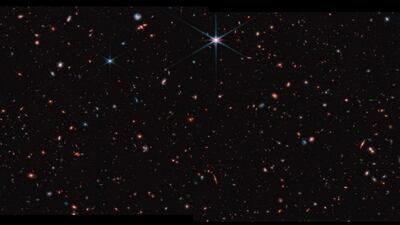
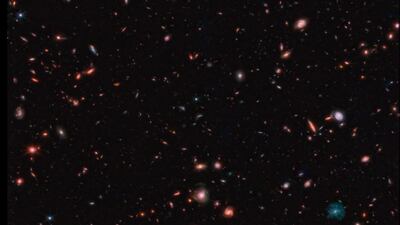
  • An enormous colour mosaic made up of images captured by the James Webb Space Telescope has been released. This image shows only a small part of the mosiac. All photos: Nasa
    An enormous colour mosaic made up of images captured by the James Webb Space Telescope has been released. This image shows only a small part of the mosiac. All photos: Nasa
  • The mosaic is made up 690 individual frames taken with the telescope’s near infrared camera – an instrument that captures radiant energy from objects invisible to the human eye.
    The mosaic is made up 690 individual frames taken with the telescope’s near infrared camera – an instrument that captures radiant energy from objects invisible to the human eye.
  • Collectively known as Epoch 1, the image is the largest one yet made using data from the world’s largest space observatory.
    Collectively known as Epoch 1, the image is the largest one yet made using data from the world’s largest space observatory.
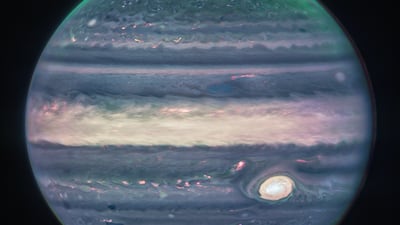
  • Jupiter as seen by the James Webb telescope.
    Jupiter as seen by the James Webb telescope.
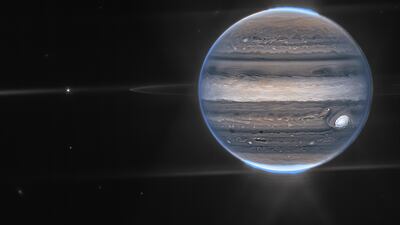
  • The James Webb telescope captures Jupiter.
    The James Webb telescope captures Jupiter.
PROFILE OF INVYGO

Started: 2018

Founders: Eslam Hussein and Pulkit Ganjoo

Based: Dubai

Sector: Transport

Size: 9 employees

Investment: $1,275,000

Investors: Class 5 Global, Equitrust, Gulf Islamic Investments, Kairos K50 and William Zeqiri

Living in...

This article is part of a guide on where to live in the UAE. Our reporters will profile some of the country’s most desirable districts, provide an estimate of rental prices and introduce you to some of the residents who call each area home. 

The five new places of worship

Church of South Indian Parish

St Andrew's Church Mussaffah branch

St Andrew's Church Al Ain branch

St John's Baptist Church, Ruwais

Church of the Virgin Mary and St Paul the Apostle, Ruwais


'Unrivaled: Why America Will Remain the World’s Sole Superpower'
Michael Beckley, Cornell Press

Infiniti QX80 specs

Engine: twin-turbocharged 3.5-liter V6

Power: 450hp

Torque: 700Nm

Price: From Dh450,000, Autograph model from Dh510,000

Available: Now

Updated: November 07, 2023, 3:11 PM