Iran's supreme leader Ayatollah Ali Khamenei visits an exhibition of the country's nuclear achievements in Tehran. Office of the Iranian Supreme Leader / AP

Europe to maintain Iran sanctions beyond October deadline


  • English
  • Arabic

UN sanctions on Iran that were due to be lifted in October are being extended beyond the deadline set by the Joint Comprehensive Plan of Action, the UK government and the EU announced on Thursday.

The UK, France and Germany are set to transfer UN sanctions on Iran into domestic law, as the regime is breaching commitments under the deal and advancing its nuclear programme “beyond all credible civilian justification”.

The sanctions, which were due to lift on October 18, include curbs on people and businesses involved in Iran’s missile, nuclear and other weapons programmes.

“Iran continues to breach its commitments under the JCPOA and advance its nuclear programme beyond all credible civilian justification,” a representative for the UK Foreign Office said.

“Alongside our French and German partners, we have taken a legitimate and proportionate step in response to Iran’s actions.

“The UK and our partners remain committed to a diplomatic solution but Iran must now take clear steps towards de-escalation.

“We are committed to preventing Iran from developing nuclear weapons.”

Iran's nuclear programme – in pictures

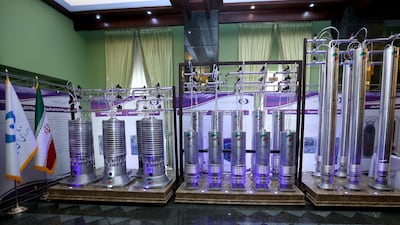
  • New generation Iranian centrifuges on display for Iran's National Nuclear Energy Day in Tehran, in April 2021. Iranian Presidency Office / Wana
    New generation Iranian centrifuges on display for Iran's National Nuclear Energy Day in Tehran, in April 2021. Iranian Presidency Office / Wana
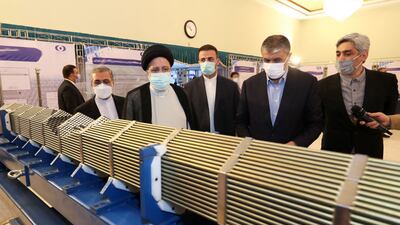
  • President Ebrahim Raisi, second right, is accompanied by Atomic Energy Organisation of Iran chief Mohammad Eslami, at Nuclear Technology Day in Tehran in April 2022. Iranian presidency / AFP
    President Ebrahim Raisi, second right, is accompanied by Atomic Energy Organisation of Iran chief Mohammad Eslami, at Nuclear Technology Day in Tehran in April 2022. Iranian presidency / AFP
  • Mr Raisi and Mr Eslami at the April 2022 event. Iranian presidency / AFP
    Mr Raisi and Mr Eslami at the April 2022 event. Iranian presidency / AFP
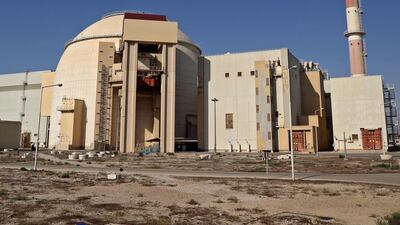
  • The Bushehr Nuclear Power Plant during a visit by Mr Raisi in October 2021. Iranian Presidency / AFP
    The Bushehr Nuclear Power Plant during a visit by Mr Raisi in October 2021. Iranian Presidency / AFP
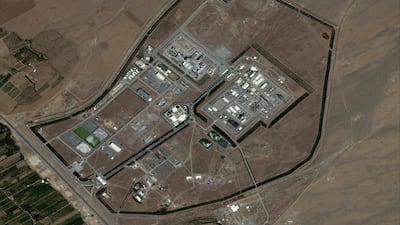
  • Iran's Arak Heavy Water Reactor complex, south of the capital Tehran in January 2020. Maxar Technologies / AFP
    Iran's Arak Heavy Water Reactor complex, south of the capital Tehran in January 2020. Maxar Technologies / AFP
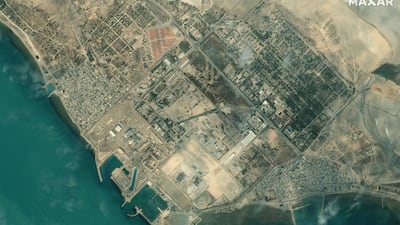
  • A satellite image of Iran's Bushehr Nuclear Power Plant in January 2020. Maxar Technologies / AFP
    A satellite image of Iran's Bushehr Nuclear Power Plant in January 2020. Maxar Technologies / AFP
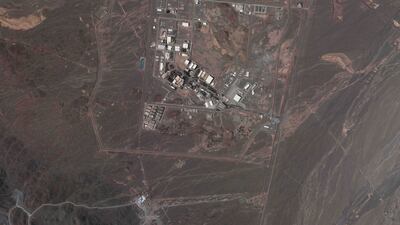
  • A satellite image of Iran's underground Natanz nuclear site in May 2022. Planet Labs PBC / AP
    A satellite image of Iran's underground Natanz nuclear site in May 2022. Planet Labs PBC / AP
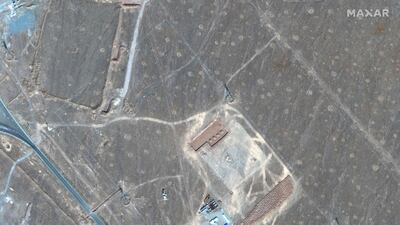
  • A satellite image in January 2020 of Iran's Fordow Fuel Enrichment Plant, north-east of the city of Qom. Maxar Technologies / AFP
    A satellite image in January 2020 of Iran's Fordow Fuel Enrichment Plant, north-east of the city of Qom. Maxar Technologies / AFP
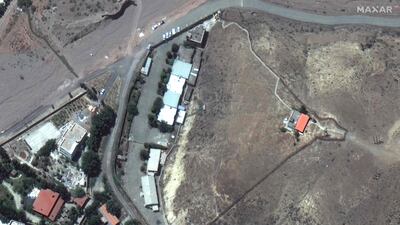
  • The Sanjarian nuclear centre, east of Tehran, in May 2021. Maxar Technologies / AFP
    The Sanjarian nuclear centre, east of Tehran, in May 2021. Maxar Technologies / AFP

The countries believe Iran’s enriched uranium stockpiles are more than 18 times the JCPOA limit, and it has built and deployed thousands of advanced centrifuges.

Iran has been offered viable deals that would have defused the nuclear issue, but the regime consistently declined, the UK government said.

The UK, France and Germany began the JCPOA’s Dispute Resolution Mechanism in January 2020 in response to Iranian non-compliance to try to find a solution.

The process is supposed to allow 30 days to resolve outstanding issues, but it has now been more than three and a half years and Iran remains out of compliance, the UK government said in a statement.

An EU representative said details of the developments had been passed to the other JCPOA participants and that they would be consulted on how to proceed.

'Transition Day' a far way off for Iran

Keeping the sanctions would reflect western efforts to prevent Iran from developing nuclear weapons and the means to deliver them despite the collapse of the 2015 deal, which then-US president Donald Trump abandoned in 2018.

The JCPOA envisaged a “Transition Day” eight years later, when remaining ballistic missile and nuclear-related sanctions on Iran would be lifted.

The crux of the agreement, which Iran made with Britain, China, France, Germany, Russia and the US, limited the regime’s nuclear programme, making it harder for it to get fissile material for a bomb in return for relief from economic sanctions.

As a result of Mr Trump’s withdrawal from the deal and US President Joe Biden’s failure to revive it, Iran could make the fissile material for one bomb in about 12 days, according to US estimates, down from a year when the accord was in force.

“Our commitment to finding a diplomatic solution remains. This decision does not amount to imposing additional sanctions nor to triggering the snapback mechanism,” the UK, France and Germany said, referring to a mechanism that would immediately restore all UN sanctions against Iran.

“We stand ready to reverse our decision, should Iran fully implement its JCPOA commitments.”

Blonde
%3Cp%3E%3Cstrong%3EDirector%3A%20%3C%2Fstrong%3EAndrew%20Dominik%3Cbr%3E%3Cstrong%3EStars%3A%20%3C%2Fstrong%3EAna%20de%20Armas%2C%20Adrien%20Brody%2C%20Bobby%20Cannavale%3Cbr%3E%3Cstrong%3ERating%3A%20%3C%2Fstrong%3E3%2F5%3Cbr%3E%3C%2Fp%3E%0A
World record transfers

1. Kylian Mbappe - to Real Madrid in 2017/18 - €180 million (Dh770.4m - if a deal goes through)
2. Paul Pogba - to Manchester United in 2016/17 - €105m
3. Gareth Bale - to Real Madrid in 2013/14 - €101m
4. Cristiano Ronaldo - to Real Madrid in 2009/10 - €94m
5. Gonzalo Higuain - to Juventus in 2016/17 - €90m
6. Neymar - to Barcelona in 2013/14 - €88.2m
7. Romelu Lukaku - to Manchester United in 2017/18 - €84.7m
8. Luis Suarez - to Barcelona in 2014/15 - €81.72m
9. Angel di Maria - to Manchester United in 2014/15 - €75m
10. James Rodriguez - to Real Madrid in 2014/15 - €75m

Mercer, the investment consulting arm of US services company Marsh & McLennan, expects its wealth division to at least double its assets under management (AUM) in the Middle East as wealth in the region continues to grow despite economic headwinds, a company official said.

Mercer Wealth, which globally has $160 billion in AUM, plans to boost its AUM in the region to $2-$3bn in the next 2-3 years from the present $1bn, said Yasir AbuShaban, a Dubai-based principal with Mercer Wealth.

Within the next two to three years, we are looking at reaching $2 to $3 billion as a conservative estimate and we do see an opportunity to do so,” said Mr AbuShaban.

Mercer does not directly make investments, but allocates clients’ money they have discretion to, to professional asset managers. They also provide advice to clients.

“We have buying power. We can negotiate on their (client’s) behalf with asset managers to provide them lower fees than they otherwise would have to get on their own,” he added.

Mercer Wealth’s clients include sovereign wealth funds, family offices, and insurance companies among others.

From its office in Dubai, Mercer also looks after Africa, India and Turkey, where they also see opportunity for growth.

Wealth creation in Middle East and Africa (MEA) grew 8.5 per cent to $8.1 trillion last year from $7.5tn in 2015, higher than last year’s global average of 6 per cent and the second-highest growth in a region after Asia-Pacific which grew 9.9 per cent, according to consultancy Boston Consulting Group (BCG). In the region, where wealth grew just 1.9 per cent in 2015 compared with 2014, a pickup in oil prices has helped in wealth generation.

BCG is forecasting MEA wealth will rise to $12tn by 2021, growing at an annual average of 8 per cent.

Drivers of wealth generation in the region will be split evenly between new wealth creation and growth of performance of existing assets, according to BCG.

Another general trend in the region is clients’ looking for a comprehensive approach to investing, according to Mr AbuShaban.

“Institutional investors or some of the families are seeing a slowdown in the available capital they have to invest and in that sense they are looking at optimizing the way they manage their portfolios and making sure they are not investing haphazardly and different parts of their investment are working together,” said Mr AbuShaban.

Some clients also have a higher appetite for risk, given the low interest-rate environment that does not provide enough yield for some institutional investors. These clients are keen to invest in illiquid assets, such as private equity and infrastructure.

“What we have seen is a desire for higher returns in what has been a low-return environment specifically in various fixed income or bonds,” he said.

“In this environment, we have seen a de facto increase in the risk that clients are taking in things like illiquid investments, private equity investments, infrastructure and private debt, those kind of investments were higher illiquidity results in incrementally higher returns.”

The Abu Dhabi Investment Authority, one of the largest sovereign wealth funds, said in its 2016 report that has gradually increased its exposure in direct private equity and private credit transactions, mainly in Asian markets and especially in China and India. The authority’s private equity department focused on structured equities owing to “their defensive characteristics.”

GIANT REVIEW

Starring: Amir El-Masry, Pierce Brosnan

Director: Athale

Rating: 4/5

ULTRA PROCESSED FOODS

- Carbonated drinks, sweet or savoury packaged snacks, confectionery, mass-produced packaged breads and buns 

- margarines and spreads; cookies, biscuits, pastries, cakes, and cake mixes, breakfast cereals, cereal and energy bars;

- energy drinks, milk drinks, fruit yoghurts and fruit drinks, cocoa drinks, meat and chicken extracts and instant sauces

- infant formulas and follow-on milks, health and slimming products such as powdered or fortified meal and dish substitutes,

- many ready-to-heat products including pre-prepared pies and pasta and pizza dishes, poultry and fish nuggets and sticks, sausages, burgers, hot dogs, and other reconstituted meat products, powdered and packaged instant soups, noodles and desserts.

Updated: September 14, 2023, 7:31 PM