A police officer patrols outside Sweden's parliament Riksdagen in Stockholm, after security services said the overall situation has deteriorated. AP

Sweden raises terrorism threat level after Quran desecration protests


Simon Rushton
  • English
  • Arabic

Sweden raised its terrorism threat level a notch on Thursday, after a series of Quran desecration demonstrations that have angered Muslim political leaders and sparked international protests.

The risk of terrorism in Sweden was now at level four, or high, on the country's five-point scale.

There have been a handful of protests in recent weeks in Sweden and Denmark – both countries where such protests are legal – burning and otherwise desecrating the Quran and other religious texts.

Sweden’s Sapo domestic security service said the overall security situation has deteriorated and the risk of terrorism was raised.

Sweden has also warned citizens abroad and businesses linked to the country to “observe increased vigilance and caution” after the protests led by an asylum seeker.

Earlier this year, a far-right activist from Denmark burnt the Quran outside the Turkish embassy in Stockholm.

“We are in a deteriorating situation and this threat will continue for a long time,” Sapo chief Charlotte von Essen said.

“The threat of attacks from actors within violent Islamism has increased during the year.”

Like many Western countries, Sweden does not have blasphemy laws that prohibit the burning of religious texts.

Stockholm is now considering whether to make it illegal to set holy books on fire.

However, attempting to doing so would face domestic opposition over rights to freedom of expression.

Authorities tried refusing several protest applications this year, citing security concerns. But the courts ruled these protests were protected by Sweden's freedom of speech laws.

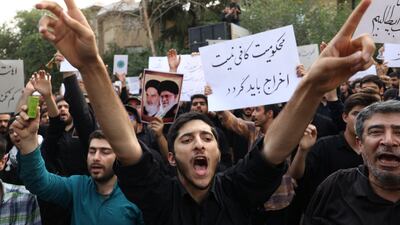
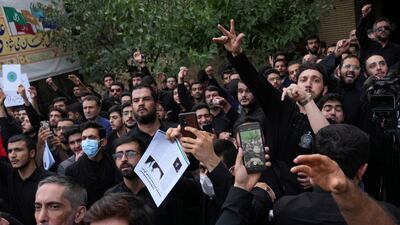
  • Demonstrators gather outside the Swedish embassy in Tehran to protest against an insult to the Quran in Stockholm. Reuters
    Demonstrators gather outside the Swedish embassy in Tehran to protest against an insult to the Quran in Stockholm. Reuters
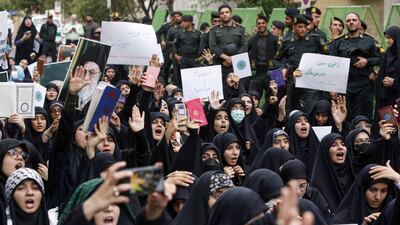
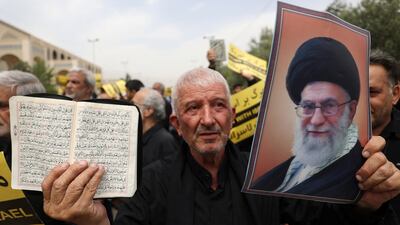
  • A demonstrator holds up the Quran and a portrait of Iranian supreme leader Ayatollah Ali Khamenei in a protest against Sweden in front of the Swedish embassy in Tehran. AP
    A demonstrator holds up the Quran and a portrait of Iranian supreme leader Ayatollah Ali Khamenei in a protest against Sweden in front of the Swedish embassy in Tehran. AP
  • An egg is thrown by demonstrator at the Swedish embassy in Tehran during a protest against the desecration of the Quran in Sweden. AP
    An egg is thrown by demonstrator at the Swedish embassy in Tehran during a protest against the desecration of the Quran in Sweden. AP
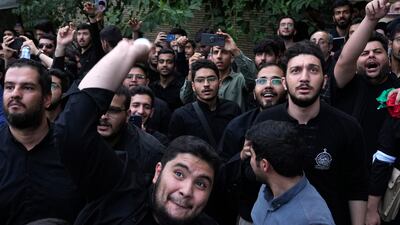
  • In Tehran, Iranian students gather during a demonstration denouncing the burning of the Quran in Sweden. AFP
    In Tehran, Iranian students gather during a demonstration denouncing the burning of the Quran in Sweden. AFP
  • An egg is thrown by demonstrator at the Swedish embassy in Tehran during a protest against the desecration of the Quran in Sweden. AP
    An egg is thrown by demonstrator at the Swedish embassy in Tehran during a protest against the desecration of the Quran in Sweden. AP
  • Iranian students outside the Swedish embassy in Tehran denounce the burning of the Quran in Sweden. AFP
    Iranian students outside the Swedish embassy in Tehran denounce the burning of the Quran in Sweden. AFP
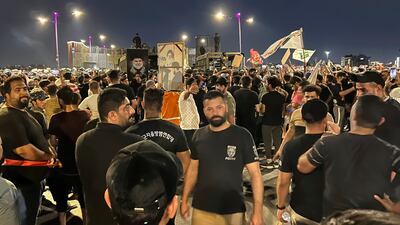
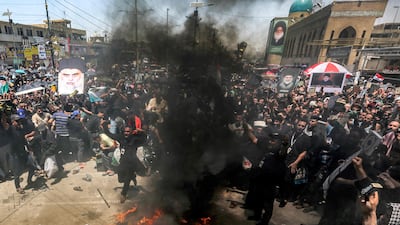
  • Protesters carrying Iraqi flags and images of Shiite cleric and political leader Moqtada Al Sadr gather in Baghdad's Tahrir Square to protest against the burning of a Quran outside the Iraqi embassy in Copenhagen, Denmark. AP
    Protesters carrying Iraqi flags and images of Shiite cleric and political leader Moqtada Al Sadr gather in Baghdad's Tahrir Square to protest against the burning of a Quran outside the Iraqi embassy in Copenhagen, Denmark. AP
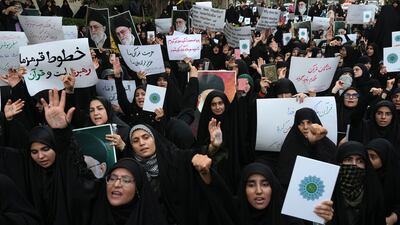
  • Protesters chant slogans against Sweden in front of the embassy in Tehran, Iran. The Farsi placard on the left reads: "Our red lines are the supreme leader and the Quran". AP
    Protesters chant slogans against Sweden in front of the embassy in Tehran, Iran. The Farsi placard on the left reads: "Our red lines are the supreme leader and the Quran". AP
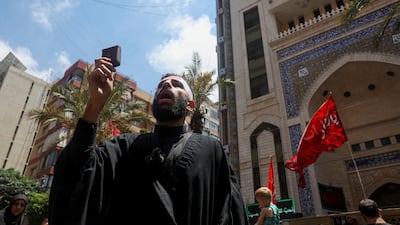
  • A Lebanese man takes part in a demonstration in Beirut called by Hezbollah to condemn the desecration of the Quran in Sweden. Reuters
    A Lebanese man takes part in a demonstration in Beirut called by Hezbollah to condemn the desecration of the Quran in Sweden. Reuters
  • People march in Beirut after Hezbollah leader Hassan Nasrallah called for protests outside mosques following Friday prayers. EPA
    People march in Beirut after Hezbollah leader Hassan Nasrallah called for protests outside mosques following Friday prayers. EPA
  • The scene in Beirut as thousands of people took to the streets in Muslim-majority countries to protest. EPA
    The scene in Beirut as thousands of people took to the streets in Muslim-majority countries to protest. EPA
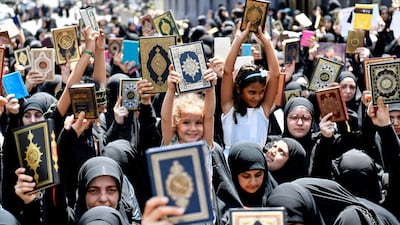
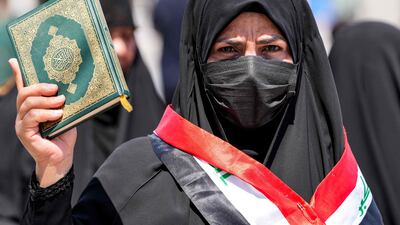
  • A woman holds the Quran in Kufa, Iraq, in protest after an activist desecrated a copy of the holy book for a second time in Sweden. AFP
    A woman holds the Quran in Kufa, Iraq, in protest after an activist desecrated a copy of the holy book for a second time in Sweden. AFP
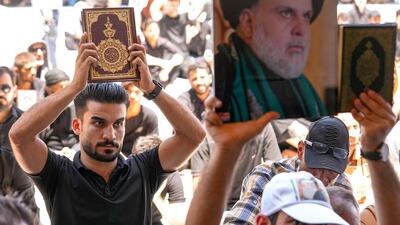
  • A demonstrator holds up a portrait of Iraqi Shiite cleric Moqtada Al Sadr, in Kufa. AFP
    A demonstrator holds up a portrait of Iraqi Shiite cleric Moqtada Al Sadr, in Kufa. AFP
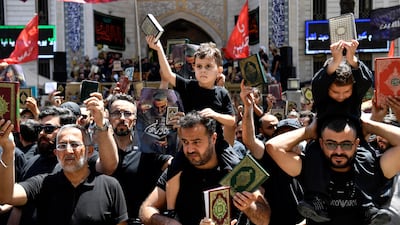
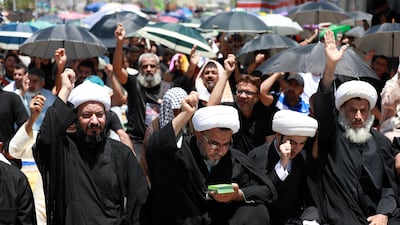
  • Shiite clerics attend a protest in Baghdad, after Iraq called for an Islamic summit to discuss the desecration of the Quran. EPA
    Shiite clerics attend a protest in Baghdad, after Iraq called for an Islamic summit to discuss the desecration of the Quran. EPA
  • Protesters burn posters of the Swedish flag and rainbow Pride flags in Sadr City, Baghdad. AFP
    Protesters burn posters of the Swedish flag and rainbow Pride flags in Sadr City, Baghdad. AFP
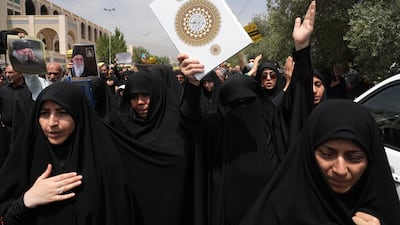
  • Iranian worshippers hold up the Quran in Tehran. The country's goverment condemned the desecration in Sweden. AP
    Iranian worshippers hold up the Quran in Tehran. The country's goverment condemned the desecration in Sweden. AP
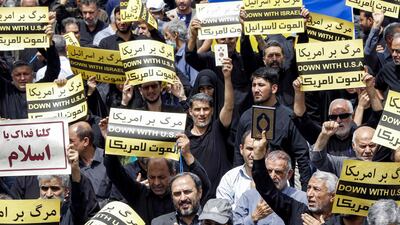
  • Demonstrators in the Iranian capital Tehran chanted: 'Down with the United States, Britain, Israel and Sweden'. Reuters
    Demonstrators in the Iranian capital Tehran chanted: 'Down with the United States, Britain, Israel and Sweden'. Reuters
  • Demonstrators in Tehran march with signs denouncing the US and Israel as they condemn the burning of the Quran. AFP
    Demonstrators in Tehran march with signs denouncing the US and Israel as they condemn the burning of the Quran. AFP

One of the Swedish protests took place during Eid Al Adha, close Stockholm’s largest mosque.

“The Swedish government fully understands that the Islamophobic acts committed by individuals at demonstrations in Sweden can be offensive to Muslims,” the Foreign Ministry has said previously.

“We strongly condemn these acts, which in no way reflect the views of the Swedish government.”

The Saudi-based inter-governmental Organisation of Islamic Co-operation has urged its 57 members to “take unified and collective measures to prevent” any repeat of the desecration of the holy book.

Protests against the desecrations have been held around the world.

In Denmark, where there have also been several similar desecrations, police on Wednesday said there would be “temporarily-intensified efforts at the internal Danish borders”.

The Danish government on has also said it will explore legal means to stop protests involving the desecration of holy texts.

The EU co-ordinator for combating anti-Muslim hatred said the bloc condemns Quran burning but that it is up to individual states whether to ban it.


Company%20profile
%3Cp%3E%3Cstrong%3ECompany%20name%3A%20%3C%2Fstrong%3EHakbah%0D%3Cbr%3E%3Cstrong%3EStarted%3A%20%3C%2Fstrong%3E2018%0D%3Cbr%3E%3Cstrong%3EFounder%3A%20%3C%2Fstrong%3ENaif%20AbuSaida%0D%3Cbr%3E%3Cstrong%3EBased%3A%20%3C%2Fstrong%3ESaudi%20Arabia%0D%3Cbr%3E%3Cstrong%3ESector%3A%20%3C%2Fstrong%3EFinTech%0D%3Cbr%3E%3Cstrong%3ECurrent%20number%20of%20staff%3A%20%3C%2Fstrong%3E22%20%0D%3Cbr%3E%3Cstrong%3EInitial%20investment%3A%20%3C%2Fstrong%3E%24200%2C000%0D%3Cbr%3E%3Cstrong%3EInvestment%20stage%3A%20%3C%2Fstrong%3Epre-Series%20A%0D%3Cbr%3E%3Cstrong%3EInvestors%3A%20%3C%2Fstrong%3EGlobal%20Ventures%20and%20Aditum%20Investment%20Management%0D%3Cbr%3E%3Cbr%3E%3C%2Fp%3E%0A
Libya's Gold

UN Panel of Experts found regime secretly sold a fifth of the country's gold reserves. 

The panel’s 2017 report followed a trail to West Africa where large sums of cash and gold were hidden by Abdullah Al Senussi, Qaddafi’s former intelligence chief, in 2011.

Cases filled with cash that was said to amount to $560m in 100 dollar notes, that was kept by a group of Libyans in Ouagadougou, Burkina Faso.

A second stash was said to have been held in Accra, Ghana, inside boxes at the local offices of an international human rights organisation based in France.

Teri%20Baaton%20Mein%20Aisa%20Uljha%20Jiya
%3Cp%3E%3Cstrong%3EDirectors%3A%3C%2Fstrong%3E%20Amit%20Joshi%20and%20Aradhana%20Sah%3C%2Fp%3E%0A%3Cp%3E%3Cstrong%3ECast%3A%3C%2Fstrong%3E%20Shahid%20Kapoor%2C%20Kriti%20Sanon%2C%20Dharmendra%2C%20Dimple%20Kapadia%2C%20Rakesh%20Bedi%3C%2Fp%3E%0A%3Cp%3E%3Cstrong%3ERating%3A%3C%2Fstrong%3E%204%2F5%3C%2Fp%3E%0A

Mercer, the investment consulting arm of US services company Marsh & McLennan, expects its wealth division to at least double its assets under management (AUM) in the Middle East as wealth in the region continues to grow despite economic headwinds, a company official said.

Mercer Wealth, which globally has $160 billion in AUM, plans to boost its AUM in the region to $2-$3bn in the next 2-3 years from the present $1bn, said Yasir AbuShaban, a Dubai-based principal with Mercer Wealth.

Within the next two to three years, we are looking at reaching $2 to $3 billion as a conservative estimate and we do see an opportunity to do so,” said Mr AbuShaban.

Mercer does not directly make investments, but allocates clients’ money they have discretion to, to professional asset managers. They also provide advice to clients.

“We have buying power. We can negotiate on their (client’s) behalf with asset managers to provide them lower fees than they otherwise would have to get on their own,” he added.

Mercer Wealth’s clients include sovereign wealth funds, family offices, and insurance companies among others.

From its office in Dubai, Mercer also looks after Africa, India and Turkey, where they also see opportunity for growth.

Wealth creation in Middle East and Africa (MEA) grew 8.5 per cent to $8.1 trillion last year from $7.5tn in 2015, higher than last year’s global average of 6 per cent and the second-highest growth in a region after Asia-Pacific which grew 9.9 per cent, according to consultancy Boston Consulting Group (BCG). In the region, where wealth grew just 1.9 per cent in 2015 compared with 2014, a pickup in oil prices has helped in wealth generation.

BCG is forecasting MEA wealth will rise to $12tn by 2021, growing at an annual average of 8 per cent.

Drivers of wealth generation in the region will be split evenly between new wealth creation and growth of performance of existing assets, according to BCG.

Another general trend in the region is clients’ looking for a comprehensive approach to investing, according to Mr AbuShaban.

“Institutional investors or some of the families are seeing a slowdown in the available capital they have to invest and in that sense they are looking at optimizing the way they manage their portfolios and making sure they are not investing haphazardly and different parts of their investment are working together,” said Mr AbuShaban.

Some clients also have a higher appetite for risk, given the low interest-rate environment that does not provide enough yield for some institutional investors. These clients are keen to invest in illiquid assets, such as private equity and infrastructure.

“What we have seen is a desire for higher returns in what has been a low-return environment specifically in various fixed income or bonds,” he said.

“In this environment, we have seen a de facto increase in the risk that clients are taking in things like illiquid investments, private equity investments, infrastructure and private debt, those kind of investments were higher illiquidity results in incrementally higher returns.”

The Abu Dhabi Investment Authority, one of the largest sovereign wealth funds, said in its 2016 report that has gradually increased its exposure in direct private equity and private credit transactions, mainly in Asian markets and especially in China and India. The authority’s private equity department focused on structured equities owing to “their defensive characteristics.”

PROFILE OF SWVL

Started: April 2017

Founders: Mostafa Kandil, Ahmed Sabbah and Mahmoud Nouh

Based: Cairo, Egypt

Sector: transport

Size: 450 employees

Investment: approximately $80 million

Investors include: Dubai’s Beco Capital, US’s Endeavor Catalyst, China’s MSA, Egypt’s Sawari Ventures, Sweden’s Vostok New Ventures, Property Finder CEO Michael Lahyani

UAE%20athletes%20heading%20to%20Paris%202024
%3Cp%3E%3Cstrong%3EEquestrian%3C%2Fstrong%3E%3Cbr%3EAbdullah%20Humaid%20Al%20Muhairi%2C%20Abdullah%20Al%20Marri%2C%20Omar%20Al%20Marzooqi%2C%20Salem%20Al%20Suwaidi%2C%20and%20Ali%20Al%20Karbi%20(four%20to%20be%20selected).%3Cbr%3E%3Cstrong%3EJudo%3C%2Fstrong%3E%3Cbr%3EMen%3A%20Narmandakh%20Bayanmunkh%20(66kg)%2C%20Nugzari%20Tatalashvili%20(81kg)%2C%20Aram%20Grigorian%20(90kg)%2C%20Dzhafar%20Kostoev%20(100kg)%2C%20Magomedomar%20Magomedomarov%20(%2B100kg)%3B%20women's%20Khorloodoi%20Bishrelt%20(52kg).%3Cbr%3E%3Cbr%3E%3Cstrong%3ECycling%3C%2Fstrong%3E%3Cbr%3ESafia%20Al%20Sayegh%20(women's%20road%20race).%3Cbr%3E%3Cbr%3E%3Cstrong%3ESwimming%3C%2Fstrong%3E%3Cbr%3EMen%3A%20Yousef%20Rashid%20Al%20Matroushi%20(100m%20freestyle)%3B%20women%3A%20Maha%20Abdullah%20Al%20Shehi%20(200m%20freestyle).%3Cbr%3E%3Cbr%3E%3Cstrong%3EAthletics%3C%2Fstrong%3E%3Cbr%3EMaryam%20Mohammed%20Al%20Farsi%20(women's%20100%20metres).%3C%2Fp%3E%0A
What is the FNC?

The Federal National Council is one of five federal authorities established by the UAE constitution. It held its first session on December 2, 1972, a year to the day after Federation.
It has 40 members, eight of whom are women. The members represent the UAE population through each of the emirates. Abu Dhabi and Dubai have eight members each, Sharjah and Ras al Khaimah six, and Ajman, Fujairah and Umm Al Quwain have four.
They bring Emirati issues to the council for debate and put those concerns to ministers summoned for questioning. 
The FNC’s main functions include passing, amending or rejecting federal draft laws, discussing international treaties and agreements, and offering recommendations on general subjects raised during sessions.
Federal draft laws must first pass through the FNC for recommendations when members can amend the laws to suit the needs of citizens. The draft laws are then forwarded to the Cabinet for consideration and approval. 
Since 2006, half of the members have been elected by UAE citizens to serve four-year terms and the other half are appointed by the Ruler’s Courts of the seven emirates.
In the 2015 elections, 78 of the 252 candidates were women. Women also represented 48 per cent of all voters and 67 per cent of the voters were under the age of 40.
 

The%20specs
%3Cp%3E%3Cstrong%3EEngine%3A%3C%2Fstrong%3E%204.0-litre%20twin-turbo%20V8%3Cbr%3E%3Cstrong%3EPower%3A%20%3C%2Fstrong%3E680hp%20at%206%2C000rpm%3Cbr%3E%3Cstrong%3ETorque%3A%20%3C%2Fstrong%3E800Nm%20at%202%2C750-6%2C000rpm%3Cbr%3E%3Cstrong%3ETransmission%3A%20%3C%2Fstrong%3ERear-mounted%20eight-speed%20auto%3Cbr%3E%3Cstrong%3EFuel%20consumption%3A%20%3C%2Fstrong%3E13.6L%2F100km%3Cbr%3E%3Cstrong%3EOn%20sale%3A%3C%2Fstrong%3E%20Orderbook%20open%3B%20deliveries%20start%20end%20of%20year%3Cbr%3E%3Cstrong%3EPrice%3A%20%3C%2Fstrong%3EFrom%20Dh970%2C000%3C%2Fp%3E%0A
The specs

Engine: 3.8-litre, twin-turbo V8

Transmission: eight-speed automatic

Power: 582bhp

Torque: 730Nm

Price: Dh649,000

On sale: now  

The White Lotus: Season three

Creator: Mike White

Starring: Walton Goggins, Jason Isaacs, Natasha Rothwell

Rating: 4.5/5

Company profile

Date started: December 24, 2018

Founders: Omer Gurel, chief executive and co-founder and Edebali Sener, co-founder and chief technology officer

Based: Dubai Media City

Number of employees: 42 (34 in Dubai and a tech team of eight in Ankara, Turkey)

Sector: ConsumerTech and FinTech

Cashflow: Almost $1 million a year

Funding: Series A funding of $2.5m with Series B plans for May 2020

Our legal consultant

Name: Hassan Mohsen Elhais

Position: legal consultant with Al Rowaad Advocates and Legal Consultants

THE%20HOLDOVERS
%3Cp%3E%3Cstrong%3EDirector%3A%20%3C%2Fstrong%3EAlexander%20Payne%3C%2Fp%3E%0A%3Cp%3E%3Cstrong%3EStarring%3A%3C%2Fstrong%3E%20Paul%20Giamatti%2C%20Da'Vine%20Joy%20Randolph%2C%20Dominic%20Sessa%3C%2Fp%3E%0A%3Cp%3E%3Cstrong%3ERating%3A%3C%2Fstrong%3E%204.5%2F5%3C%2Fp%3E%0A
Updated: August 17, 2023, 2:32 PM