Belarusian President Alexander Lukashenko speaks in Minsk on June 27. Belarus President Press Service / EPA

Belarus's Lukashenko says he told Putin not to kill Wagner's Prigozhin


Soraya Ebrahimi
  • English
  • Arabic

Belarus strongman Alexander Lukashenko said Tuesday he had urged his ally President Vladimir Putin not to kill the head of the mercenary Wagner Group, which last week tried to topple Russia's top brass.

Mr Lukashenko, a long-time ally of Mr Putin, claimed to have negotiated an end to the armed insurrection and has said he will take in exiled rebels and Wagner chief Yevgeny Prigozhin.

"I said to Putin: we could waste [Prigozhin)], no problem; if not on the first try, then on the second," he told a meeting of security officials, according to state media.

"I told him: don't do this."

Mr Lukashenko, 68, has been hit with western sanctions for cracking down on opposition figures and allowing Russia to attack Ukraine last year from Belarusian territory.

Meanwhile, Belarus welcomed Mr Prigozhin into exile on Tuesday as Mr Putin thanked regular troops for averting a civil war.

Mr Putin's supporters insisted that his rule was not weakened by the revolt, which was widely seen as the biggest threat to Kremlin authority since he came to power.

Asked whether Mr Putin's power was diminished by the sight of Wagner's rebel mercenaries seizing a military headquarters, advancing on Moscow and shooting down military aircraft along the way, Kremlin spokesman Dmitry Peskov accused political commentators of exaggerating.

"We don't agree," Mr Peskov said.

Wagner forces aim to topple Moscow's military leadership - in pictures

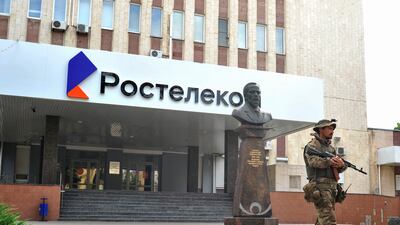
  • A serviceman from private military company Wagner Group blocks the access to the Rostelecom building in Rostov-on-Don, southern Russia. EPA
    A serviceman from private military company Wagner Group blocks the access to the Rostelecom building in Rostov-on-Don, southern Russia. EPA
  • A military column of Wagner private mercenary group drives along the M-4 highway, which links the capital Moscow with Russia's southern cities, near Voronezh. Reuters
    A military column of Wagner private mercenary group drives along the M-4 highway, which links the capital Moscow with Russia's southern cities, near Voronezh. Reuters
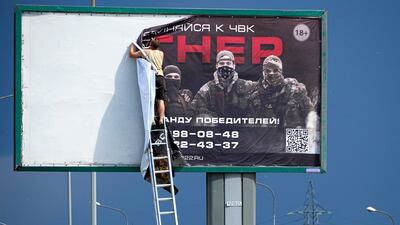
  • A man takes down the poster with writing reading 'Join us at Wagner' on the outskirts of St. Petersburg. AP Photo
    A man takes down the poster with writing reading 'Join us at Wagner' on the outskirts of St. Petersburg. AP Photo
  • People pose for photos on a tank reading 'Siberia' as servicemen from Wagner Group block a street in downtown Rostov-on-Don. EPA
    People pose for photos on a tank reading 'Siberia' as servicemen from Wagner Group block a street in downtown Rostov-on-Don. EPA
  • Wagner forces near the headquarters of the Southern Military District in Rostov-on-Don. Reuters
    Wagner forces near the headquarters of the Southern Military District in Rostov-on-Don. Reuters
  • A Wagner group fighter on a street in the Russian city of Rostov-on-Don. AFP
    A Wagner group fighter on a street in the Russian city of Rostov-on-Don. AFP
  • Fighters from the Wagner group on the streets of Rostov-on-Don close to the headquarters of the Southern Military District. Reuters
    Fighters from the Wagner group on the streets of Rostov-on-Don close to the headquarters of the Southern Military District. Reuters
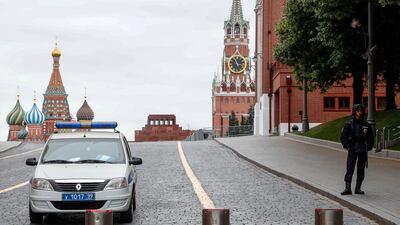
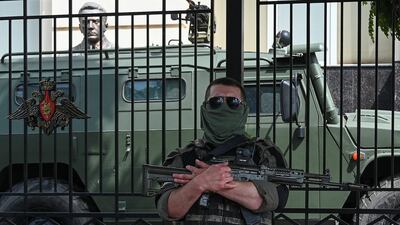
  • A Russian police patrol on guard at Kremlin in Moscow. EPA
    A Russian police patrol on guard at Kremlin in Moscow. EPA
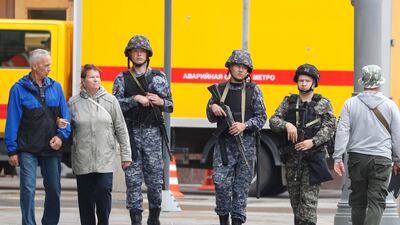
  • Russian servicemen stand on the streets of central Moscow. EPA
    Russian servicemen stand on the streets of central Moscow. EPA
  • Wagner group fighter stands guard near the headquarters of the Southern Military District in the city of Rostov-on-Don, Russia. Reuters
    Wagner group fighter stands guard near the headquarters of the Southern Military District in the city of Rostov-on-Don, Russia. Reuters
  • Yevgeny Prigozhin, founder of the Wagner mercenary group, speaks inside the headquarters of the Russian army's southern military command centre, which his forces took control of, in the city of Rostov-on-Don. Reuters
    Yevgeny Prigozhin, founder of the Wagner mercenary group, speaks inside the headquarters of the Russian army's southern military command centre, which his forces took control of, in the city of Rostov-on-Don. Reuters
  • Russian police officers guard the Wagner group's headquarters in Saint Petersburg, after President Vladmir Putin described the actions by the mercenary forces as treason. AFP
    Russian police officers guard the Wagner group's headquarters in Saint Petersburg, after President Vladmir Putin described the actions by the mercenary forces as treason. AFP
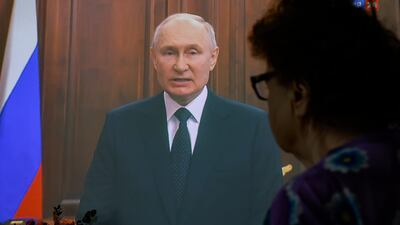
  • A woman watches Mr Putin's televised address to the nation, in Moscow. EPA
    A woman watches Mr Putin's televised address to the nation, in Moscow. EPA
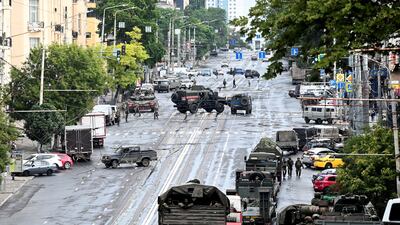
  • Russian policemen block a street in downtown Rostov-on-Don, southern Russia. EPA
    Russian policemen block a street in downtown Rostov-on-Don, southern Russia. EPA
  • Wagner fighters stationed on a street in Rostov-on-Don. Reuters
    Wagner fighters stationed on a street in Rostov-on-Don. Reuters
  • Russian servicemen block a street in downtown Rostov-on-Don. EPA
    Russian servicemen block a street in downtown Rostov-on-Don. EPA
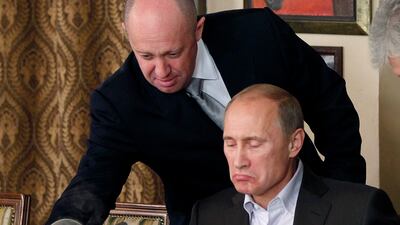
  • Mr Prigozhin serves food to Mr Putin, who at the time was Russia's prime minister, at the Wagner chief's restaurant outside Moscow. AP
    Mr Prigozhin serves food to Mr Putin, who at the time was Russia's prime minister, at the Wagner chief's restaurant outside Moscow. AP
  • Wagner fighters in Rostov-on-Don. Reuters
    Wagner fighters in Rostov-on-Don. Reuters
  • Policemen guard an area near the Wagner offices, in St Petersburg. AP
    Policemen guard an area near the Wagner offices, in St Petersburg. AP
  • A Wagner fighter stands guard on a street in Rostov-on-Don. Reuters
    A Wagner fighter stands guard on a street in Rostov-on-Don. Reuters
  • Wagner fighters in Rostov-on-Don. Reuters
    Wagner fighters in Rostov-on-Don. Reuters
  • A Wagner fighter on top of an armoured vehicle in Rostov-on-Don. Reuters
    A Wagner fighter on top of an armoured vehicle in Rostov-on-Don. Reuters

Mr Putin tried to portray the dramatic events at the weekend as a victory for the Russian army.

"You de facto stopped civil war," he told troops from the Defence Ministry, National Guard, FSB security service and Interior Ministry, who gathered in a Kremlin courtyard to hold a minute's silence for airmen killed by Wagner.

"In the confrontation with rebels, our comrades-in-arms, pilots, were killed. They did not flinch and honourably fulfilled their orders and their military duty."

Mr Prigozhin, a former Kremlin ally and catering contractor who built Russia's most powerful private army, has boasted with some support from news footage that his men were cheered by civilians during his short-lived revolt.

But Mr Putin insisted that Wagner's ordinary fighters had seen that "the army and the people were not with them".

In another meeting with defence officials, he confirmed that Wagner was wholly funded by the Russian federal budget, despite operating as an independent company.

He said that since the assault on Ukraine, Moscow had paid the group 86.26 billion roubles (about $1 billion) in salaries.

Russian officials have been trying to put the crisis behind them for three days, with the FSB dropping charges against rank-and-file Wagner troopers and the military preparing to disarm the group.

"Preparations are under way for the transfer of heavy military equipment from the private military company Wagner to units of the Russian armed forces," the Defence Ministry said.


SPECS

Nissan 370z Nismo

Engine: 3.7-litre V6

Transmission: seven-speed automatic

Power: 363hp

Torque: 560Nm

Price: Dh184,500

HIV on the rise in the region

A 2019 United Nations special analysis on Aids reveals 37 per cent of new HIV infections in the Mena region are from people injecting drugs.

New HIV infections have also risen by 29 per cent in western Europe and Asia, and by 7 per cent in Latin America, but declined elsewhere.

Egypt has shown the highest increase in recorded cases of HIV since 2010, up by 196 per cent.

Access to HIV testing, treatment and care in the region is well below the global average.  

Few statistics have been published on the number of cases in the UAE, although a UNAIDS report said 1.5 per cent of the prison population has the virus.

Mercer, the investment consulting arm of US services company Marsh & McLennan, expects its wealth division to at least double its assets under management (AUM) in the Middle East as wealth in the region continues to grow despite economic headwinds, a company official said.

Mercer Wealth, which globally has $160 billion in AUM, plans to boost its AUM in the region to $2-$3bn in the next 2-3 years from the present $1bn, said Yasir AbuShaban, a Dubai-based principal with Mercer Wealth.

Within the next two to three years, we are looking at reaching $2 to $3 billion as a conservative estimate and we do see an opportunity to do so,” said Mr AbuShaban.

Mercer does not directly make investments, but allocates clients’ money they have discretion to, to professional asset managers. They also provide advice to clients.

“We have buying power. We can negotiate on their (client’s) behalf with asset managers to provide them lower fees than they otherwise would have to get on their own,” he added.

Mercer Wealth’s clients include sovereign wealth funds, family offices, and insurance companies among others.

From its office in Dubai, Mercer also looks after Africa, India and Turkey, where they also see opportunity for growth.

Wealth creation in Middle East and Africa (MEA) grew 8.5 per cent to $8.1 trillion last year from $7.5tn in 2015, higher than last year’s global average of 6 per cent and the second-highest growth in a region after Asia-Pacific which grew 9.9 per cent, according to consultancy Boston Consulting Group (BCG). In the region, where wealth grew just 1.9 per cent in 2015 compared with 2014, a pickup in oil prices has helped in wealth generation.

BCG is forecasting MEA wealth will rise to $12tn by 2021, growing at an annual average of 8 per cent.

Drivers of wealth generation in the region will be split evenly between new wealth creation and growth of performance of existing assets, according to BCG.

Another general trend in the region is clients’ looking for a comprehensive approach to investing, according to Mr AbuShaban.

“Institutional investors or some of the families are seeing a slowdown in the available capital they have to invest and in that sense they are looking at optimizing the way they manage their portfolios and making sure they are not investing haphazardly and different parts of their investment are working together,” said Mr AbuShaban.

Some clients also have a higher appetite for risk, given the low interest-rate environment that does not provide enough yield for some institutional investors. These clients are keen to invest in illiquid assets, such as private equity and infrastructure.

“What we have seen is a desire for higher returns in what has been a low-return environment specifically in various fixed income or bonds,” he said.

“In this environment, we have seen a de facto increase in the risk that clients are taking in things like illiquid investments, private equity investments, infrastructure and private debt, those kind of investments were higher illiquidity results in incrementally higher returns.”

The Abu Dhabi Investment Authority, one of the largest sovereign wealth funds, said in its 2016 report that has gradually increased its exposure in direct private equity and private credit transactions, mainly in Asian markets and especially in China and India. The authority’s private equity department focused on structured equities owing to “their defensive characteristics.”

Director: Laxman Utekar

Cast: Vicky Kaushal, Akshaye Khanna, Diana Penty, Vineet Kumar Singh, Rashmika Mandanna

Rating: 1/5

Company%20profile
%3Cp%3E%3Cstrong%3ECompany%20name%3A%20%3C%2Fstrong%3EHakbah%0D%3Cbr%3E%3Cstrong%3EStarted%3A%20%3C%2Fstrong%3E2018%0D%3Cbr%3E%3Cstrong%3EFounder%3A%20%3C%2Fstrong%3ENaif%20AbuSaida%0D%3Cbr%3E%3Cstrong%3EBased%3A%20%3C%2Fstrong%3ESaudi%20Arabia%0D%3Cbr%3E%3Cstrong%3ESector%3A%20%3C%2Fstrong%3EFinTech%0D%3Cbr%3E%3Cstrong%3ECurrent%20number%20of%20staff%3A%20%3C%2Fstrong%3E22%20%0D%3Cbr%3E%3Cstrong%3EInitial%20investment%3A%20%3C%2Fstrong%3E%24200%2C000%0D%3Cbr%3E%3Cstrong%3EInvestment%20stage%3A%20%3C%2Fstrong%3Epre-Series%20A%0D%3Cbr%3E%3Cstrong%3EInvestors%3A%20%3C%2Fstrong%3EGlobal%20Ventures%20and%20Aditum%20Investment%20Management%0D%3Cbr%3E%3Cbr%3E%3C%2Fp%3E%0A
Updated: June 27, 2023, 11:12 PM