


Follow the latest news here
The chief of the Wagner mercenary force, Yevgeny Prigozhin, has been allowed to leave Russia for Belarus, following his decision to halt the advance of his fighters on Moscow.
This marks a de-escalation of a security crisis that had seen Prigozhin's forces seize a military headquarters in Rostov-on-Don, southern Russia, and move towards the capital on Saturday.
The troop withdrawal was announced shortly before the Kremlin confirmed Prigozhin's imminent departure to Belarus.
Neither the Wagner leader nor the group's members will face prosecution.
As the situation unfolded, Russia's President Vladimir Putin warned of the risk of civil war, while Moscow advised locals to stay off the streets.
Prigozhin said the decision to withdraw his troops was to avoid bloodshed.
“We're turning our columns around and going back to field camps,” he said.
There had been celebrations among some locals when Wagner took over the military headquarters in Rostov-on-Don.
Alexander Lukashenko, the Belarusian leader, claimed to have negotiated a truce with Prigozhin.
Kremlin spokesman Dmitry Peskov confirmed that the criminal case against Prigozhin will be closed and he will proceed to Belarus.
Mr Peskov said it was vital to prevent further bloodshed and internal confrontation.
Ukrainian officials viewed the internal conflict in Russia as a potential opportunity for their counter-offensive.
Presidential aide Mykhailo Podolyak suggested that Prigozhin's actions demonstrated that there was “no longer a monopoly on violence”.
The US and its allies said they were monitoring the situation.
Moscow said the rebellion was serving Russia's external enemies.
-
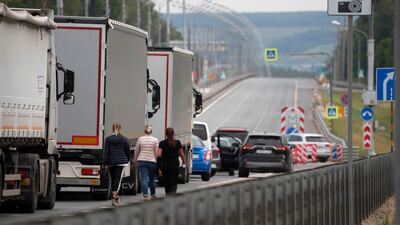
Traffic on the M-4 road in the Moscow region is brought to a halt. EPA -
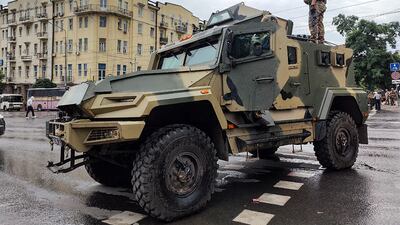
An armoured vehicle of the Wagner group outside the headquarters of the Southern Military District of the Russian armed forces in Rostov-on-Don, Russia. AP -
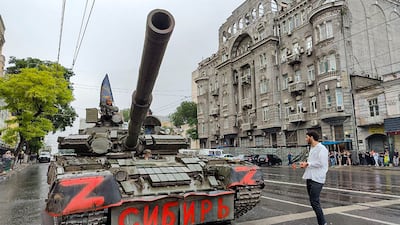
In Rostov, servicemen sit on a tank with a flag of the Wagner group. The letters on the tank's hull appear to spell Siberia. AP -
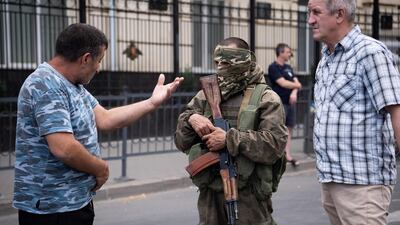
Rostov-on-Don residents speak with a Wagner fighter. AFP -
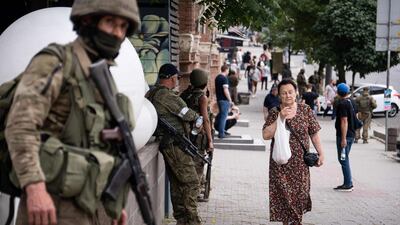
Life in Rostov-on-Don appears to go on after Wagner forces arrived in their city. AFP -
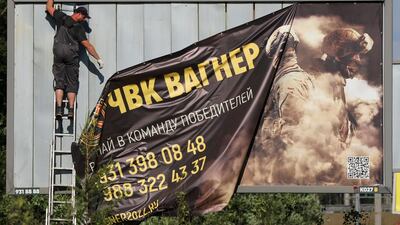
On the outskirts of Saint Petersburg, a banner promoting the Wagner private mercenary group is taken down from view. Reuters -
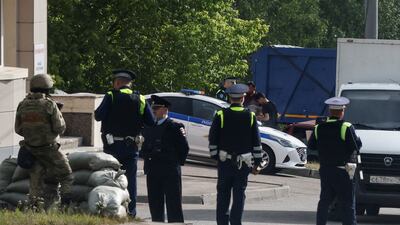
Security personnel watch traffic at a checkpoint in Moscow. Reuters


Before Wagner turned around, Russian forces had initiated a “counter-terrorist operation” to block the advance.
Moscow Mayor Sergey Sobyanin had announced “anti-terrorist” measures, with critical facilities under “reinforced protection”.
Chechen leader Ramzan Kadyrov had pledged his units to help quell the Wagner rebellion.
Prigozhin, whose forces have been at the forefront of Russia's war in Ukraine, has frequently criticised Defence Minister Sergei Shoigu and Chief of the General Staff Valery Gerasimov.
He has accused them of starving his forces of ammunition and other supplies, leading to heavy losses.
Prigozhin claimed a recent missile strike from Russian lines had inflicted heavy casualties on his troops, prompting the march on Moscow.

