


Ukraine's first lady Olena Zelenska warned assembled elites in Davos on Tuesday of worse crises to come if they do not bring Russian aggression to a halt.
Making a rare set-piece address, Ms Zelenska told the World Economic Forum to get behind a 10-point peace plan being promoted by her husband, President Volodymyr Zelenskyy.
She said the problems overshadowing Davos, such as food shortages and soaring consumer prices, would only mount if Russia is not restrained.
It was the first main speech of the 2023 forum, as it returned to its usual winter slot in the Swiss Alps after two years of disruption due to the Covid-19 pandemic.
The summit opened two days after a missile strike in Dnipro, Ukraine, that killed at least 44 people — with another 22 still missing — in one of the worst single strikes of the war.
Swiss President Alain Berset said the postwar order was “currently experiencing its greatest crisis”, as the war in Ukraine worsens global problems such as inflation.
Ms Zelenska asked dignitaries: “What will happen to the cost of living when tens of millions of people will be forced to flee mass starvation and become refugees?
“How does the world want to achieve climate neutrality when so far it hasn’t even stopped the burning of entire cities in Ukraine?”
She described people losing their homes, doctors performing surgery by candlelight and farmers afraid to return to their fields after 11 months of war.
Ukraine conflict — in pictures
-
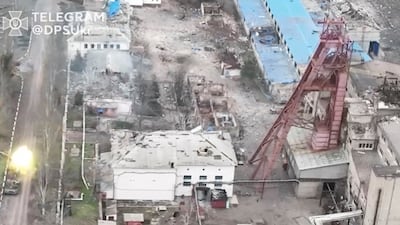
A tank, seen left, fires a round in Soledar, a town in the Donetsk region of eastern Ukraine. Reuters -
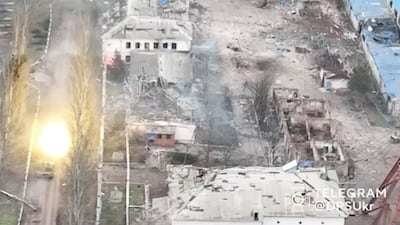
Tank fire in Soledar, Donetsk. Reuters -
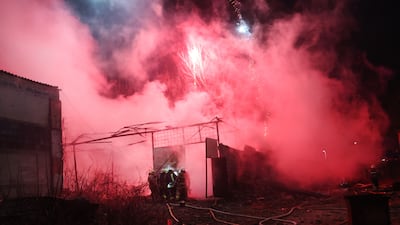
Firefighters work to put out a blaze at a Kharkiv fireworks storage site after it was struck by a Russian missile. Getty -
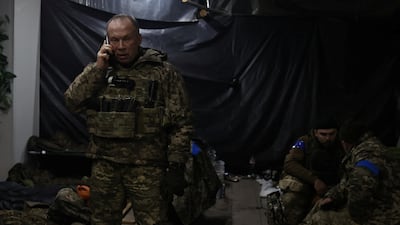
Col Gen Oleksandr Syrskyi, commander of Ukraine's ground forces, visits his troops on the frontline in Soledar, Donetsk. Reuters -
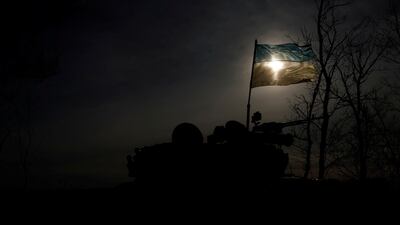
A Ukrainian flag attached to a tank flutters in the wind in Bakhmut. Reuters -
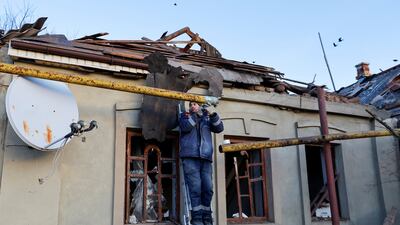
A specialist from an emergency crew works on a residential building in Donetsk that was damaged in recent shelling. Reuters -
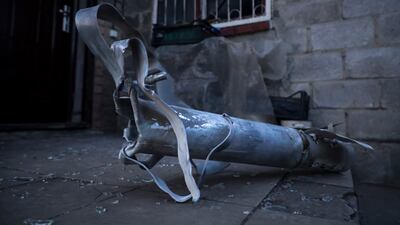
A missile fragment left by shelling in Russian-controlled Donetsk. AP -
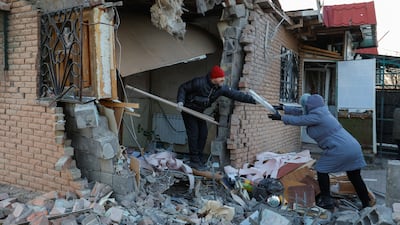
Residents remove debris and carry their belongings out of a building destroyed by recent shelling in Donetsk, Russian-controlled Ukraine. Reuters -
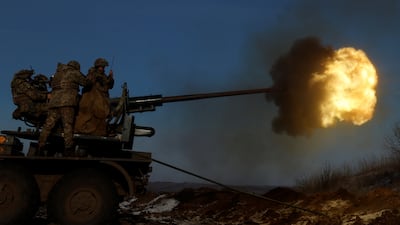
Ukrainian forces fire an anti-aircraft weapon as Russia's attack on the frontline city of Bakhmut continues. Reuters -
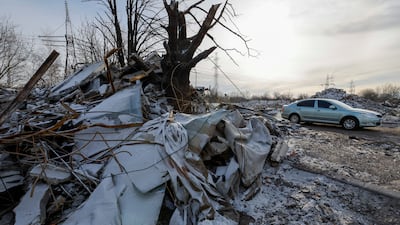
A car drives past a destroyed building purported to have been used as temporary accommodation for Russian soldiers, dozens of whom were killed in a Ukrainian missile strike in Makiivka, Russian-controlled Ukraine. Reuters -
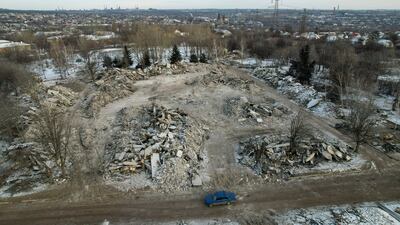
The site of a temporary barracks for Russian soldiers in Makiivka, which was destroyed in a Ukrainian missile attack. Reuters -
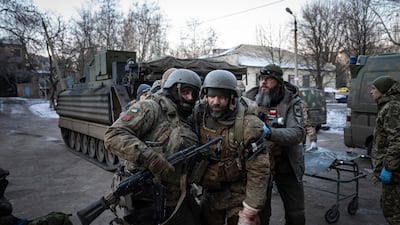
A Ukrainian serviceman carries his injured comrade from the battlefield to a hospital in the Donetsk region. AP -
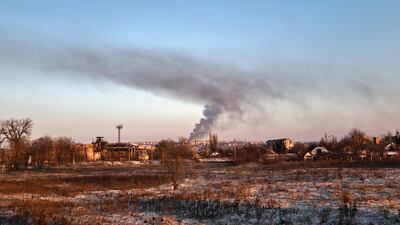
Smoke rises after shelling in Soledar, the site of heavy battles with Russian forces in the Donetsk region. AP


She called it an “insult to mankind and human nature” to face the prospect of starvation, after the war limited exports from one of the world's most fertile countries.
“I ask you to look at the need to stop this aggression exactly like this, with the eyes of the people whose lives have been brought into chaos by the aggressor country,” she said.
Taking the stage after Ms Zelenska, European Commission President Ursula von der Leyen said there would be “no let-up” in European support for Ukraine.
It comes as Nato allies debate whether to send their top-of-the-range battle tanks to Ukraine, such as the Leopard tanks it is demanding from Germany.
Ms von der Leyen said financial aid would help Ukraine to pay wages and pensions and ensure the running of hospitals, schools, and housing services.
“We are in it for as long as it takes and stand by our Ukrainian friends,” she said.
What's next for Ukraine?
In a session later in the day on the future of Ukraine, Deputy prime minister Yuliia Svyrydenko said her country would win the war.
“Because we are discussing the future, it means that everybody understands Russia won’t achieve its goal and we will definitely win this war,” she said.
“It’s very hard to speak about the future right now when Ukraine is under constant missile strikes like we witnessed this weekend, the massive attack on Dnipro.”
She said Ukraine needed more heavy weapons to repel Russia's attacks.
“All questions related to what the future holds for Ukraine will start with the question what can the additional support for military, for weapons, for heavy weapons for Ukraine be for now to speed up the victory and to start the rebuilding, reconstruction and return the refugees,” said Ms Svyrydenko.
“We are asking our allies to provide us with additional weapons, with heavy weapons, armaments, everything, to squeeze Russia from Ukrainian territory.
“The second thing is we are able and willing to discuss the peace formula announced by President Zelenskyy.
“It’s very important right now to move from paper to practical implementation.”

