


Western powers need to “quit coming up with excuses” not to equip Ukraine with advanced weapons to rapidly defeat Russia, a retired US general has told The National.
A division of Nato tanks and long-range precision missiles should immediately be given to the country, said retired Lt Gen Ben Hodges.
The former commander of US Army Europe confidently predicted that Ukraine would defeat the invaders this year, with Crimea retaken by September.
But to do so, America and Europe must continue providing weapons and ammunition and remain resolute in backing Kyiv.
“They need tanks, whether it's American Abrams or German Leopards,” Mr Hodges said.
“But we need to quit coming up with excuses about why it's too hard or it's too much logistics or too much maintenance and get started on the training and deliver them.”
Having seen first-hand the training of troops in Ukraine, Mr Hodges, 64, said their military had the manpower, ability and structure to form a modern all-arms armoured division.
“The Ukrainians are going to defeat Russia, there's no doubt about that,” he said.
“They have irreversible momentum and there's not much the Russians can do to stop it, as long as the West continues supplies. That's the key.
“The Russians know that and they’re going to do everything they can to string this out so the West will lose the will to continue.”
But if western powers fulfilled their promises, Ukraine will “defeat Russia and they will liberate Crimea by the end of next summer”.

Before Russian invaded there was significant hesitancy among Nato powers over providing arms to Ukraine for fear that it could lead to escalation.
But since February the West has given Kyiv increasingly sophisticated weapons, culminating in the delivery of Patriot air defence missiles.
Deep strike
Previously, countries were “wringing their hands” over the idea of sending small Stinger anti-aircraft missiles in case they were used to shoot down a Russian helicopter.
“How ridiculous does that sound now?” Mr Hodges said. “I’m astounded at how we have continued to deter ourselves.”
He said the West should not stop at Patriots but provide the advanced Army Tactical Missile System, or Atacms — pinpoint-accurate 1,700kg missiles with a range of 300km.

It has been said that such advanced systems would put the West on collision course with Russia, which could result in a nuclear conflict.
Mr Hodges said that while Nato needed to the take President Vladimir Putin’s nuclear threats seriously “because he doesn’t care how many innocent people get killed”, he believed it was very unlikely the Russian leader would use the missiles, after US President Joe Biden said there would be “catastrophic consequences”.
Leaders should also “quit worrying so much about, ‘Oh, my God, if we get an attack on this or hit a target in Crimea then the Russians might go to use a nuclear weapon’,” Mr Hodges said from his home in Frankfurt, Germany.
“That makes zero sense, as it's so unlikely.”
He also suggested that those in the Kremlin close to Mr Putin “are thinking about life after him” and if a nuclear weapon was used they would lose all power and wealth.
Decisive terrain
While some fear an attack on Crimea — which was historically part of Russia — would lead to a wider war and possibly nuclear conflict, Mr Hodges said retaking the peninsula annexed by Russia in 2014 was vital to Ukraine’s survival.
“Crimea’s the endgame for Ukraine,” he said. “If Russia retains Crimea, then Ukraine will never really be safe or fully re-establish her economy, because Russia will continue to block ships coming in and out of Azov Sea.
“From Crimea, the Russians can also still interdict anything flowing in and out of Odesa, so that's the decisive terrain and why President [Volodymyr] Zelenskyy correctly is not yielding total restoration of Ukraine sovereignty.”
Winter Offensive
Before Ukraine launches its next major operation, its generals will degrade Russia’s resources by continued attacks on its ammunition, command headquarters and barracks, said Mr Hodges.
A Himars missile strike in Makiivka in the eastern region of Donetsk on Sunday killed at least 89 Russian soldiers.

Kyiv’s general staff are highly disciplined in maintaining operational security, Mr Hodges said, so it would be unclear where and when their attack would start.
“I am sure they will continue their masterful use of deception and surprise,” he said.
If the Ukrainians were equipped with three modern armoured brigades of about 200 tanks, a few hundred more infantry fighting vehicles, along with engineers and artillery, it would “significantly accelerate their ability to destroy large numbers of Russian forces and the Russians won't be able to do much about it”, said the retired general.
Stumbling Russia
Like many other senior officers, Mr Hodges, who served in Iraq and Afghanistan, admitted he had “completely overestimated Russian capability” and failed to realise the depth of corruption” in the military.
He also misunderstood how little operational experience the Russian Army actually had with just five per cent of its forces doing all the fighting in Georgia, Crimea and Syria.
Unlike American and British forces, they also “failed to train to the point of failure, where you make mistakes and learn from them”.

That meant despite its expensive and advanced equipment , “that means nothing if you don't have well-trained, disciplined personnel operating it”.
“They spent a ton of money on new aeroplanes but all the Russian Air Force has done is launch missiles at civilian targets. They've been pretty much a disaster.”
The “great” Black Sea fleet was “hiding in Crimea, terrified of Kyiv’s missiles, and Ukraine doesn’t even have a navy”.
Given all their losses, Russia had also resorted to using ancient tanks that are more than 60 years old, said Mr Hodges.

By contrast, the Ukrainians have proven extremely resilient and “so much more tech-savvy and innovative and creative than the Russians”, despite both countries belonging to the Soviet Union for 70 years.
Ukraine had “unleashed the talent of young people” by investing in education, with “no limits on what young people were allowed to do”, said Mr Hodges.
New modern army
On Wednesday, Mr Zelenskyy said that allies must provide the heavy armour.
“There is no rational reason why Ukraine has not yet been supplied with western tanks,” he said.
A suggestion that western powers might accept his request came when it was then announced that France would be sending AMX-10 light tanks to Ukraine.
A six-wheeled-vehicle, the tank is highly manoeuvrable, and with a good sighting system and 105mm gun, it has the ability to take on Russian armour.

There is an array of other Nato arms that would make a significant difference in the fighting, but analysts say that the foremost concern is providing enough ammunition.
While it is a “wish list”, providing Ukraine with advanced attack helicopters such as the Apache would play a key role in defeating Russian armour.
Similarly, modern fighters such as the F-16 or Typhoon would greatly improve their air defence and ability for ground attack, although the training and support would be a huge commitment.
The Terminal High Altitude Area Defence systems, or Thaad, would enable them to shoot down ballistic missiles such as the Russian Iskander or any rockets provided by Iran.

In addition to Abrams or Leopard tanks, Ukraine’s infantry will need armoured fighting vehicles such as the American Bradley — of which US President Joe Biden promised 50 on Thursday — British Warrior or German Marder.
Berlin has also promised to send Marders in co-ordination with the US.
To support the armour a large number of Oshkosh tank transporters will be necessary, particularly for the long distances in Ukraine.
But more important is a large fleet of heavy equipment transport lorries to carry ammunition and stores for artillery, armour and infantry.
In essence, as one analyst suggested, “it is giving Ukraine an entire army to defeat Russia”.
Sudden collapse
With Russia’s campaign suffering significant reverses, the point could arrive when “people around the Kremlin are going to start looking at this disaster”, said Mr Hodges, and consider whether Mr Putin is a hindrance.
“He could well be displaced within a year,” he said, and it could happen earlier if there was a sudden catastrophic defeat in Ukraine.
“The vast majority of Russian troops now are recently mobilised soldiers who know they are not defending Russia but occupying Ukraine, and there are so many examples in history of armies collapsing sooner than you expected.”
Ukraine latest - in pictures
-
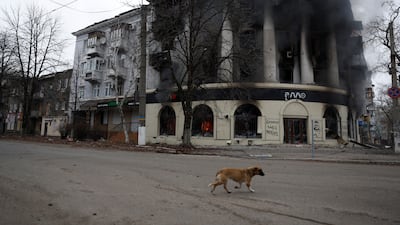
A building burned from a strike as Russia's attack on Ukraine continues, in Bakhmut. Reuters -
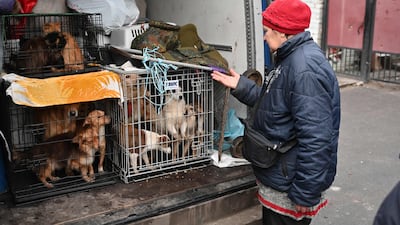
Antonina, a refugee from Bakhmut in Donetsk region, with dogs she rescued in Izyum, Kharkiv. AFP -
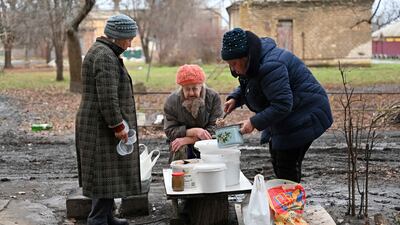
A resident gives her neighbours hot food brought by volunteers in Izyum. AFP -
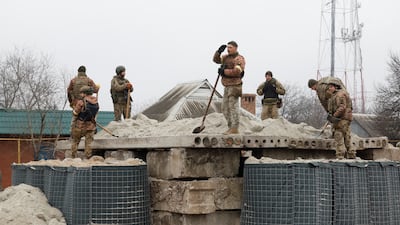
A Ukrainian soldier salutes as he works to build a bunker with sand in Bakhmut. Reuters -
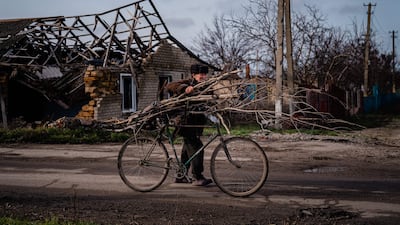
Volodymyr Kovalov, 77, carries tree branches attached to his bike as he collects wood for heating and cooking in Kherson region. AFP -
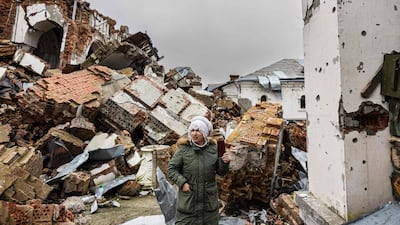
A local resident takes pictures of a destroyed monastery in Dolyna, eastern Ukraine. AFP -
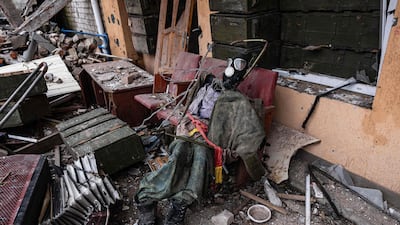
A decoy dummy made with the clothes of a Russian soldier at the entrance of a destroyed cinema in Kamyanka, eastern Ukraine. AFP -
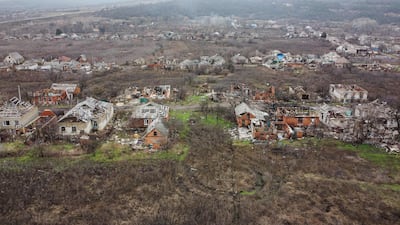
Destroyed houses in the city of Kamyanka. AFP -
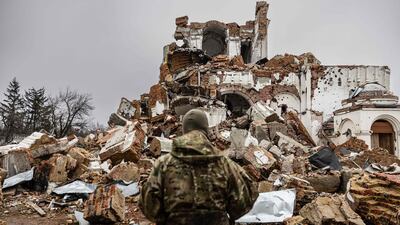
Caesar, 50, a Russian who joined the Freedom of Russia Legion to fight on the side of Ukraine, stands in front of a destroyed monastery in Dolyna. AFP -
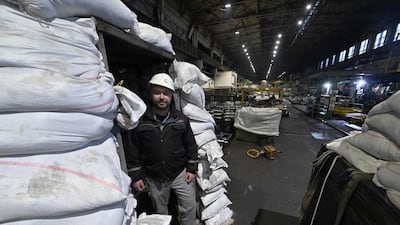
An employee stands next to a shelter at a stainless pipes plant in Nikopol, Dnipropetrovsk region. AFP -

Ivan and Iryna Kalinin before the start of the Russian invasion of Ukraine. Iryna, who was pregnant, was killed in a Russian air strike on Mariupol's maternity hospital. Ivan returned to the occupied city to rebury his wife and baby. AP -
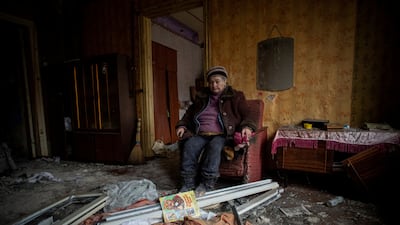
Natalia, 67, sits inside her house that was damaged in a Russian military strike, in Kramatorsk, Ukraine. Reuters -
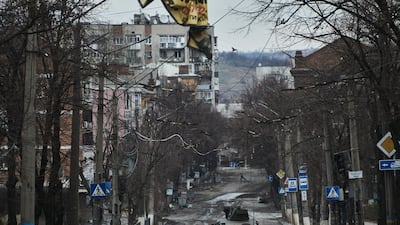
Ukrainian soldiers ride in a military vehicle in Bakhmut, a city in the Donetsk enclave. AP -
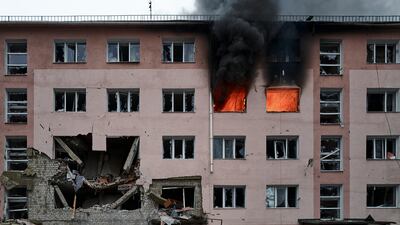
Smoke billows from a building on fire after a Russian attack in Bakhmut. AP -
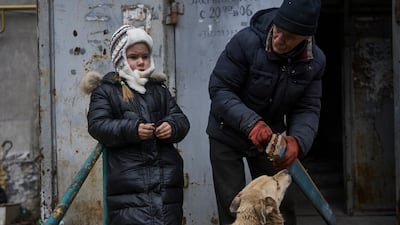
Sasha and her grandfather stand outside their home in Bakhmut. AP -
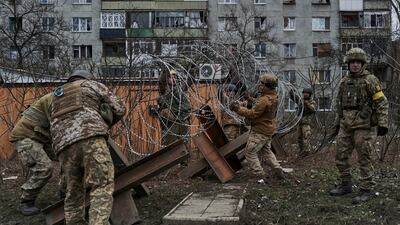
Ukrainian soldiers set up a barricade in Bakhmut. AP -
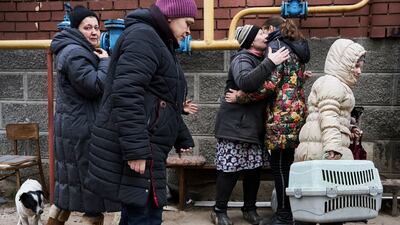
Nastya carries her cat as her mother Anna says goodbye to neighbours with whom they lived for months in a basement during Russian attacks in Soledar, a city in the Donetsk enclave of Ukraine. AP -
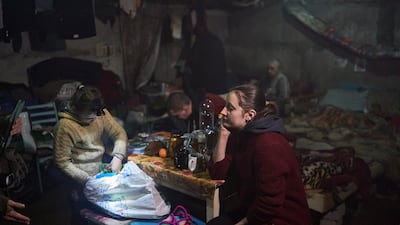
Anna and Nastya in the basement during a Russian attack nearby. AP -
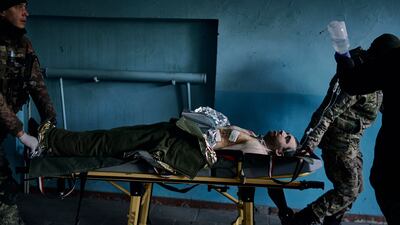
A Ukrainian soldier is wheeled on a stretcher at a hospital in the Donetsk enclave. AP -
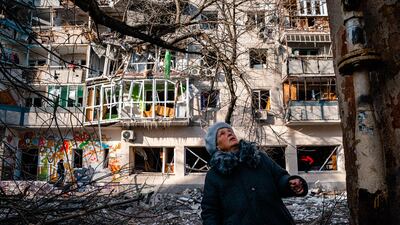
A woman looks a building damaged by Russian shelling in Kherson. AFP -
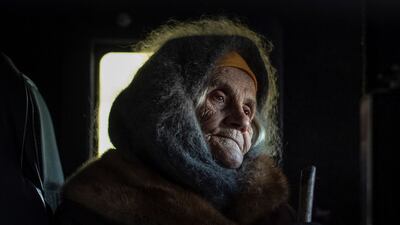
Oleksandra Koshkina, 85, sits in a car as she returns to her village of Torske, in the Donetsk enclave. Reuters -
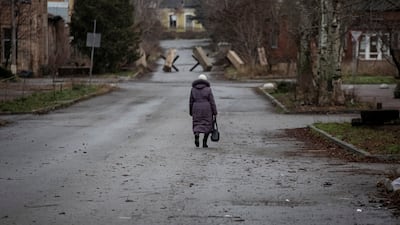
A resident of Bakhmut walks along an empty street. Reuters -
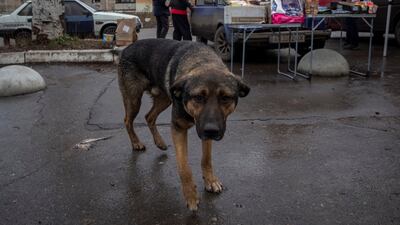
A street market in Bakhmut. Reuters -
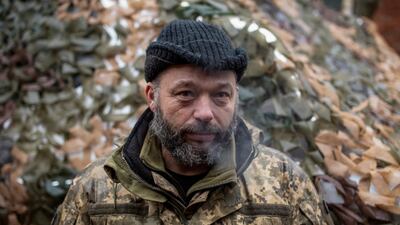
A Ukrainian soldier poses for a picture in the Donetsk enclave. Reuters -
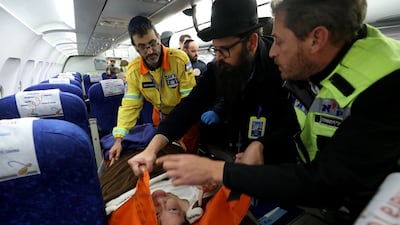
Officials tend to a patient on a plane carrying Ukrainian Jewish refugees as they wait to disembark at Israel's Ben Gurion Airport near Tel Aviv. AFP



