


German Chancellor Olaf Scholz said on Wednesday that the country was ready for winter after finding alternatives to Russian energy.
In a budget debate in parliament, Mr Scholz praised the public for their “prudence and community spirit” in conserving gas.
It came after a new gas terminal was built in record time, condemned coal and nuclear plants were restored to the grid and storage tanks were filled to capacity to prepare for winter.
A warm October helped Germans make major cutbacks in their gas consumption ― although many businesses are worried about high costs with temperatures plunging in recent days.
“Germany is crisis-proof and winter-proof because of the adaptability and strength of its citizens and, yes, because of this government’s work,” Mr Scholz told MPs.
“A year ago our gas storage tanks were as empty as they had rarely been before ― today they are filled to the brim.”
In an impassioned defence of his 11 months in power, Mr Scholz said Germany was addressing mistakes of the past in energy, climate, military and economic policy that left it reliant on Russia.
He condemned what he called the “Alice in Wonderland” politics of opposition leader Friedrich Merz, who denounced Mr Scholz’s record on energy and defence policy.
Mr Merz, the leader of the Christian Democrats (CDU), said promised upgrades to the military funded by €100 billion ($103.1 billion) of borrowing had yet to materialise.

He said the Greens in Mr Scholz’s coalition had let ideology get in the way of energy policy, after a fractious debate on nuclear power.
Mr Scholz laid the blame for Germany’s problems at the door of the previous 16 years of conservative-led governments ― in which he served as finance minister for the last four.
“I’ve heard you tell your party in all seriousness, Mr Merz, that the last 16 years of CDU-led governments were not the problem, but the last 16 weeks under my coalition,” Mr Scholz said.
“I can only say that anyone who believes that believes in talking white rabbits. Welcome to Alice’s Wonderland.”
Mr Scholz said military upgrades would take time as the necessary factories and machinery are built up.
But Mr Merz said the chancellor had broken promises by failing to raise defence spending to the Nato target of 2 per cent of GDP.

There is a consensus among German MPs that the armed forces are in a shabby state, but parties differ on who is to blame.
Mr Scholz blamed a succession of conservative defence ministers, while the opposition says it was the Social Democrats who blocked higher spending.
“After years of neglect we are ensuring we have a modern, strong military that can protect our allies and our country,” he said.
The chancellor defended a planned €200 billion package of energy subsidies, which angered some European countries who could not afford to prop up their economies so extensively.
He said it would help businesses and workers to bridge the gap until cheaper energy can be produced at home, with Mr Scholz’s coalition planning a huge expansion of wind and solar energy.
Germany prepares for the Christmas period - in pictures
-

Crowds flock to the Christmas market in Frankfurt, Germany. AFP -

Christmas figurines are displayed at a market in Ludwigsburg, southern Germany. AFP -

An employee moves a sawed-off tree at a farm in Berggiesshuebel. Reuters -

Dozens of Christmas markets in Germany open around the end of November. AFP -
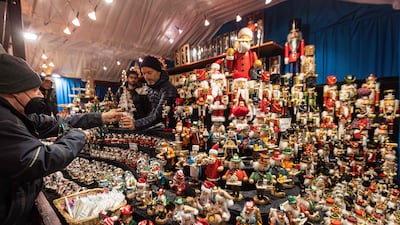
A man buys small Christmas-themed figurines in Frankfurt. AFP -
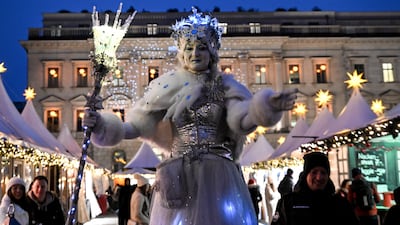
A woman dressed as a snow queen performs at the Christmas market at Babelplatz in Berlin. EPA -

Traditional gingerbread is sold at the Christmas market in Frankfurt. AFP -
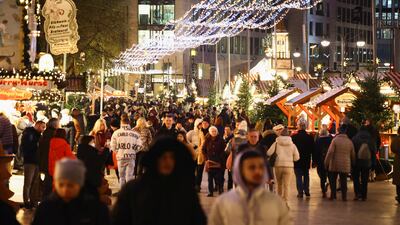
People visit the Breitscheid Square market in Berlin. Reuters



