


Ukraine and its allies have condemned plans by Moscow to hold referendums on whether four occupied areas of the country want to join Russia, in a challenge to the West that could sharply escalate the war.
"The Russians can do whatever they want. It will not change anything," Ukraine's Foreign Minister, Dmytro Kuleba, said at the UN.
"Ukraine has every right to liberate its territories and will keep liberating them whatever Russia has to say," Mr Kuleba added in a tweet.
Ukrainian President Volodymyr Zelenskyy on Tuesday praised western allies for their condemnation of plans by authorities in pro-Moscow regions of Ukraine to hold the referendums.
"I thank all the friends and partners of Ukraine for their massive and firm condemnation of Russia's intentions to organise yet more pseudo-referendums," Mr Zelenskyy said in his daily address.
He played down the importance of the plans by pro-Russian authorities in the regions of Donetsk, Lugansk, Kherson and Zaporizhzhia to hold the votes from September 23 to 27.
"Today there was pretty big news from Russia. But what actually happened? Have we heard anything we didn't hear before?" Mr Zelenskyy said.
"Our position does not change according to this noise or any other announcement. Let's preserve our unity, protect Ukraine, liberate our land and not show any weakness."
Nato Secretary General Jens Stoltenberg decried Moscow's plans for what he called “sham” referendums in occupied parts of Ukraine, warning President Vladimir Putin against further escalating the conflict.
“Such sham votes, referendums, do not have any legitimacy, and therefore they do not change the nature of the conflict,” Mr Stoltenberg told Bloomberg TV on Tuesday.
“This will only further worsen the situation, and therefore we need to provide more support to Ukraine.”
US National Security Adviser Jake Sullivan said Washington rejected any such referendums "unequivocally," and the EU and Canada also condemned the plan.
EU foreign policy chief Josep Borrell said the bloc and its member states would not recognise the outcome of the referendums and would consider further measures against Russia if the votes went ahead.
French President Emmanuel Macron and Lithuanian President Gitanas Nauseda used the word "parody" to describe the planned votes.
German Chancellor Olaf Scholz denounced the plans, saying they must be rejected by the international community.
"It is very, very clear that these sham referendums cannot be accepted and are not covered by international law," Mr Scholz said outside the UN General Assembly.
He called the referendums "part of an intent of imperialist aggression" by Russia, which invaded Ukraine in February, prompting condemnation and sanctions by western powers.
"Russia must withdraw its troops," Mr Scholz said.
Ukraine war latest - in pictures
-
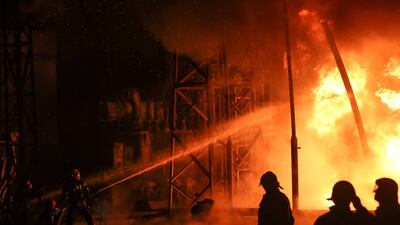
Ukrainian firefighters at a thermal power plant damaged by a Russian missile strike, in Kharkiv. Reuters -
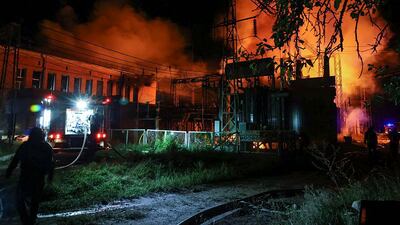
Rescuers in Kharkiv extinguish a fire after a rocket strike. EPA -
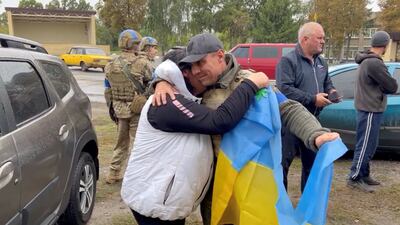
Ukrainian soldiers and local officials are greeted by residents with hugs and handshakes in the village of Kozacha. Reuters -
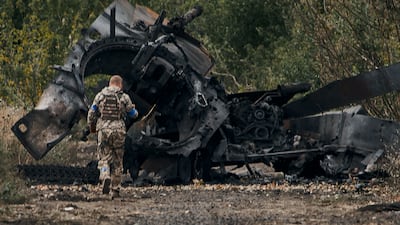
The charred remains of a Russian tank in territory retaken by Ukraine in the Kharkiv region. AP -
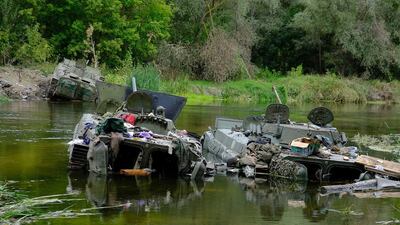
Half-submerged Russian tanks amid the Ukrainian counter-offensive in Kharkiv. AFP -
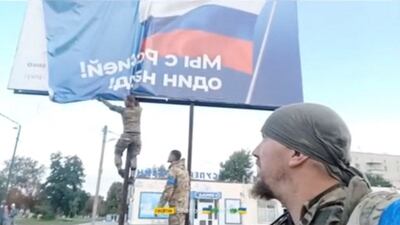
A Russian poster is pulled from a billboard to reveal a poem by Ukrainian Taras Shevchenko in Balakliia, Kharkiv. Reuters -
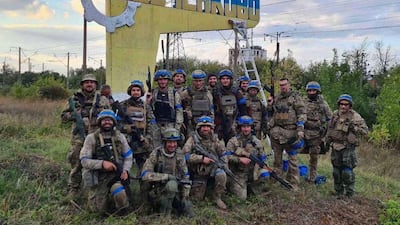
Ukrainian troops in the recently retaken settlement of Vasylenkove. Reuters -
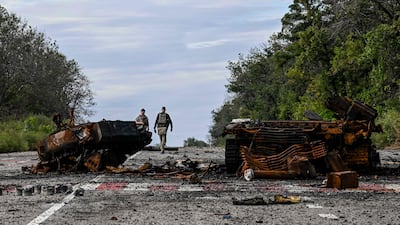
Charred armoured cars litter the road in Balakliia. AFP -
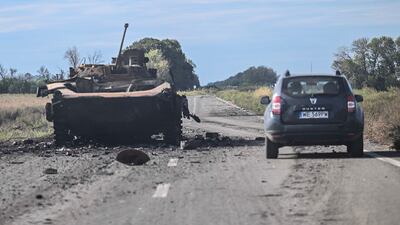
A burnt-out tank in Kharkiv region. AFP -
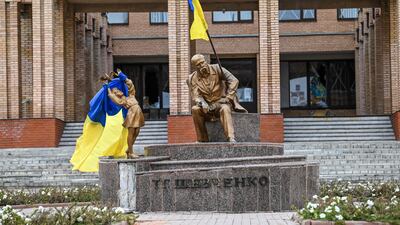
Ukrainian flags are placed on statues in a square in Balakliia. AFP -
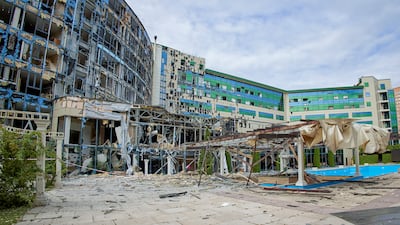
Shell holes pepper the Misto entertainment complex in Kharkiv. EPA -
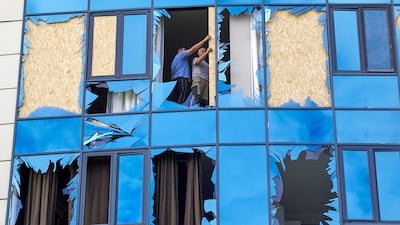
Fixing windows in the damaged Misto complex. EPA


In the apparently co-ordinated move, pro-Russian figures announced referendums for September 23 to 27 in Luhansk, Donetsk, Kherson and Zaporizhzhia provinces, representing about 15 per cent of Ukrainian territory, or an area about the size of Hungary.
Russia already considers Luhansk and Donetsk, which make up the Donbas region Moscow partially occupied in 2014, to be independent states.
Ukraine and the West consider all parts of Ukraine held by Russian forces to be illegally occupied.
Some pro-Kremlin figures said the referendums were an ultimatum to the West to accept Russian territorial gains or face an all-out war with a nuclear-armed foe.
Zaporizhzhia latest - in pictures
-

Jeffrey DeLaurentis, US ambassador for special political affairs, speaks during a UN Security Council meeting on the situation at the Zaporizhzhia nuclear power plant in Ukraine. Getty Images / AFP -

Russian Ambassador to the UN Vasily Nebenzya speaks during a UN Security Council meeting on the situation at the Zaporizhzhia nuclear power plant in Ukraine. Getty Images / AFP -

UN Secretary General Antonio Guterres was told by the International Atomic Energy Agency that inspectors on the ground were 'gravely concerned' after finding damage caused to buildings at the plant. Getty Images / AFP -

Members of the UN Security Council attend a meeting on Tuesday. Getty Images / AFP -

IAEA Director General Rafael Grossi speaks to reporters as the agency prepares to visit the Zaporizhzhia nuclear power plant. AP -

Mr Grossi and 13 of his colleagues inspected the plant that is on the front line of the Russian war in Ukraine. Getty Images -

Refugees from eastern Ukraine receive humanitarian aid at a distribution point in Zaporizhzhia. AP -

Refugees from eastern Ukraine receive humanitarian aid. AP -

A Russian serviceman guards an area of the Zaporizhzhia nuclear power station. AP -

Girls play as a woman distributes iodine tablets to residents at a local school in case of a radiation leak in Zaporizhzhia. AP -

A woman and her daughter stand in front of their house in the village of Zorya, located about 20 kilometres from the nuclear power plant. AP -

A pack of iodine tablets being distributed at a local school in case of a radiation leak in Zaporizhzhia. AP -

Residents in the village of Zorya say that it's not the shelling that scares them most but the risk of a leak in the plant. AP -

Heavy fighting continues near Europe's largest nuclear power plant. AP -

People wait for their turn to get iodine tablets in Zaporizhzhia. AP -

Broken windows at a building at the Russian-controlled Zaporizhzhia plant. Reuters -

A motorcade carrying members of the IAEA leaves after inspecting the plant. AP -

Agency team members inspect the Zaporizhzhia plant. AP -

A general view of a crater left by a Russian missile strike, as Russia's attack on Ukraine continues. Reuters -

During several hours of work at the Zaporizhzhia plant, the IAEA mission received key information about the situation at the nuclear power plant from personnel. EPA -

A picture taken during a visit organised by the Russian military shows international journalists around a drone near Zaporizhzhia. EPA -

A missile outside the Zaporizhzhia plant. EPA -

A view of the Ukrainian plant. EPA -

A picture taken during a visit organised by the Russian military shows Russian servicemen on guard at the plant. EPA -

IAEA Director General Rafael Grossi and agency members inspect the Zaporizhzhia plant. EPA -

A Ukrainian serviceman with a bomb-sniffing dog checks a motorcade transporting part of the IAEA mission. Reuters -

Mr Grossi speaks with journalists after he and a part of the IAEA mission returned from inspections. Reuters -

A Russian military convoy is seen in May on the road towards the Zaporizhzhia plant. AP


"Encroachment on to Russian territory is a crime which allows you to use all the forces of self–defence," Dmitry Medvedev, a former Russian president and now deputy chairman of President Vladimir Putin's Security Council, said on social media.
Margarita Simonyan, editor-in-chief of the pro-Kremlin RT TV station, wrote: "Today a referendum, tomorrow recognition as part of the Russian Federation.
"The day after tomorrow strikes on Russian territory become a full-fledged war between Ukraine and Nato and Russia, untying Russia's hands in every respect."
The US and Nato allies that have been backing Ukraine with weapons and other support said such plebiscites would be meaningless.
If the referendum plan "wasn't so tragic it would be funny", Mr Macron said in New York, where leaders were arriving for a UN General Assembly meeting likely to be dominated by the war in Ukraine.
A spokesman for Mr Nauseda quoted him as saying: "These regions are and will be Ukraine, and Russia's sham referendums are illegal. Lithuania will never recognise them."
Ukraine military forces clean up abandoned Russian positions - video
Making fighting in occupied territory look like an attack on Russia could give Moscow a justification to move in its two million military reservists.
Moscow has so far resisted such a move despite mounting losses in what it calls a limited "special military operation", rather than a war.
Mr Sullivan said Washington was aware of reports that Mr Putin might be considering ordering a mobilisation, which the US official said would do nothing to undermine Ukraine's ability to fight back against Russian aggression.
Russia has declared capturing all of Luhansk and Donetsk provinces to be its main aim since its invasion forces were defeated in March on the outskirts of Kyiv.
It now holds about 60 per cent of Donetsk and had captured nearly all of Luhansk by July after slow advances during months of intense fighting.
Those gains are now under threat after Russian forces were driven from neighbouring Kharkiv province this month, losing control of their main supply lines for much of the Donetsk and Luhansk front lines.
The referendums were announced a day after Ukraine said its troops had recaptured a foothold in Luhansk, the village of Bilohorivka, and were preparing to advance across the province.
The general staff of Ukraine's armed forces said on Tuesday evening that its operations in Donetsk near the towns of Bakhmut and Avdiivka caused Russia to suffer "significant losses".
But Russia shelled those towns and dozens more in north-eastern and southern Ukraine, the general staff said. Reuters could not independently verify those reports.
Putin's inner circle – in pictures
-
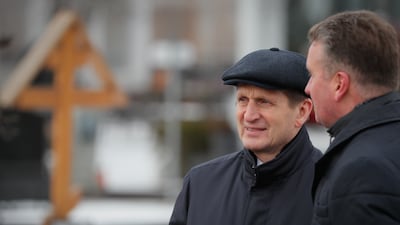
Head of Russia's SVR intelligence service Sergei Naryshkin has seen his status eroded by the strong resistance encountered in Ukraine, which he did not foresee. EPA -
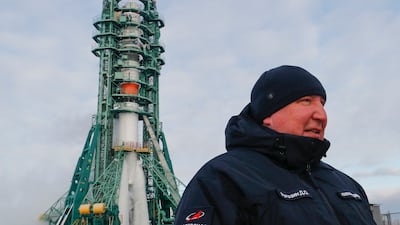
Head of Russia's Roscosmos space agency Dmitry Rogozin has threatened to abandon a Nasa astronaut on the International Space Station. AFP -
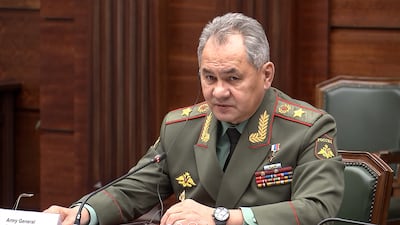
Russian Defence Minister Sergei Shoigu was one of the architects of Moscow's intervention in Syria. AFP -
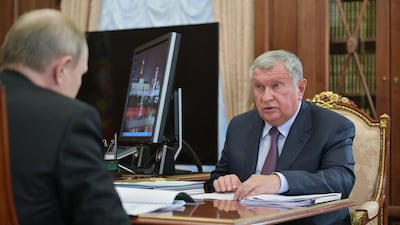
Russian President Vladimir Putin meets with Russia's oil giant Rosneft chief Igor Sechin. He has been described as Mr Putin's right-hand man. AFP -
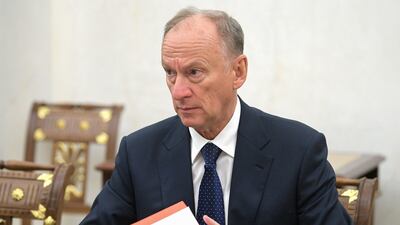
Secretary of Russia's Security Council Nikolai Patrushev attends a meeting in Moscow. He is said to have known Mr Putin for 50 years. AFP -
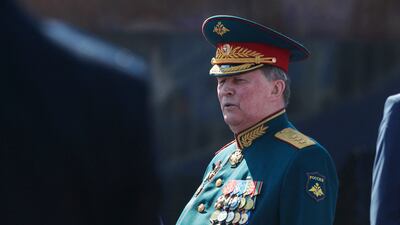
Sergei Ivanov, Russian special representative on questions of ecology and transport, is a close friend of Mr Putin. AFP -
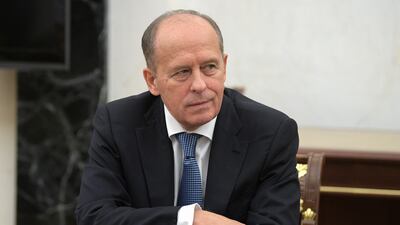
Federal Security Service director Alexander Bortnikov is responsible for a huge network of agents in Russia. AFP -

At 58, president of the Duma Lower House of Parliament Vyacheslav Volodin is one of the younger members of the inner circle. He has been touted as a possible successor to Mr Putin. AFP


In the south, Russia controls most of Zaporizhzhia but not its regional capital.
In Kherson, where the regional capital is the only major city Russia has so far captured intact since the invasion, Ukraine has launched a major counter-offensive.
Unverified footage on social media showed Ukrainian forces in Bilohorivka, which is only 10 kilometres west of the city of Lysychansk that fell to the Russians after weeks of some of the war's most intense fighting in July.
"There will be fighting for every centimetre," the Ukrainian governor of Luhansk, Serhiy Gaidai, wrote on Telegram. "The enemy is preparing their defence. So we will not simply march in."
Pro-Russian officials have said the referendums could be held electronically. Russia staged a referendum in Crimea eight years ago before declaring the former Ukrainian territory annexed.
In a move designed to shore up Russia's military in Ukraine, its Parliament on Tuesday approved a bill to toughen punishments for a host of crimes such as desertion, damage to military property and insubordination, if they were committed during mobilisation or combat situations.

