• A replica of the Hakuto-R series 1 lander that will take the UAE's Rashid rover to the lunar surface in November this year. It was on display at International Astronautical Congress 2021 in Dubai. All photos: Antonie Robertson / The National
    A replica of the Hakuto-R series 1 lander that will take the UAE's Rashid rover to the lunar surface in November this year. It was on display at International Astronautical Congress 2021 in Dubai. All photos: Antonie Robertson / The National
  • Last year’s congress was held in Dubai – the first time an Arab country hosted it since 1950.
    Last year’s congress was held in Dubai – the first time an Arab country hosted it since 1950.
  • The Nasa stand at last year’s event featured a model of the Super Launch System rocket. It is one of the world's most powerful rockets that would make missions to the Moon possible again.
    The Nasa stand at last year’s event featured a model of the Super Launch System rocket. It is one of the world's most powerful rockets that would make missions to the Moon possible again.
  • Roscosmos' launch complex at the French Guiana spaceport.
    Roscosmos' launch complex at the French Guiana spaceport.
  • The congress was attended by more than 4,000 visitors.
    The congress was attended by more than 4,000 visitors.
  • Heads of space agencies, including from the US, Russia, Japan, India and Canada, took part in a plenary session where they provided status on their national space programmes.
    Heads of space agencies, including from the US, Russia, Japan, India and Canada, took part in a plenary session where they provided status on their national space programmes.
  • A replica of the UAE's Hope probe.
    A replica of the UAE's Hope probe.
  • UAE astronaut Sultan Al Neyadi at the congress.
    UAE astronaut Sultan Al Neyadi at the congress.
  • UAE astronaut Nora Al Matrooshi also attended the event.
    UAE astronaut Nora Al Matrooshi also attended the event.
  • Ms Al Matrooshi is the first Arab female astronaut.
    Ms Al Matrooshi is the first Arab female astronaut.
  • Hazza Al Mansouri, the first Emirati man in space, speaks at the congress.
    Hazza Al Mansouri, the first Emirati man in space, speaks at the congress.

Moon, Mars and Chinese missions on agenda at world’s largest space conference in Paris


Sarwat Nasir
  • English
  • Arabic

The world’s largest space conference that will bring together heads of space agencies, private space players, engineers, scientists and astronauts, is set to begin in Paris on Sunday.

The annual International Astronautical Congress (IAC) helps provide a deeper insight into some of the latest exploration missions.

Under the theme ‘Space for All’, the event, organised by the International Astronautical Federation, is taking place at the Paris Convention Centre until next Thursday.

Last year’s IAC was held in Dubai, the first time an Arab country had hosted it since 1950.

The National explains what is on the agenda at this year’s event.

Heads of space agencies

Space agency chiefs from China, the US, India, Japan, Canada and Europe will outline their priorities and highlight past achievements.

All except China and India are partners on the International Space Station.

China is building its own space station — the Tiangong — in low-Earth orbit, with astronauts currently on board.

Chinese astronauts wave from inside the Wentian lab module. AP

India is planning to launch its astronauts on a domestically built rocket and spacecraft, and has already led a Moon mission that made a crash-landing on the lunar surface.

Nasa launched the James Webb Space Telescope last year, built with its partners from the European and Canadian space agencies.

It is also trying to launch Artemis 1, a test flight around the Moon but with no crew.

The chiefs will hold a press conference after their panel session.

No participation from Russia

The current agenda indicates no participation from Russia’s space agency Roscosmos nor private Russian companies.

Last year, Dmitry Rogozin, who was then director of Roscosmos, spoke as part of the ‘Heads of Space Agencies’ panel and answered media questions.

Yury Borisov has since taken over the role.

Europe and Russia’s relationship in space has plummeted since the invasion of Ukraine.

This year, Europe’s space agency cut ties with Russia on a Mars mission they were working on together.

Meanwhile, Roscosmos removed its Soyuz rockets and staff from a European spaceport in French Guiana.

Russia plans to quit the ISS within this decade and build an independent one.

China to reveal future plans

China’s space agency — the China National Space Administration — will share plans and co-operation opportunities in its lunar and deep space exploration programme.

China is quickly becoming a global space power, having achieved a Mars orbiting and landing mission, built its independent space station in low-Earth orbit and with plans in motion to develop an International Lunar Research Station.

It aims to carry out planetary exploration programmes, including asteroid sampling, main belt comet exploration, Mars sample return and Jupiter system exploration.

Nasa and private companies

Engineers will gather to discuss the achievements of the James Webb Space Telescope, the world’s most powerful that took more than two decades to build.

Nasa will discuss the Moon to Mars objective, a plan that aims to build a sustainable human presence on the Moon and then launch astronauts to Mars from the lunar surface.

Climate change will also feature prominently in discussions at this year’s IAC, as many parts of the world have experienced severe heatwaves and extreme weather so far this year.

Private companies such as Blue Origin, Axiom Space, Lockheed Martin, Nanoracks and Airbus will also attend the event.

Most will speak about the future of low-Earth orbit in the next decade, as companies try to commercialise it.

UAE and Saudi Arabia

The Mohammed bin Rashid Space Centre, the UAE Space Agency and the Saudi Space Commission will be participating.

Saudi Arabia is investing heavily in its space programme, with plans to explore the Moon and Mars. Events like this give emerging space nations like Saudi Arabia a platform to seek potential partnerships and secure deals.

The UAE is also expected to announce new partnerships during this year’s IAC.

Artemis Accords signatories to meet

Countries that have signed the Artemis Accords — a US-led international agreement that outlines responsible space exploration — will meet for the first time at the IAC.

So far, 21 members have signed, including the UAE, Saudi Arabia and Bahrain.

Stunning images by the James Webb Space Telescope - in pictures

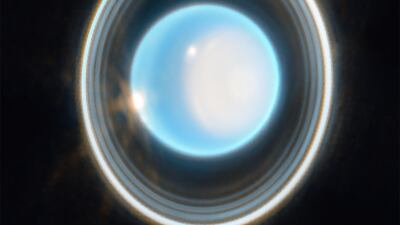
  • Uranus is surrounded by 13 rings and 27 small moons as it rotates at a nearly 90-degree angle from the plane of its orbit. Photo: Nasa
    Uranus is surrounded by 13 rings and 27 small moons as it rotates at a nearly 90-degree angle from the plane of its orbit. Photo: Nasa
  • Complex organic molecules similar to smoke or smog in a galaxy more than 12 billion light-years from Earth. Photo: Nasa
    Complex organic molecules similar to smoke or smog in a galaxy more than 12 billion light-years from Earth. Photo: Nasa
  • A delicate image of dust structures and bright star clusters taken by the James Webb Space Telescope. Photo: Nasa
    A delicate image of dust structures and bright star clusters taken by the James Webb Space Telescope. Photo: Nasa
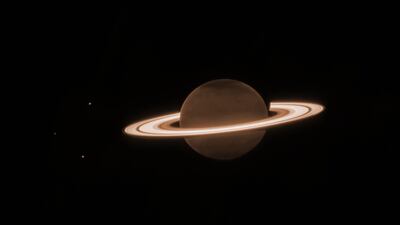
  • Saturn has seven rings with several gaps and divisions between them, as well as 53 known moons. Photo: Nasa
    Saturn has seven rings with several gaps and divisions between them, as well as 53 known moons. Photo: Nasa
  • Star cluster NGC 346, spiral galaxies NGC 1672 and Messier 74, and the Pillars of Creation, towering tendrils of cosmic dust and gas at the heart of the Eagle Nebula. Photo: Nasa
    Star cluster NGC 346, spiral galaxies NGC 1672 and Messier 74, and the Pillars of Creation, towering tendrils of cosmic dust and gas at the heart of the Eagle Nebula. Photo: Nasa
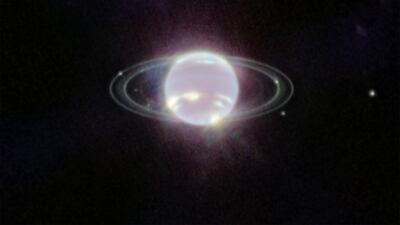
  • An infrared image of Neptune, the only planet in our solar system not visible to the naked eye. Photo: Nasa
    An infrared image of Neptune, the only planet in our solar system not visible to the naked eye. Photo: Nasa
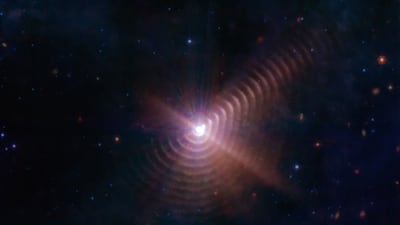
  • Every eight years, the two stars in this image are brought together by their orbits – creating colliding streams of gas that, under the right conditions, form a new ring of dust. Photo: Nasa
    Every eight years, the two stars in this image are brought together by their orbits – creating colliding streams of gas that, under the right conditions, form a new ring of dust. Photo: Nasa
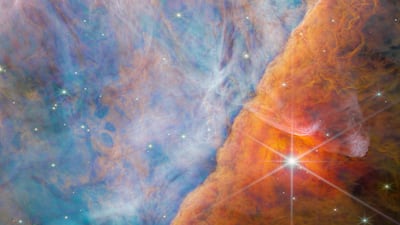
  • A part of the Orion Nebula known as the Orion Bar. Photo: Nasa
    A part of the Orion Nebula known as the Orion Bar. Photo: Nasa
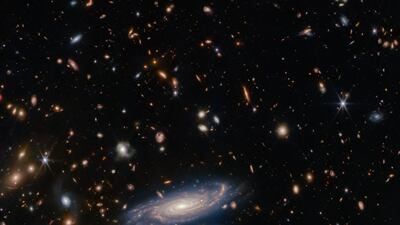
  • A crowded field of galaxies, along with stars crowned with the James Webb Space Telescope's signature six-pointed diffraction spikes. Photo: Nasa
    A crowded field of galaxies, along with stars crowned with the James Webb Space Telescope's signature six-pointed diffraction spikes. Photo: Nasa
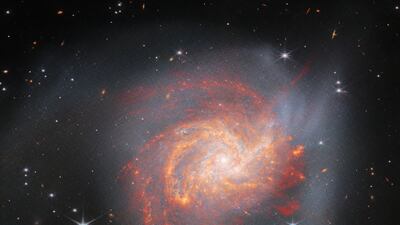
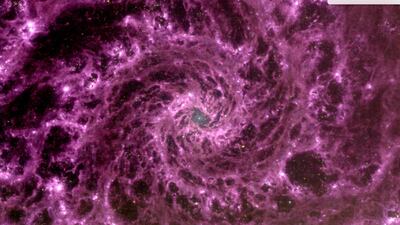
  • The NGC 3256 spiral galaxy was formed after a collision of two massive galaxies about 500 million years ago. Photo: Nasa
    The NGC 3256 spiral galaxy was formed after a collision of two massive galaxies about 500 million years ago. Photo: Nasa
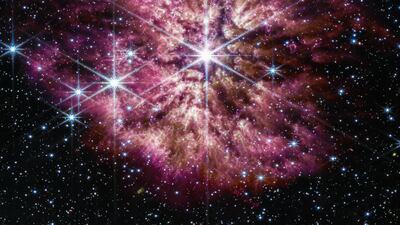
  • The Wolf-Rayet 124 star, featured in an image combining near-infrared and mid-infrared wavelengths of light. Photo: Nasa
    The Wolf-Rayet 124 star, featured in an image combining near-infrared and mid-infrared wavelengths of light. Photo: Nasa
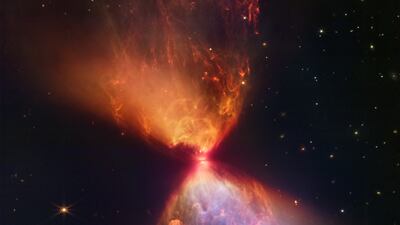
  • An hourglass-shaped cloud of dust and gas is illuminated by light from a protostar. Photo: Nasa
    An hourglass-shaped cloud of dust and gas is illuminated by light from a protostar. Photo: Nasa
  • Two views of the Southern Ring Nebula, which show the planetary nebula as a misshapen oval. Photo: Nasa
    Two views of the Southern Ring Nebula, which show the planetary nebula as a misshapen oval. Photo: Nasa
  • A composite image of the Cartwheel Galaxy captured by the James Webb Space Telescope in August 2022. AFP
    A composite image of the Cartwheel Galaxy captured by the James Webb Space Telescope in August 2022. AFP
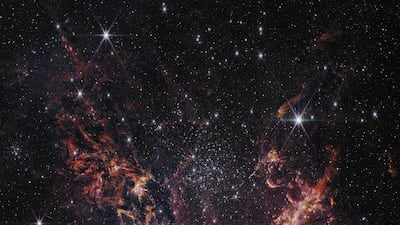
  • A cluster of stars in the Small Magellanic Cloud, near the Milky Way. Photo: JWST
    A cluster of stars in the Small Magellanic Cloud, near the Milky Way. Photo: JWST
  • A colour composite image of the Messier 74 galaxy. Photo: JWST
    A colour composite image of the Messier 74 galaxy. Photo: JWST
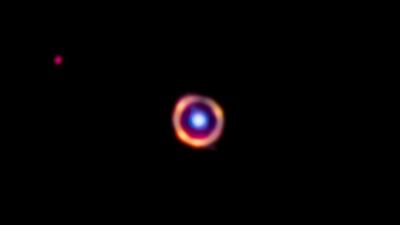
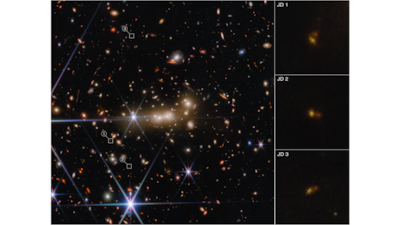
  • The gravity of galaxy cluster MACS0647 bends and magnifies light from the more distant MACS0647-JD. Photo: Nasa
    The gravity of galaxy cluster MACS0647 bends and magnifies light from the more distant MACS0647-JD. Photo: Nasa
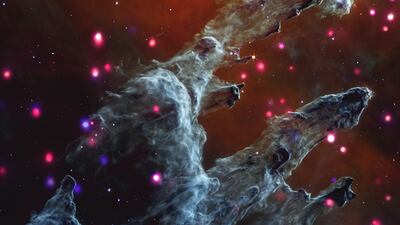
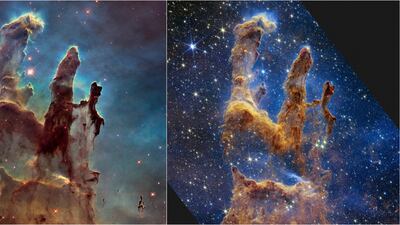
  • The 'Pillars of Creation' — clouds of hydrogen gas and dust 6,500 light years from Earth — captured by the Hubble Space Telescope, left, and James Webb Space Telescope. AP
    The 'Pillars of Creation' — clouds of hydrogen gas and dust 6,500 light years from Earth — captured by the Hubble Space Telescope, left, and James Webb Space Telescope. AP
  • Dust rings resembling a fingerprint created by a rare type of star and its companion. PA
    Dust rings resembling a fingerprint created by a rare type of star and its companion. PA
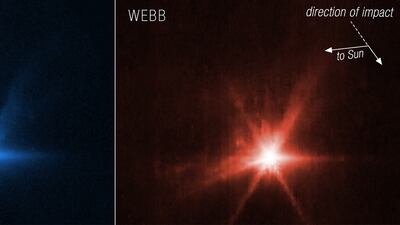
  • Images of the asteroid Dimorphos hours after Nasa crashed a spacecraft into it in September 2022. EPA
    Images of the asteroid Dimorphos hours after Nasa crashed a spacecraft into it in September 2022. EPA
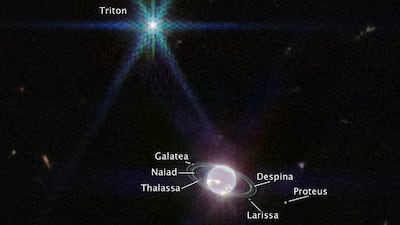
  • Neptune and seven of its 14 known moons. AFP
    Neptune and seven of its 14 known moons. AFP
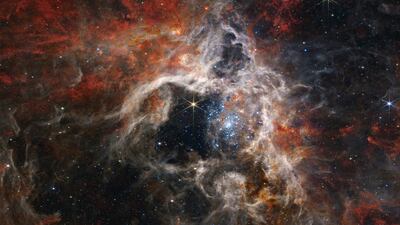
  • Thousands of young stars in a stellar nursery called the Tarantula Nebula. Photo: Nasa
    Thousands of young stars in a stellar nursery called the Tarantula Nebula. Photo: Nasa
  • A image of an exoplanet — a gas giant with no rocky surface. Photo: Nasa, ESA and CSA
    A image of an exoplanet — a gas giant with no rocky surface. Photo: Nasa, ESA and CSA
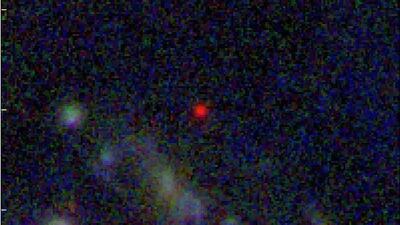
  • Glass-z13, the oldest galaxy to be detected, was formed about 300 million years after the Big Bang. Photo: JWST
    Glass-z13, the oldest galaxy to be detected, was formed about 300 million years after the Big Bang. Photo: JWST
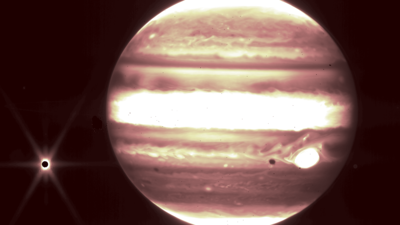
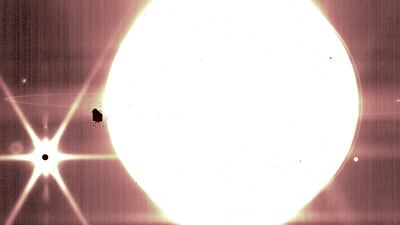
  • Jupiter and its moon Europa. Photo: Nasa
    Jupiter and its moon Europa. Photo: Nasa
  • Jupiter and its moons Europa, Thebe and Metis. Photo: Nasa
    Jupiter and its moons Europa, Thebe and Metis. Photo: Nasa
  • Another image of Jupiter and some of its 79 moons. Photo: Nasa
    Another image of Jupiter and some of its 79 moons. Photo: Nasa
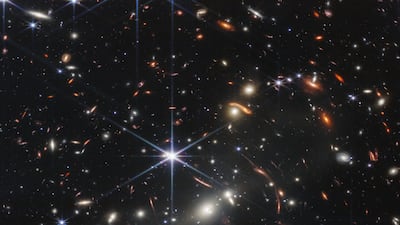
  • An image of galaxy cluster Smacs 0723 taken by the James Webb telescope. Photo: Nasa
    An image of galaxy cluster Smacs 0723 taken by the James Webb telescope. Photo: Nasa
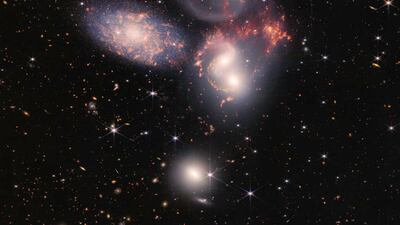
  • Stephan’s Quintet is an area in space that has five galaxies. Photo: JWST
    Stephan’s Quintet is an area in space that has five galaxies. Photo: JWST
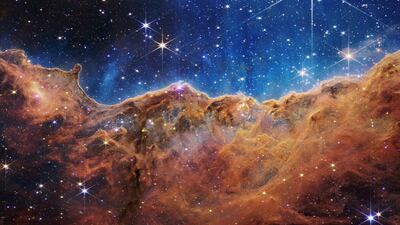
  • The 'Cosmic Cliffs' of the Carina Nebula. Photo: JWST
    The 'Cosmic Cliffs' of the Carina Nebula. Photo: JWST
  • An anniversary image shows the birth of a star in the Rho Ophiuchi cloud complex, the closest star-forming region to Earth. Photo: Nasa
    An anniversary image shows the birth of a star in the Rho Ophiuchi cloud complex, the closest star-forming region to Earth. Photo: Nasa
APPLE IPAD MINI (A17 PRO)

Display: 21cm Liquid Retina Display, 2266 x 1488, 326ppi, 500 nits

Chip: Apple A17 Pro, 6-core CPU, 5-core GPU, 16-core Neural Engine

Storage: 128/256/512GB

Main camera: 12MP wide, f/1.8, digital zoom up to 5x, Smart HDR 4

Front camera: 12MP ultra-wide, f/2.4, Smart HDR 4, full-HD @ 25/30/60fps

Biometrics: Touch ID, Face ID

Colours: Blue, purple, space grey, starlight

In the box: iPad mini, USB-C cable, 20W USB-C power adapter

Price: From Dh2,099

The%20specs%20
%3Cp%3E%3Cstrong%3EEngine%3A%20%3C%2Fstrong%3E2.0-litre%204cyl%20turbo%0D%3Cbr%3E%3Cstrong%3EPower%3A%20%3C%2Fstrong%3E261hp%20at%205%2C500rpm%0D%3Cbr%3E%3Cstrong%3ETorque%3A%20%3C%2Fstrong%3E400Nm%20at%201%2C750-4%2C000rpm%0D%3Cbr%3E%3Cstrong%3ETransmission%3A%20%3C%2Fstrong%3E7-speed%20dual-clutch%20auto%0D%3Cbr%3E%3Cstrong%3EFuel%20consumption%3A%20%3C%2Fstrong%3E10.5L%2F100km%0D%3Cbr%3E%3Cstrong%3EOn%20sale%3A%20%3C%2Fstrong%3ENow%0D%3Cbr%3E%3Cstrong%3EPrice%3A%20%3C%2Fstrong%3EFrom%20Dh129%2C999%20(VX%20Luxury)%3B%20from%20Dh149%2C999%20(VX%20Black%20Gold)%3C%2Fp%3E%0A
Federer's 11 Wimbledon finals

2003 Beat Mark Philippoussis

2004 Beat Andy Roddick

2005 Beat Andy Roddick

2006 Beat Rafael Nadal

2007 Beat Rafael Nadal

2008 Lost to Rafael Nadal

2009 Beat Andy Roddick

2012 Beat Andy Murray

2014 Lost to Novak Djokovic

2015 Lost to Novak Djokovic

2017 Beat Marin Cilic

Kill%20
%3Cp%3E%3Cstrong%3EDirector%3A%3C%2Fstrong%3E%20Nikhil%20Nagesh%20Bhat%3C%2Fp%3E%0A%3Cp%3E%3Cstrong%3EStarring%3C%2Fstrong%3E%3A%20Lakshya%2C%20Tanya%20Maniktala%2C%20Ashish%20Vidyarthi%2C%20Harsh%20Chhaya%2C%20Raghav%20Juyal%3C%2Fp%3E%0A%3Cp%3E%3Cstrong%3ERating%3A%3C%2Fstrong%3E%204.5%2F5%3Cbr%3E%3C%2Fp%3E%0A
Know before you go
  • Jebel Akhdar is a two-hour drive from Muscat airport or a six-hour drive from Dubai. It’s impossible to visit by car unless you have a 4x4. Phone ahead to the hotel to arrange a transfer.
  • If you’re driving, make sure your insurance covers Oman.
  • By air: Budget airlines Air Arabia, Flydubai and SalamAir offer direct routes to Muscat from the UAE.
  • Tourists from the Emirates (UAE nationals not included) must apply for an Omani visa online before arrival at evisa.rop.gov.om. The process typically takes several days.
  • Flash floods are probable due to the terrain and a lack of drainage. Always check the weather before venturing into any canyons or other remote areas and identify a plan of escape that includes high ground, shelter and parking where your car won’t be overtaken by sudden downpours.


THE SPECS

Engine: 1.6-litre turbo

Transmission: six-speed automatic

Power: 165hp

Torque: 240Nm

Price: From Dh89,000 (Enjoy), Dh99,900 (Innovation)

On sale: Now

The%20specs
%3Cp%3E%3Cstrong%3EEngine%3A%20%3C%2Fstrong%3E2.3-litre%204cyl%20turbo%0D%3Cbr%3E%3Cstrong%3EPower%3A%20%3C%2Fstrong%3E299hp%20at%205%2C500rpm%0D%3Cbr%3E%3Cstrong%3ETorque%3A%20%3C%2Fstrong%3E420Nm%20at%202%2C750rpm%0D%3Cbr%3E%3Cstrong%3ETransmission%3A%20%3C%2Fstrong%3E10-speed%20auto%0D%3Cbr%3E%3Cstrong%3EFuel%20consumption%3A%20%3C%2Fstrong%3E12.4L%2F100km%0D%3Cbr%3E%3Cstrong%3EOn%20sale%3A%20%3C%2Fstrong%3ENow%0D%3Cbr%3E%3Cstrong%3EPrice%3A%20%3C%2Fstrong%3EFrom%20Dh157%2C395%20(XLS)%3B%20Dh199%2C395%20(Limited)%3C%2Fp%3E%0A
The specs

Engine: 3-litre twin-turbo V6

Power: 400hp

Torque: 475Nm

Transmission: 9-speed automatic

Price: From Dh215,900

On sale: Now

The specs
  • Engine: 3.9-litre twin-turbo V8
  • Power: 640hp
  • Torque: 760nm
  • On sale: 2026
  • Price: Not announced yet
Company%20profile
%3Cp%3EName%3A%20Tabby%3Cbr%3EFounded%3A%20August%202019%3B%20platform%20went%20live%20in%20February%202020%3Cbr%3EFounder%2FCEO%3A%20Hosam%20Arab%2C%20co-founder%3A%20Daniil%20Barkalov%3Cbr%3EBased%3A%20Dubai%2C%20UAE%3Cbr%3ESector%3A%20Payments%3Cbr%3ESize%3A%2040-50%20employees%3Cbr%3EStage%3A%20Series%20A%3Cbr%3EInvestors%3A%20Arbor%20Ventures%2C%20Mubadala%20Capital%2C%20Wamda%20Capital%2C%20STV%2C%20Raed%20Ventures%2C%20Global%20Founders%20Capital%2C%20JIMCO%2C%20Global%20Ventures%2C%20Venture%20Souq%2C%20Outliers%20VC%2C%20MSA%20Capital%2C%20HOF%20and%20AB%20Accelerator.%3Cbr%3E%3C%2Fp%3E%0A
The specs
Engine: 2.0-litre 4-cyl turbo

Power: 201hp at 5,200rpm

Torque: 320Nm at 1,750-4,000rpm

Transmission: 6-speed auto

Fuel consumption: 8.7L/100km

Price: Dh133,900

On sale: now 

Updated: September 15, 2022, 11:33 AM