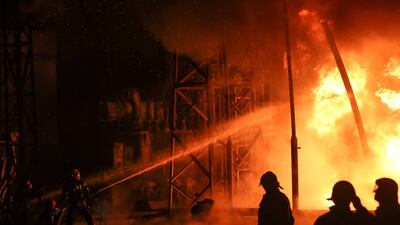
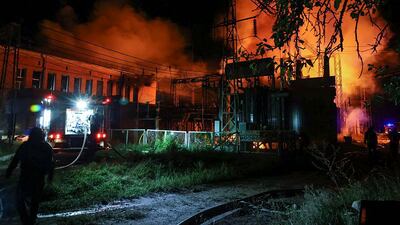
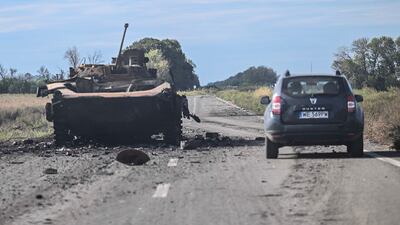
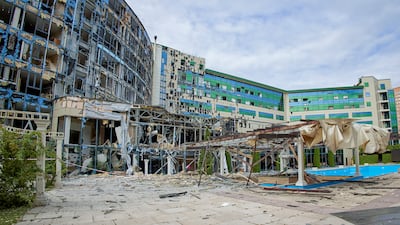
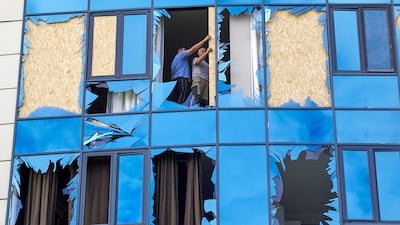
Ukraine’s forces looked to consolidate rapid territory gains at the weekend, as Russia carried out revenge attacks on its power infrastructure, causing power cuts across the country.
Officials in Ukraine said targets included water facilities and a thermal power station in Kharkiv.
Mr Zelenskyy described the continuing offensive in the north-east, which Ukraine launched last Tuesday, as a potential breakthrough in the six-month long war.
Defence forces had dislodged the enemy from more than 20 settlements in the past day, according to Ukraine's General Staff.
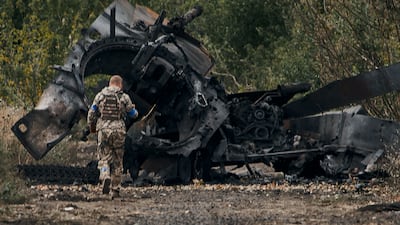
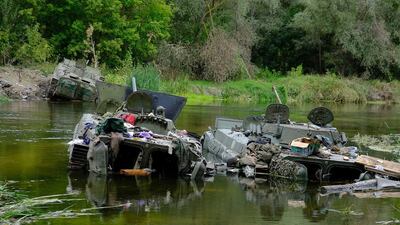
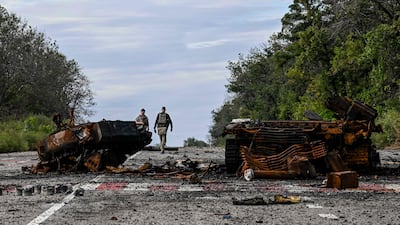
Thousands of Russian soldiers left ammunition and equipment behind as they fled Izium, which they had been using as a logistics hub.
According to an intelligence update from the UK’s Ministry of Defence (MoD), Ukraine has recaptured territory of at least twice the size of Greater London since Wednesday.
It said Russia had probably ordered the withdrawal of troops from the “entirety of occupied Kharkiv Oblast west of the Oskil River” in the face of Ukrainian advances.
“Isolated pockets of resistance remain in this sector, but since Wednesday, Ukraine has recaptured territory at least twice the size of Greater London.”
Russia is also struggling in the south, near Kherson, to bring sufficient reserves forward across the Dnipro River to the front line, said the MoD.
“An improvised floating bridge Russia started over two weeks ago remains incomplete; Ukrainian long-range artillery is now probably hitting crossings of the Dnipro so frequently that Russia cannot carry out repairs to damaged Road bridges.”
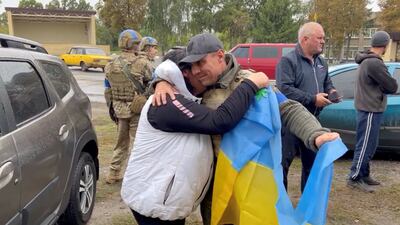
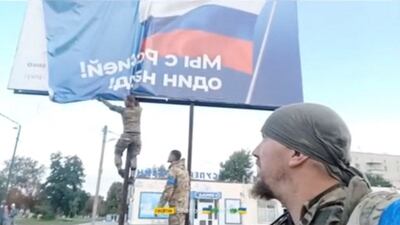
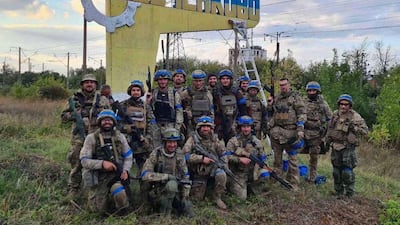
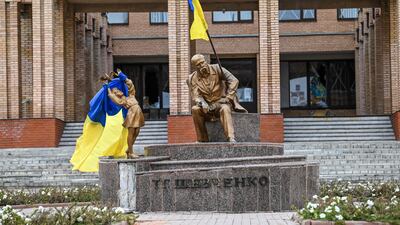
In the village of Kozacha Lopan north of Kharkiv, near the Russian border, Ukrainian soldiers and local officials were greeted by residents with hugs and handshakes.
“Kozacha (Lopan) is and will be Ukraine,” district mayor Vyacheslav Zadorenko said, in a video he posted on Facebook.
“No 'Russian World' whatsoever. See for yourselves where the 'Russian World' rags are lying around. Glory to Ukraine, glory to the Ukrainian Armed Forces.”
Former army chief Lord Dannatt said the Russians have “pretty much turned and fled” from the Kharkiv area of Ukraine, representing a “significant reverse” of their position.
While this is a “great success” for the Ukrainians, he said they continue to need “more and more” western arms and ammunition to be able to “keep the pressure up”.
“We are witnessing some incredible scenes,” he told Sky News.
“Although the Ukrainians have made significant advances, there's a lot of their country still in Russian occupation. So there's a long way to go.”
Speaking on Radio 4 on Monday morning, Sergei Markov, a Russian political scientist and former close adviser to Russian President Vladimir Putin, said “of course” he was concerned by the recent Ukrainian gains.
“It’s a big victory of the Ukrainian army, which took something [like] 5 per cent of the territories which had been taken by the Russian army before,” he said.
Mr Markov said he suspected Russia would now change its strategy, moving towards escalation to “more real war,” which will involve “some kind of mobilisation”.
“Some mobilisation in Russia will happen. Possibly mobilisation of IT specialists. Mobilisation of the special forces, something like this.
“And most important, it could be mobilisation for the Russian economy. Because Russia needs much more drones, much more specific modern weaponry.”
Lord Dannatt said Russia is responding to Ukraine's recent success in the Kharkiv area in a “typically heavy handed way”.
“They know that they've had a significant reverse on the battlefield, so they're lashing out in other ways to try and restore their position,” he told Sky News.
He said targeting a power station was an example of Moscow “blindly lashing out”.
The retaliatory attacks caused a total power cut in the Kharkiv and Donetsk regions, and partial blackouts in the Zaporizhzhia, Dnipropetrovsk and Sumy regions, Mr Zelenskyy said.
Kharkiv governor Oleh Synehubov said 80 per cent of electricity and water supplies had been restored in the region by Monday morning.
An adviser to Mr Zelenskyy admitted on an early morning interview on BBC Radio 4 that Russia may try and win the war by unconventional tactics, taking out power and water and attacking steel and electricity plants.
“They have moved to that strategy months ago when they realised their blitzkrieg had failed,” said Alexander Rodnyansky, who is also an associate professor of economics at the University of Cambridge.
“If you can’t achieve an immediate victory on their end then they are going to try and make this a slow and painful death for us. But they are not going to be successful with that.”
On Sunday, French President Emmanuel Macron called on his Russian counterpart Vladimir Putin to end military operations and come to the negotiating table.
“President Macron had a phone call with his Russian counterpart, Vladimir Putin, and called for ending Russian military operations as soon as possible so that negotiations can begin,” a statement from the Elysee Palace said.
Mr Macron also expressed his concern to the Russian president about the safety of the Zaporizhzhia nuclear power plant.
The head of the International Atomic Energy Agency, Rafael Grossi, said on Monday both sides are interested in the UN atomic watchdog's proposal to establish a protection zone around the Russian-held plant.
Mr Grossi has called both for an immediate stop to nearby shelling, which Ukraine and Russia both blame on each other, and a more formal "nuclear safety and security protection zone" around the plant.
"I have seen signs that they are interested in this agreement," he told a news conference. "What I see is two sides that are engaging with us, that are asking questions, lots of questions."
Issues being discussed include the radius of the zone and the role of IAEA staff, Mr Grossi said. Two IAEA officials are currently stationed at the plant and form what the agency calls a "continuous presence" there.

Turning%20waste%20into%20fuel
%3Cp%3EAverage%20amount%20of%20biofuel%20produced%20at%20DIC%20factory%20every%20month%3A%20%3Cstrong%3EApproximately%20106%2C000%20litres%3C%2Fstrong%3E%3C%2Fp%3E%0A%3Cp%3EAmount%20of%20biofuel%20produced%20from%201%20litre%20of%20used%20cooking%20oil%3A%20%3Cstrong%3E920ml%20(92%25)%3C%2Fstrong%3E%3C%2Fp%3E%0A%3Cp%3ETime%20required%20for%20one%20full%20cycle%20of%20production%20from%20used%20cooking%20oil%20to%20biofuel%3A%20%3Cstrong%3EOne%20day%3C%2Fstrong%3E%3C%2Fp%3E%0A%3Cp%3EEnergy%20requirements%20for%20one%20cycle%20of%20production%20from%201%2C000%20litres%20of%20used%20cooking%20oil%3A%3Cbr%3E%3Cstrong%3E%E2%96%AA%20Electricity%20-%201.1904%20units%3Cbr%3E%E2%96%AA%20Water-%2031%20litres%3Cbr%3E%E2%96%AA%20Diesel%20%E2%80%93%2026.275%20litres%3C%2Fstrong%3E%3C%2Fp%3E%0A
Jetour T1 specs
Engine: 2-litre turbocharged
Power: 254hp
Torque: 390Nm
Price: From Dh126,000
Available: Now
What can victims do?
Always use only regulated platforms
Stop all transactions and communication on suspicion
Save all evidence (screenshots, chat logs, transaction IDs)
Report to local authorities
Warn others to prevent further harm
Courtesy: Crystal Intelligence
The specs
Engine: 6.2-litre supercharged V8
Power: 712hp at 6,100rpm
Torque: 881Nm at 4,800rpm
Transmission: 8-speed auto
Fuel consumption: 19.6 l/100km
Price: Dh380,000
On sale: now
Read more about the coronavirus
Mercer, the investment consulting arm of US services company Marsh & McLennan, expects its wealth division to at least double its assets under management (AUM) in the Middle East as wealth in the region continues to grow despite economic headwinds, a company official said.
Mercer Wealth, which globally has $160 billion in AUM, plans to boost its AUM in the region to $2-$3bn in the next 2-3 years from the present $1bn, said Yasir AbuShaban, a Dubai-based principal with Mercer Wealth.
“Within the next two to three years, we are looking at reaching $2 to $3 billion as a conservative estimate and we do see an opportunity to do so,” said Mr AbuShaban.
Mercer does not directly make investments, but allocates clients’ money they have discretion to, to professional asset managers. They also provide advice to clients.
“We have buying power. We can negotiate on their (client’s) behalf with asset managers to provide them lower fees than they otherwise would have to get on their own,” he added.
Mercer Wealth’s clients include sovereign wealth funds, family offices, and insurance companies among others.
From its office in Dubai, Mercer also looks after Africa, India and Turkey, where they also see opportunity for growth.
Wealth creation in Middle East and Africa (MEA) grew 8.5 per cent to $8.1 trillion last year from $7.5tn in 2015, higher than last year’s global average of 6 per cent and the second-highest growth in a region after Asia-Pacific which grew 9.9 per cent, according to consultancy Boston Consulting Group (BCG). In the region, where wealth grew just 1.9 per cent in 2015 compared with 2014, a pickup in oil prices has helped in wealth generation.
BCG is forecasting MEA wealth will rise to $12tn by 2021, growing at an annual average of 8 per cent.
Drivers of wealth generation in the region will be split evenly between new wealth creation and growth of performance of existing assets, according to BCG.
Another general trend in the region is clients’ looking for a comprehensive approach to investing, according to Mr AbuShaban.
“Institutional investors or some of the families are seeing a slowdown in the available capital they have to invest and in that sense they are looking at optimizing the way they manage their portfolios and making sure they are not investing haphazardly and different parts of their investment are working together,” said Mr AbuShaban.
Some clients also have a higher appetite for risk, given the low interest-rate environment that does not provide enough yield for some institutional investors. These clients are keen to invest in illiquid assets, such as private equity and infrastructure.
“What we have seen is a desire for higher returns in what has been a low-return environment specifically in various fixed income or bonds,” he said.
“In this environment, we have seen a de facto increase in the risk that clients are taking in things like illiquid investments, private equity investments, infrastructure and private debt, those kind of investments were higher illiquidity results in incrementally higher returns.”
The Abu Dhabi Investment Authority, one of the largest sovereign wealth funds, said in its 2016 report that has gradually increased its exposure in direct private equity and private credit transactions, mainly in Asian markets and especially in China and India. The authority’s private equity department focused on structured equities owing to “their defensive characteristics.”
RESULT
Bayern Munich 5 Eintrracht Frankfurt 2
Bayern: Goretzka (17'), Müller (41'), Lewandowski (46'), Davies (61'), Hinteregger (74' og)
Frankfurt: Hinteregger (52', 55')
Match info
Uefa Champions League Group B
Tottenham Hotspur 1 (Eriksen 80')
Inter Milan 0
Company name: Play:Date
Launched: March 2017 on UAE Mother’s Day
Founder: Shamim Kassibawi
Based: Dubai with operations in the UAE and US
Sector: Tech
Size: 20 employees
Stage of funding: Seed
Investors: Three founders (two silent co-founders) and one venture capital fund
Leaderboard
15 under: Paul Casey (ENG)
-14: Robert MacIntyre (SCO)
-13 Brandon Stone (SA)
-10 Laurie Canter (ENG) , Sergio Garcia (ESP)
-9 Kalle Samooja (FIN)
-8 Thomas Detry (BEL), Justin Harding (SA), Justin Rose (ENG)
Polarised public
31% in UK say BBC is biased to left-wing views
19% in UK say BBC is biased to right-wing views
19% in UK say BBC is not biased at all
Source: YouGov
What is the FNC?
The Federal National Council is one of five federal authorities established by the UAE constitution. It held its first session on December 2, 1972, a year to the day after Federation.
It has 40 members, eight of whom are women. The members represent the UAE population through each of the emirates. Abu Dhabi and Dubai have eight members each, Sharjah and Ras al Khaimah six, and Ajman, Fujairah and Umm Al Quwain have four.
They bring Emirati issues to the council for debate and put those concerns to ministers summoned for questioning.
The FNC’s main functions include passing, amending or rejecting federal draft laws, discussing international treaties and agreements, and offering recommendations on general subjects raised during sessions.
Federal draft laws must first pass through the FNC for recommendations when members can amend the laws to suit the needs of citizens. The draft laws are then forwarded to the Cabinet for consideration and approval.
Since 2006, half of the members have been elected by UAE citizens to serve four-year terms and the other half are appointed by the Ruler’s Courts of the seven emirates.
In the 2015 elections, 78 of the 252 candidates were women. Women also represented 48 per cent of all voters and 67 per cent of the voters were under the age of 40.
THE SPECS
Engine: 2.0-litre four-cylinder turbo
Transmission: eight-speed automatic
Power: 258hp at 5,000-6,500rpm
Torque: 400Nm from 1,550-4,400rpm
Fuel economy, combined: 6.4L/100km
Price, base: from D215,000 (Dh230,000 as tested)
On sale: now
Tank warfare
Lt Gen Erik Petersen, deputy chief of programs, US Army, has argued it took a “three decade holiday” on modernising tanks.
“There clearly remains a significant armoured heavy ground manoeuvre threat in this world and maintaining a world class armoured force is absolutely vital,” the general said in London last week.
“We are developing next generation capabilities to compete with and deter adversaries to prevent opportunism or miscalculation, and, if necessary, defeat any foe decisively.”
THE%20HOLDOVERS
%3Cp%3E%3Cstrong%3EDirector%3A%20%3C%2Fstrong%3EAlexander%20Payne%3C%2Fp%3E%0A%3Cp%3E%3Cstrong%3EStarring%3A%3C%2Fstrong%3E%20Paul%20Giamatti%2C%20Da'Vine%20Joy%20Randolph%2C%20Dominic%20Sessa%3C%2Fp%3E%0A%3Cp%3E%3Cstrong%3ERating%3A%3C%2Fstrong%3E%204.5%2F5%3C%2Fp%3E%0A
Porsche Taycan Turbo specs
Engine: Two permanent-magnet synchronous AC motors
Transmission: two-speed
Power: 671hp
Torque: 1050Nm
Range: 450km
Price: Dh601,800
On sale: now