


Russian forces shelled a Ukrainian city close to Zaporizhzhia nuclear plant, the biggest in Europe, reinforcing warnings from the UN nuclear chief that the fighting around the site could lead to a disastrous accident.
Dnipropetrovsk’s regional governor said Russian forces at the nuclear plant fired 60 rockets across the Dnipro river at Nikopol, a city of 107,000 people, on Thursday.
About 50 residential buildings were damaged while residents were left without electricity, Valentyn Reznichenko wrote on Telegram.
The nuclear plant, in the Ukrainian city of Enerhodar, has been under Russian control since Moscow’s troops seized it early on during the war.
The actions of Moscow's forces have probably undermined the security and safety of the plant's normal operations, Britain said on Friday.
"Russian forces have probably used the wider facility area, in particular, the adjacent city of Enerhodar, to rest their forces, utilising the protected status of the nuclear power plant to reduce the risk to their equipment and personnel from overnight Ukrainian attacks," Britain said in an intelligence update on Twitter.
Moscow's intentions regarding the plant remain unclear five months into its occupation of Ukraine.
Its forces are probably operating in the regions adjacent to the power station, having used artillery units based in these areas to fire at Ukrainian territory on the western bank of the Dnipro river, Britain said.
Rafael Grossi, director general of the International Atomic Energy Agency, said on Tuesday that the situation was becoming more perilous daily at the Zaporizhzhia plant.
“Every principle of nuclear safety [at the plant] has been violated,” he said. “What is at stake is extremely serious and extremely grave and dangerous.”
He expressed concern about the way the plant was being operated and the danger posed by the fighting going on around it.
Mr Grossi cited shelling at the beginning of the war when the nuclear plant was taken over, as well continuing instances of Ukraine and Russia accusing each other of attacks there.
-
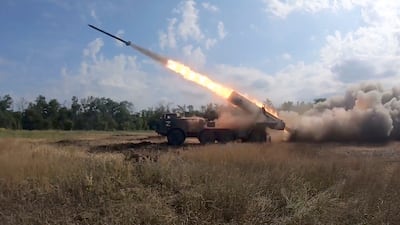
A Russian multiple-launch 'Hurricane' rocket system in action during battles in an undisclosed area in Ukraine. EPA -
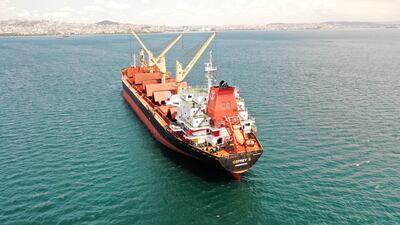
The Turkish bulk carrier 'Osprey S' is anchored off the shore near Istanbul. The vessel was expected to arrive in Ukraine's Chornomorsk port carrying grain, becoming the first ship to arrive at a Ukrainian port during the war. Reuters -
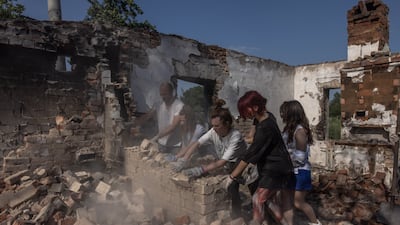
Young volunteers from the 'Repair Together' initiative, together with the local residents, clear rubble from a house that was destroyed during fighting, in Ivanivka, Chernihiv region. EPA -
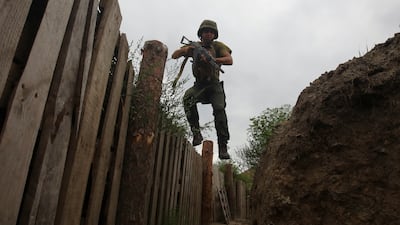
A member of the Ukrainian National Guard jumps into a trench at a position near a front line, in the Kharkiv region. Reuters -

A Ukrainian soldier after a rocket fragment hit his car, in Bakhmut. AFP -

Combine harvesters of the Continental Farmers Group agricultural company harvest wheat in the Ternopil region of Ukraine. Getty Images -
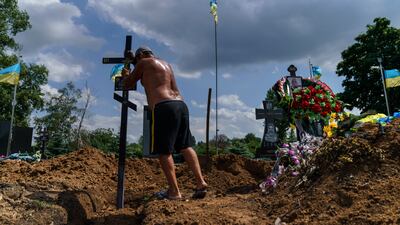
A cemetery worker places a cross on the grave of Ukrainian soldier Serhiy Marchenko, who died aged 26, after his burial in Pokrovsk, Donetsk region. AP -
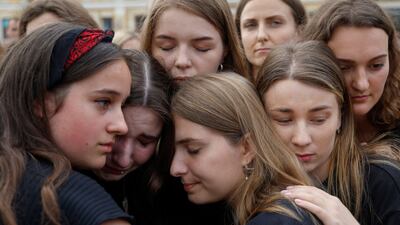
Women attend a rally of relatives and friends of defenders of the Azovstal Iron and Steel Works in Mariupol. Reuters -
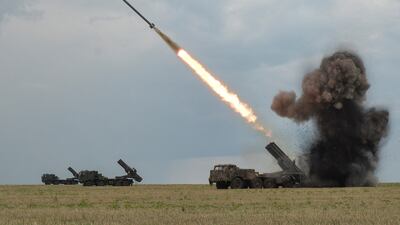
Ukrainian troops fire with a BM27 Uragan multiple-launch rocket system, in the Kharkiv region. Reuters -
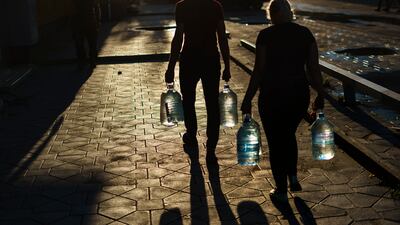
A couple carry water bottles after filling them up at a store in Pokrovsk, Donetsk region. AP -
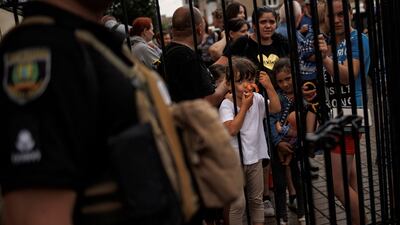
A girl holds a doll as people wait in Pokrovsk, to board a train to Dnipro and Lviv, during an evacuation effort from war-affected areas of eastern Ukraine. Reuters -
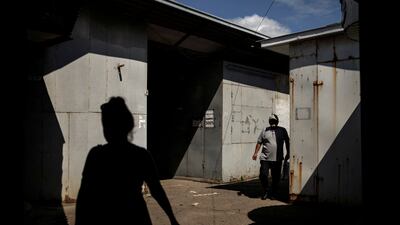
People make their way through the partially-closed Market of Kramatorsk. Reuters


Experts at the US-based Institute for the Study of War said they believe Russia is shelling the area intentionally, “putting Ukraine in a difficult position”.
“Either Ukraine returns fire, risking international condemnation and a nuclear incident — which Ukrainian forces are unlikely to do — or Ukrainian forces allow Russian forces to continue firing on Ukrainian positions from an effective ‘safe zone',” the think tank said.
The Russian capture of Zaporizhzhia renewed fears that the largest of Ukraine’s four nuclear power plants could be damaged, setting off an emergency similar to the 1986 Chernobyl accident, the world’s worst nuclear disaster, which happened about 110 kilometres north of the capital, Kyiv.
Russian President Vladimir Putin has sent a 15,000-strong army contingent to southern Ukraine, western officials said in a briefing on Thursday.
With Ukrainian troops advancing on Kherson, the first urban area to be captured by Russia, Mr Putin is understood to be desperate to hold on to it.
It has been reported that the Russians have resorted to ferrying troops and supplies into the city on a makeshift pontoon bridge after the last road crossing over the Dnipro River was disabled by long-range missile strikes.
But western officials have now confirmed reports that the Russians have built a new force, many taken from domestic prisons, that could be used in an offensive potentially starting next month.
“We can confirm that we are seeing a formation,” a western official said. “An army corps is typically 10,000 to 15,000 personnel but we are not sure how it will be employed.
“We can't even comment on whether it's going to be employed in Ukraine or not. But there is a range of options open to the Russians — reinforcing Kherson or a counterstrike in the southern region.”

