


Three never-seen-before subatomic particles have been discovered by scientists working on the Large Hadron Collider (LHC) and trying to unlock the building blocks of the universe, the European nuclear research centre Cern said on Tuesday.
The 27 kilometre-long LHC at Cern in Switzerland is the machine that found the Higgs boson particle, which along with its linked energy field is thought to have played a vital role in the formation of the universe after the Big Bang 13.7 billion years ago.
The LHC was powered up again on Tuesday after a three-year break for maintenance, as the world’s leading physicists look to build on the Higgs discovery by tackling unsolved mysteries about dark matter.
Now Cern scientists say they have observed a new kind of "pentaquark" and the first known pair of "tetraquarks", adding three members to the list of new hadrons found at the LHC.
"The more analyses we perform, the more kinds of exotic hadrons we find," physicist Niels Tuning said in a statement.
"We're witnessing a period of discovery similar to the 1950s, when a 'particle zoo' of hadrons started being discovered and ultimately led to the quark model of conventional hadrons in the 1960s. We're creating 'particle zoo 2.0'."
-
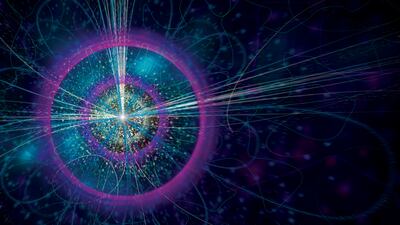
Monday July 4 marks 10 years since one of the most celebrated scientific breakthroughs of the 21st century: the discovery of the Higgs boson, a particle that is key to understanding the universe. Getty Images -
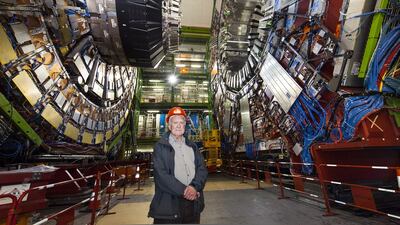
Peter Higgs, now 93, predicted the existence of the particle that bears his name in 1964. Photo: CERN -

Former European Organisation for Nuclear Research (CERN) director generals Christopher Llewelyn-Smith, CERN scientific director Lyn Evans, Herwig Schopper, Luciano Maiani and Robert Aymard on July 4, 2012, during a seminar in Geneva on the latest update in the 50-year bid to explain a riddle of fundamental matter in the search for a particle called the Higgs boson. AFP -
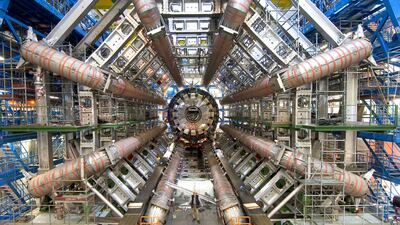
The Large Hadron Collider while under construction at CERN. It is a 27-kilometre pipe in which particles are flung at each other at almost the speed of light. PA -

The Large Hadron Collider started up in 2008 and was the first of its kind powerful enough to generate enough evidence for the Higgs — which is produced in about one in every billion of these collisions. PA -
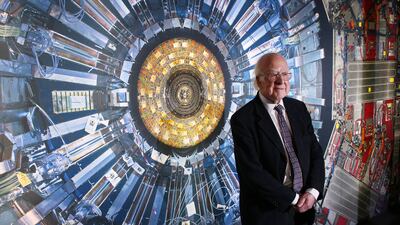
Peter Higgs theorised in 1964 that particles whizzing around the universe pick up their mass by travelling through an invisible field — a bit like a vehicle ploughing through snow. Getty Images -

Visitors take pictures at the tunnels during an open day at the CERN particle physics research facility in Meyrin, Switzerland. Getty Images -

The CERN Computer / Data Centre and server farm is seen during a behind the scenes tour at CERN. Getty Images -

A technician works in the Large Hadron Collider at CERN. AP


The findings will help physicists better understand how quarks bind together into composite particles.
Quarks are elementary particles that usually combine in groups of twos and threes to form hadrons such as the protons and neutrons that make up atomic nuclei.
More rarely, however, they can also combine into four or five-quark particles, or tetra and pentaquarks.
The Higgs finding proved that particles acquire mass by churning through an invisible field, like winter shoes gathering snow, and was a moment of excitement for physicists working on the theory.
For decades, the Higgs boson remained tantalisingly out of reach and like a search for a mythical animal, there was no way of proving that its footprints were not an illusion until the creature had actually been sighted.
A forerunner of the LHC, the Large Electron-Positron Collider, made an assault on the Higgs in 2000 but was not quite powerful enough to bludgeon it into existence.
The LHC started up in 2008, sending particles whizzing around a 27-kilometre pipe about 100 metres below the Earth’s surface, but a magnet failure after only 10 days pushed the project back by another year while repairs were made.
It started to generate possible Higgs bosons but they appeared at a rate of about one in every billion collisions, meaning it took years to collect enough data to prove anything.
Even then, it lasts for such a small amount of time before decaying — nought-point-(21 zeroes)-one seconds — that scientists have to look for the particles into which it morphs, such as photons, to be able to retrace its steps.
But on July 4, 2012, a critical line was crossed when enough data had been gathered that the possibility of a mistake — that the results indicating the Higgs boson were a fluke of subatomic dice-rolling — could safely be discounted.

