


If Ukraine is to defeat Russia, Nato needs a “fundamental mindset shift”, the alliance’s former military deputy chief said.
Retired British general Sir Richard Shirreff told The National that a summit to be held in Madrid this month would have to agree to increases in defence budgets to deter aggression.
He criticised what he regarded as a lack of action over Ukraine, suggesting that US armoured divisions should have been sent to eastern Europe three months ago to demonstrate Nato’s determination to stop Russia.
The Madrid meeting should conclude with an agreement to give Ukraine the most advanced equipment needed to defeat Russia, Mr Shirreff said.
He said that Ukraine should be allowed to fire its newly-acquired long-range missiles directly at military installations inside Russia.
He suggested that Turkey would move close to dropping its objections to Sweden and Finland joining Nato if US President Joe Biden intervened.
Summit points
“There will never be peace in Europe or the transatlantic region until [Vladimir] Putin and Putin's regime are defeated,” said Mr Shirreff, who in 2016 wrote the part-fictional book War with Russia: An Urgent Warning from Senior Military Command.
Any talk of a ceasefire and ceding Ukraine territory would be “perceived as a weakness” by Russia, he said.
“This is one of those moments in history where you’ve just got to go through it, a bit like our forefathers did in 1939," Mr Shirreff said, referring to the start of the Second World War.
"It's the same dynamic of a bloodstained autocrat, who's prepared to inflict unspeakable damage and trauma on a neighbour to achieve his political ends.”
To defeat Russia, Ukraine needs “the necessary tools”, which would mean Nato “taking significant risk because there's always the risk of escalation”.
To mitigate that risk, Nato had to be prepared for the worst-case scenario, which was war with Russia.
“This is going to require a fundamental mindset shift in Nato, and we're not anywhere near that yet,” Mr Shirreff said. “But that's what should come out of Madrid. Nato nations have got to bite the bullet and that means rearmament.”
Defence budgets had to be increased. He said the British Army was in a poor state, and that it needed to be doubled in size rather than be cut by 4,000 troops to 72,000.
Stationing an under-size brigade in Estonia was insufficient, he said. Britain needed to have at least a division in the Baltic State to deter Russia, but it would struggle to assemble one after decades of cuts.
The Americans should be have sent at least three armoured divisions into eastern Europe since the Russian invasion, Mr Shirreff said.
“Where is the Third Cavalry Division, or First Cavalry Division from Fort Hood [in the US], or the Second Infantry Division?” he said.
“They should have been sailing across the Atlantic 100 days ago. Why have the reserves not been called up? Frankly, we’ve just been sitting on our hands and saying it's all going to be fine, let's just put a few NLAWs [anti-tank weapons] on Ukrainian shoulders.”
Missiles sent to Ukraine
The US and Britain recently agreed to send precision missile systems with a range of 80 kilometres to Ukraine.
Mr Shirreff said that Ukraine needed much more — Britain is providing three multiple launch rocket systems — to prove decisive.
He also made an argument for the weapons to be fired against military targets inside Russia to stop weapons and troops reaching the front line in eastern Ukraine.
“I wouldn't hesitate to say to Ukraine, if you want to target Russia, go for it,” he said.
Mr Shirreff said that his would be a risk but it was now time, given the alleged atrocities meted out by Moscow’s troops, “to let the Ukrainians take the gloves off".
“In order to weaken your enemy, you hit him in the rear to make it more difficult to bring up the supplies. The more you strike the deep battle, the easier the close battle comes.
"We should be giving the Ukrainians the means to inflict that sort of damage on the Russians. Give them the tools to do the job in serious quantities.”
In pictures - the Nato military alliance
-

A solemn welcoming ceremony of US soldiers at Adazi military base, Latvia, on February 25, 2022. More than 300 soldiers of the 173rd Air Force Brigade arrived to demonstrate the US commitment to defend Nato allies and strengthen Latvia's defence capabilities following Russia's military operation in Ukraine. EPA -
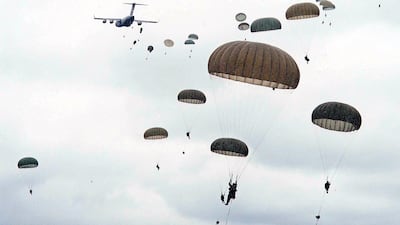
US paratroopers in Ukraine's western Lviv region during a Nato-sponsored training exercise in 2020. AP -
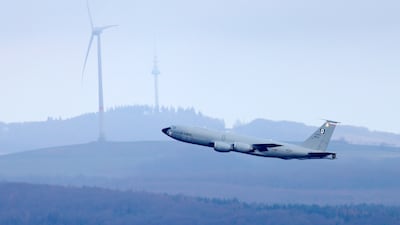
A US military aircraft takes off at the US Air Base Ramstein, in Landstuhl, Germany, on February 25. US President Joe Biden February 24 authorised the deployment of further armed forces to Germany as part of Nato's response to Russia's military aggression on Ukraine. EPA -
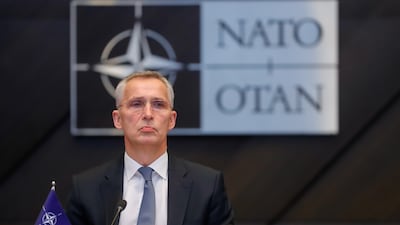
Nato Secretary General Jens Stoltenberg at the alliance's headquarters in Brussels, Belgium, on February 25. EPA -
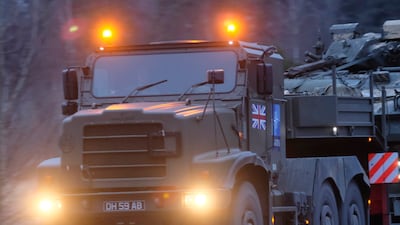
A convoy of British armoured vehicles of the Royal Welsh Battlegroup on the way to Estonia, driving through Liepupe, Latvia, on February 25. British troops and equipment are heading to Estonia as part of the UK's contribution to strengthen Nato's uplift to Eastern Europe. EPA -
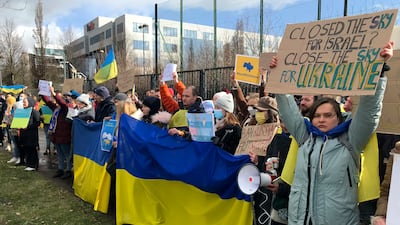
Protesters outside a Nato leaders virtual summit in Brussels on February 25. AP -
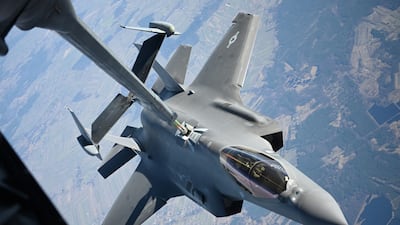
A US Air Force F-35 Lightning II aircraft assigned to the 34th Fighter Squadron receives fuel from a KC-10 Extender aircraft over Poland on February 24. US Air Force/Reuters -
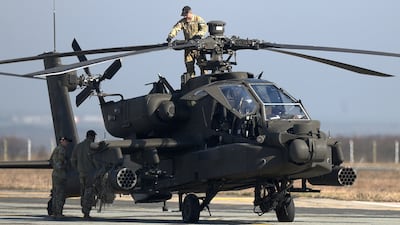
US military personnel check an Apache attack helicopter AH-64 during a technical stop on the tarmac at Traian Vuia International Airport in Timisoara, Romania, on February 24. EPA -
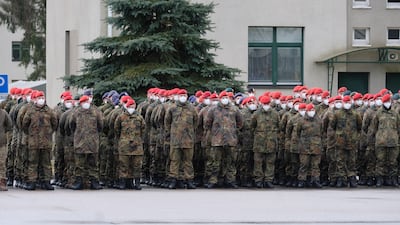
German soldiers of the Nato enhanced Forward Presence (EFP) Battalion Battle Group in Lithuania attend a ceremony during a visit of German Defence Minister Christine Lambrecht to Rukla Military Base, Lithuania, on February 22. EPA


'Massive hike in defence spending'
Nato needed a “massive hike in defence spending” and a mindset requiring “a militarisation of society”.
“Effective deterrence is overmatching Russia at every stage and that requires us to rearm,” Mr Shirreff said, speaking from his home near Salisbury Plain in southern England.
“These things have got to be addressed in Madrid with a sense of real urgency, which is at the moment totally absent.”
Mr Shirreff, who commanded British forces in Iraq in 2006, said he was not “just another Cold War warrior calling for more tanks”.
He advocated a combination of modern warfare such as drones and cyber methods alongside the tanks, artillery and infantry.
“The reality of war and the fighting in Ukraine has demonstrated that you will never take ground with a few brave men running around with NLAWs and drones. The only way to take ground is to put your people on the ground and kill the people who are occupying it."
There are 2.5 million troops under arms in Nato. The Madrid summit should also consider a return a Cold War posture, when Britain alone had three divisions in West Germany, he said.
Deterrence was needed because it was clear that Mr Putin was a “maximalist for re-establishing a new Russian Empire”.
Russian losses
“There is a moment when the initiative is up for grabs," he said, referring to military campaigns.
That moment came when Russia withdrew from Kyiv in April to rearm for the eastern offensive.
“If the West and Nato had given Ukraine the means to do the job, then the battle for the Donbas might not have happened, because the Russians could have been hit and kept on the back foot.”
He believed that the “grinding, attritional” Russian offensive, that western officials suggested last Thursday was “deeply troubled at all levels”, could end this summer.
Mr Sherriff, 66, suggested the Russian campaign would “culminate” in late August, giving another chance for Ukraine to seize the initiative.
“If we can give Ukraine the arms and training they need to build up their capability, then the Russians will be will be ultimately defeated.”
While Russia had an “inexhaustible supply of manpower”, its units had been “cut to pieces”, with an estimated 20,000 dead and more than 750 tanks lost with replacements taking months to train.
He said Ukraine should not to launch a counter-offensive “prematurely”.

Nordic Nato
Nato’s 30 heads of state who attend the summit on June 29 need to decide how to use the Article 5 collective response if Russia attacked an airbase in Poland hosting lethal western aid for Ukraine, he said.
But equally important would be the fast-tracking of Finland and Sweden, who applied to join Nato last month.
Mr Shirreff’s understanding was that the objection raised by Turkey could be removed if Mr Biden “got engaged to smooth it over to give enough face saving” for President Recep Tayyip Erdogan to remove the veto.
This could entail America reinstating Turkey in the F-35 Lightning stealth fighter programme. It was removed by Washington in 2019 after Ankara bought Russian-built S-400 air defence missiles.
The accession of the two Nordic countries to the alliance, especially given Finland’s strong military, would “send a really powerful message to Russia of Nato strength”, Mr Shirreff said.
Ukraine in Nato
He said that if Ukraine had been allowed to join Nato as promised in 2008, conflict could have been prevented.
Nato should have been prepared to put forces in Ukraine to deter any Russian attack. “Arguably, if that had happened, there would be no war now.”
He reasoned that Nato’s “hollowed out” forces meant if Russia did attack there was “only one way you can go, which is nuclear”.
Therefore, the conventional deterrent had be to grow as well as “communicating your willingness to use it”.
Mr Shirreff said that if Russia placed tactical nuclear missiles close to Nato’s border, then the alliance should move similar weapons to Poland and the Baltic States.
“We did the same in the Cold War with cruise missiles and that had a deterrent effect. The Russians only respect strength. Where they see weakness, they will continue to probe and exploit.”

