


Live updates: follow the latest news on Russia-Ukraine
European leaders were battling on Monday to break a weeks-long diplomatic deadlock and agree a ban on Russian oil, with Hungary showing no sign of lifting its veto despite a climbdown from its neighbours.
The European Union’s 27 leaders were examining a proposal to stop Russian oil arriving by sea while keeping open the pipelines relied on by landlocked nations, a major concession to Hungarian Prime Minister Viktor Orban.
But arriving for a Brussels summit on the fallout from the war in Ukraine, Mr Orban said there was “no compromise at this moment at all” and blasted what he said was the “irresponsible behaviour” of the bloc’s top officials in announcing the sanctions before member states were ready.
“Because energy is a serious issue, it’s not a kid game — it means that first we need solutions, and then the sanctions,” said Mr Orban, who said Hungary’s energy supplies were still not guaranteed in the latest offer.
The oil stand-off has pushed western powers towards the limit of what they are willing to do to help Ukraine. US President Joe Biden hinted at another such ceiling on Monday by saying he would not send rocket systems that could hit targets well inside Russian territory.
Ukraine had asked the US for batteries of long-range rockets such as the M270 system that can launch multiple rockets at the same time with a range of up to 300 kilometres. Washington had signalled interest but is proceeding with caution after a warning of escalation from the Kremlin.
European Commission president Ursula von der Leyen said she did not believe an oil deal was likely during the two-day meeting in Brussels, although some officials hope that at least the outline of an embargo could be approved on Monday.
Ms von der Leyen said the sixth sanctions package “has matured” after Hungary’s objections left it in limbo for weeks, throwing the EU’s unity into question after five earlier rounds of sanctions had passed with almost unprecedented speed.
“My expectations are low that it will be solved in the next 48 hours. But I'm confident that thereafter there will be a possibility,” she said.

Some officials struck a more optimistic note. Josep Borrell, the EU’s top foreign policy official, said he was “fully confident” that an agreement would eventually get over the line.
European Parliament president Roberta Metsola said there was a good atmosphere in the talks, while another official spoke of "light at the end of the tunnel" despite earlier optimism being blown apart by Mr Orban's arrival.
The summit began with a closed-door address by Ukrainian President Volodymyr Zelenskyy — his second time addressing the European Council, after he publicly admonished Mr Orban when he last spoke to the 27 leaders in March.
There was no repeat dressing down this time, with Mr Zelenskyy instead urging unity because Russia would like to see "27 separate states, 27 fragments that cannot be put together".
But he said dozens of children had been killed and hundreds of schools destroyed in the time the EU has been debating the sanctions package, and bemoaned the fact that "for some reason, it is not there yet".
Draft conclusions of the summit call for Mr Zelenskyy's push for Ukrainian membership of the EU to be dealt with at the next European Council meeting in June, according to an official briefed on the talks.
In an apparent rebuke to suggestions that Ukraine could have a looser affiliation with the bloc, Mr Zelenskyy told the council: "We need to be like you."
While Hungary has been the most outspoken critic of an oil embargo — with Mr Orban saying it would amount to a nuclear attack against its economy, which gets 65 per cent of its oil from Russia — other countries have sought grace periods to find alternatives to Russian oil.
The Czech Republic and Slovakia, landlocked like Hungary, have each asked for up to three years to revamp their energy systems. A final package, including any exemptions, must be passed by unanimous vote among the 27 members.
An EU official close to the talks said some temporary exceptions had been granted to ensure security of supply but that the bloc would revisit these “as soon as possible”.
They defended a potential compromise on pipelines by saying about two-thirds of oil imports from Russia would be cut off if sea shipments are banned.
Slovakian Prime Minister Eduard Heger, while agreeing with Mr Orban on the needs of landlocked countries, revealed he had lobbied the Hungarian leader before the summit in an attempt to "get him on board".
Dutch Prime Minister Mark Rutte said Poland and Germany’s moves to get rid of pipeline oil, going further than what would be required by the sanctions, meant 90 per cent of Russian crude exports could end up being stopped.
Ms von der Leyen had proposed a total oil ban on May 4, answering the calls of countries such as Poland and Lithuania to stop funnelling money to Russia while it pursues its offensive in Ukraine.
But Hungary has said oil prices would rise by more than 50 per cent if transit routes such as the 4,000-kilometre Druzhba pipeline through Ukraine were brought to a standstill.
-
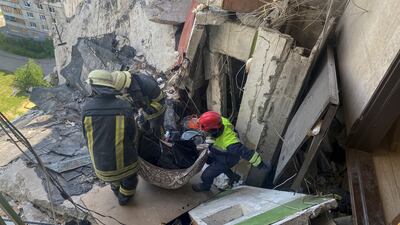
Rescuers carry the body of civilian from a residential building damaged by shelling in Kharkiv, Ukraine. Reuters -
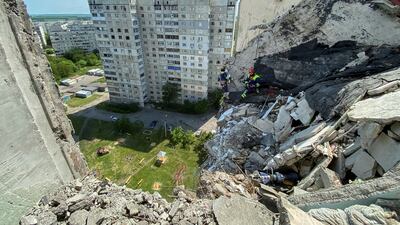
Kharkiv, Ukraine's second city, is feeling the strain after coming under heavy Russian bombardment. Reuters -
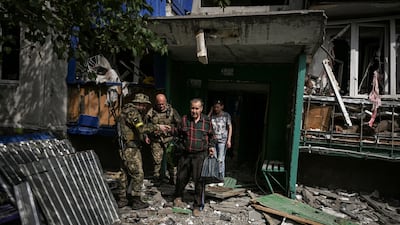
Ukrainian troops help an elderly man out of a damaged apartment building after an air strike in the city of Slovyansk in Donbas region. AFP -
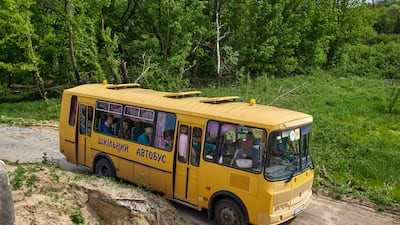
A school bus carrying Ukrainian refugees leaves Kharkiv. EPA -

The pain of war hits this woman hard shortly after her apartment building in Slovyansk was damaged by Russian shelling. AFP -
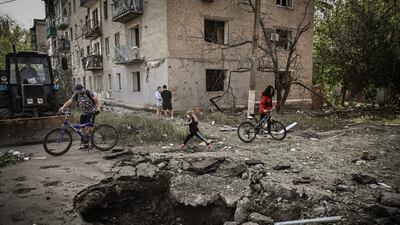
A crater scars the road surface in Slovyansk, Donbas. AFP -
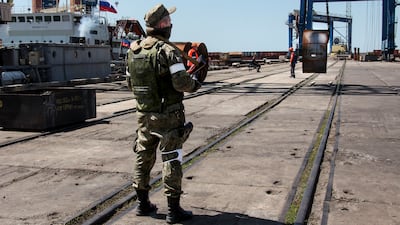
A Russian soldier oversees the loading of steel on to a Russian ship at Mariupol port in Ukraine. AP -
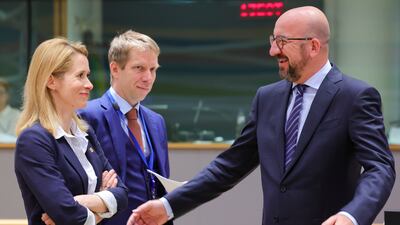
European Council President Charles Michel, right, and Estonian Prime Minister Kaja Kallas, left, talk before the second day's session of an extraordinary meeting of EU leaders to discuss Ukraine, energy and food security, in Brussels. AP -
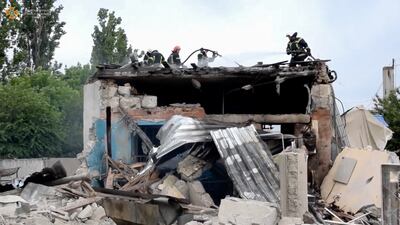
Rescuers extinguish a fire at a meat factory, amid fighting in Mykolaiv, Ukraine. Reuters -
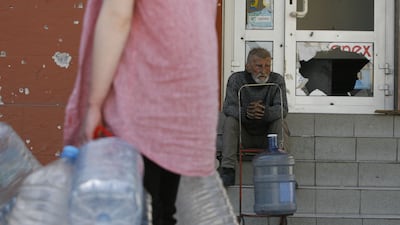
A man waits to collect water in Mariupol. AFP -
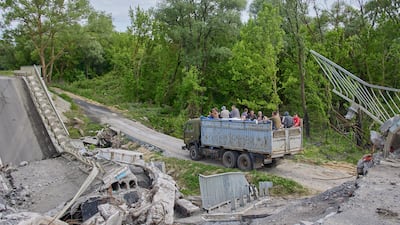
Ukrainians cross a makeshift bridge built next to a destroyed structure, in the Kharkiv region. EPA -

A destroyed tank in Mariupol. AFP -
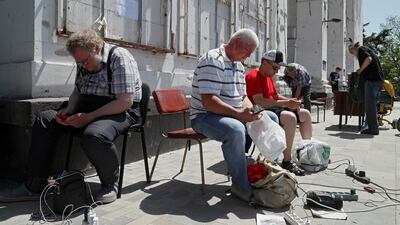
People charge electronic devices outside a theatre building, in Mariupol. Reuters -
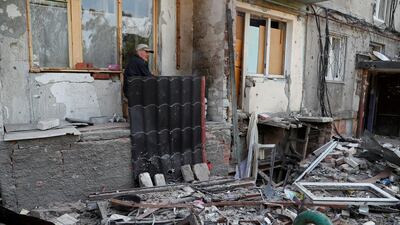
Pensioner Gennady Ivanov, 83, sits outside a residential building heavily damaged by shelling, in Mariupol. Reuters -

Ukrainian firefighters try to extinguish a fire at a house that was hit by Russian strikes, in Kharkiv. AP -
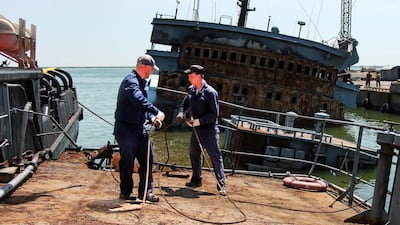
Russian Navy sailors of the Black Sea Fleet prepare to raise a sunken Ukrainian warship at the sea port, in Mariupol. AP -
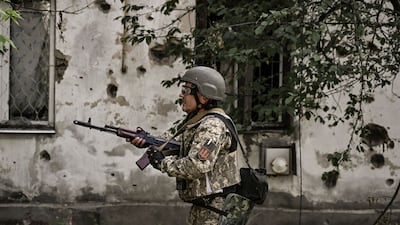
A Ukrainian soldier in the city of Lysytsansk, in the eastern region of Donbas. AFP -
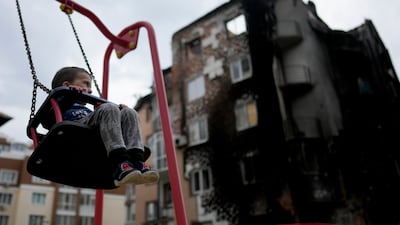
A boy, Yarik, plays in a playground in front a building destroyed during attacks, in Irpin. AP -
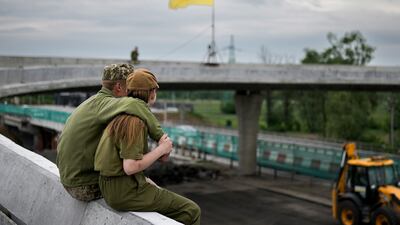
Two Ukrainian soldiers enjoy a tender off-duty moment near the village of Stoyanka, Kyiv region. GettyImages -
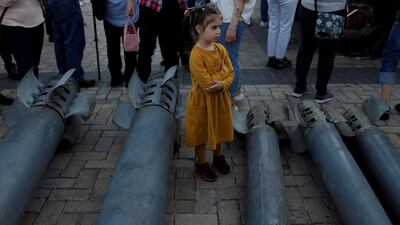
A girl in Kyiv looks at Russian weapons used in the attack on Ukraine. Reuters -
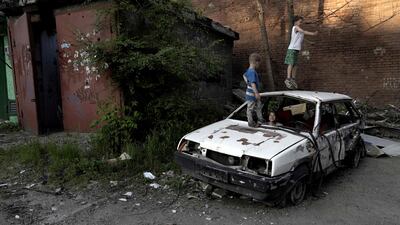
Children play on a destroyed car in a residential area of Mariupol. AFP -

Demonstrators hold Ukrainian flags at a charity telethon in support of Ukraine, in Berlin. Reuters -

Ukrainian servicemen near Zaytseve village in Donetsk, Ukraine. EPA -
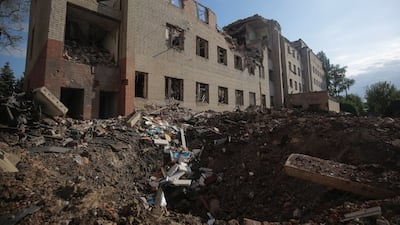
A shell hole near a destroyed building in Zaytseve village. EPA -

In the Saltivka district of Kharkiv, writing on the vans reads "warning, shelling" and "warning, passing by for civilians is prohibited". AFP -
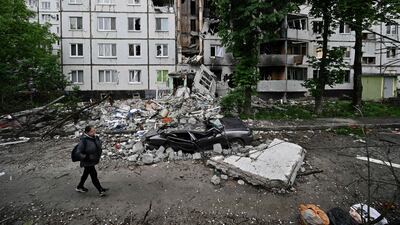
A heavily damaged residential building in the Saltivka district of Kharkiv. AFP -
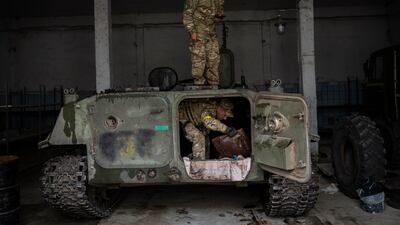
Ukrainian servicemen inspect a Russian amphibious vehicle near Kharkiv, eastern Ukraine. AP -
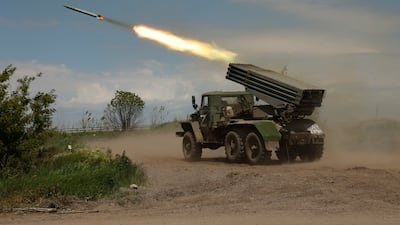
A rocket launcher belonging to a "Donetsk People's Republic" militia is fired from its position not far from Panteleimonivka, eastern Ukraine. AP -

The damaged building of the economics department of Karazin National University in Kharkiv. AFP -
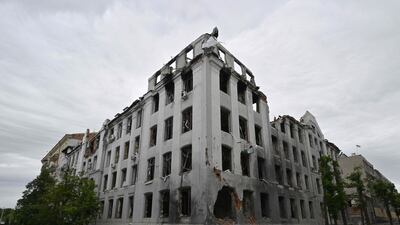
Karazin National University in Kharkiv came under heavy Russian bombardment. AFP -
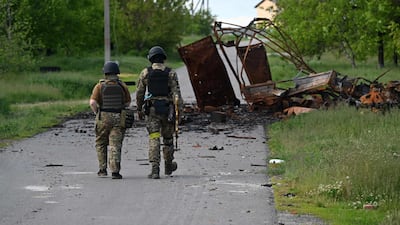
Ukrainian troops approach a destroyed military vehicle in the village of Rus'ka Lozova, north of Kharkiv. AFP -
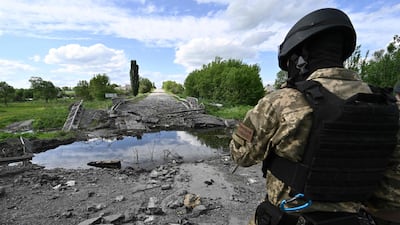
A bridge is a destroyed near Rus'ka Lozova, north of Kharkiv. AFP -
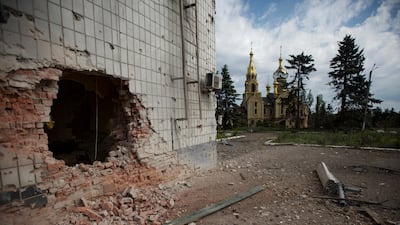
A building after a Russian military strike in the town of Marinka, as Russia's attack on Ukraine continues, in Donetsk region. Reuters -
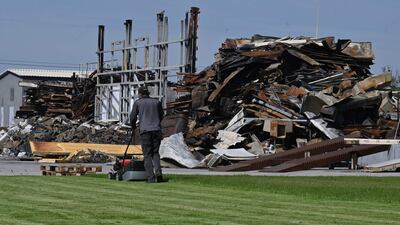
An employee mows the lawn near a destroyed warehouse refrigerator, belonging to the Chanta factory, in Novi Petrivtsi, near Kyiv. AFP -

Defiant Ukrainian service members ride on top of a military vehicle, amid Russia's invasion of Ukraine, on the road connecting Kostiantynivka and Bakhmut, in Donetsk region. Reuters -
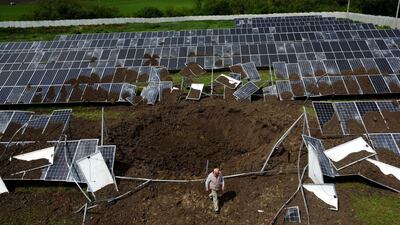
Vladimir Mihailovich, a solar plant manager, surveys a crater after the business in Merefa on the outskirts of Kharkiv was hit by Russian shelling. Reuters -
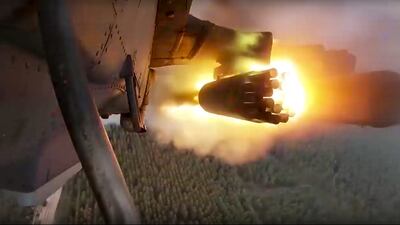
A KA-52 helicopter gunship fires rockets on a mission at an undisclosed location in Ukraine. AP -
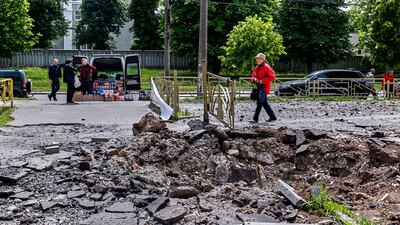
Locals walk past a road damaged by shelling in a residential area in Kharkiv. EPA -

Diana, on the train, waves to her mother Viktoriya and sister Kseniya as she leaves Pokrovsk in eastern Ukraine. AP -
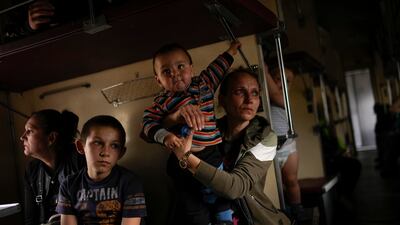
Yana Skakova and her son Yehor, who fled from Lysychansk, sit in an evacuation train in Pokrovsk, eastern Ukraine. AP


Europe’s reliance on Russian fuel has also sparked fears of power shortages next winter if the Kremlin turns off the tap, as it has already done in respect of Poland, Bulgaria and Finland’s gas supplies.
Estonian Prime Minister Kaja Kallas, a supporter of the sanctions, said an agreement that included special opt-outs for Hungary would be “better than nothing” as the war in Ukraine nears the 100-day mark.
“It’s up to every country’s moral compass how to proceed with this,” she said. “We see already people growing tired of the war, but we can’t get tired because Ukrainians are not tired.”
Latvian Prime Minister Arturs Krisjanis Karins said diplomats were “forgetting the big picture” and getting bogged down in details at a time when Russian missiles continue to pound Ukraine.
“It's only money, the Ukrainians are paying with their lives,” he said. “We can and we must support them, if only out of self-interest because only when Russia is defeated can we in Europe feel safe.”
Mr Orban had tried to push the question of sanctions off the order paper altogether, arguing in a letter last week that the oil debate was best left to technical discussions between officials.
Germany had sided with Mr Orban on that point and said the EU should not put on a show of disunity at a time when Russia is probing for weaknesses in the western alliance.

But two diplomatic sources said leaders would try to thrash out a political agreement at the European Council meeting, which could then be finalised at a technical level.
Mr Orban has for years been at loggerheads with Brussels over policies seen as eroding Hungary's democracy, and has long been regarded as the EU's most Kremlin-friendly leader. He was re-elected in April.
He has not objected to other parts of the sixth package which would penalise more Russian banks and add to the list of prominent Russian political and military figures covered by European sanctions.
Ambassadors from every EU country had held hours of talks on Sunday and Monday in a last-ditch attempt to break the deadlock before the heads of state and government assembled.
The talks were also expected to focus on defence, food security and the wider energy revamp proposed by the commission.
Nato Secretary General Jens Stoltenberg was meanwhile making preparations for a summit in Madrid next month where allies will be asked to approve a hardening of their defence posture towards Russia.
“We will chart the way ahead for the next decade, we will reset our deterrence and defence for a more dangerous world,” he said.

