


Enrique Mora, the EU's Iran nuclear talks co-ordinator, is to visit Tehran on Tuesday.
The bloc has said it wants to break a continuing deadlock in the negotiations and save the 2015 accord.
Talks to revive the 2015 nuclear deal between Iran and world powers have been on hold since March. A sticking point has been whether the US will keep the Islamic Revolutionary Guard Corps on its Foreign Terrorist Organisation list.
"This trip could be seen as a new step in constructive consultations on the few but important issues that have remained in the Vienna talks," Iran's semi-official Nour News agency said on Saturday, reporting news of Mr Mora's visit.
EU foreign policy chief Josep Borrell told the Financial Times he was seeking a “middle way” to end the impasse, which threatens to scupper more than a year of European diplomatic efforts.
Mr Borrell is considering a scenario in which the IRGC's terrorist designation is lifted, but other parts of the organisation — which has several arms and a sprawling business empire — remain in the US list, the FT reported.
-
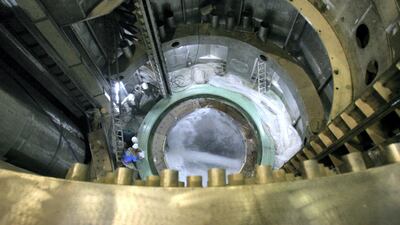
Russian contractors work at the Bushehr nuclear reactor site in 2007. The plant opened four years later. Bloomberg -
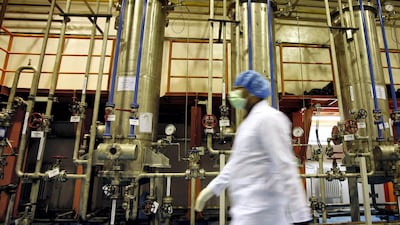
An Iranian technician at the International Atomic Energy Agency inspects the country's Isfahan plant in 2007. Tehran is no longer co-operating with the agency at nuclear sites across the country. EPA -

Workers wait to begin constructing a second reactor at the Bushehr nuclear power plant in 2019. AFP -
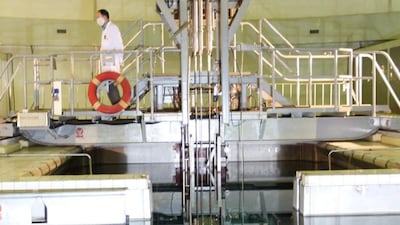
A metal-encased rod with 20 per cent enriched nuclear fuel is inserted into a reactor in Tehran in 2012. AFP -
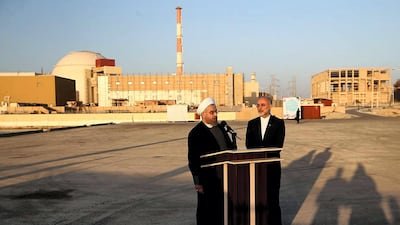
Fomer Iranian President Hassan Rouhani and the country's Atomic Energy Organisation chief Ali Akbar Salehi speak at the Bushehr nuclear site in 2015. AFP -
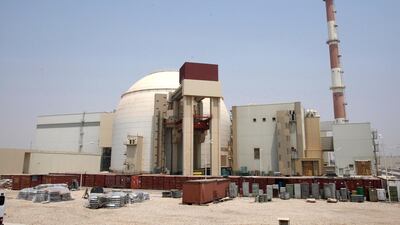
Iran's Bushehr nuclear plant has been restarted. EPA -
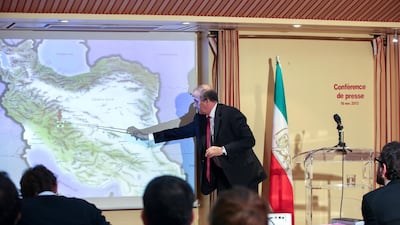
Mehdi Abrichamtchi, chairman of the Peace and Security Committee at the National Council of Resistance of Iran, shows journalists the location of a secret nuclear site in Iran in 2013. AFP -
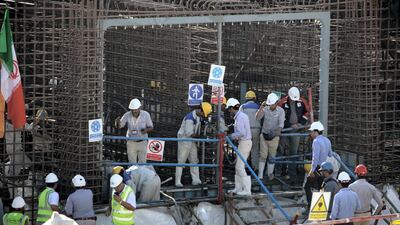
Workers prepare to begin the construction of a second reactor at the Bushehr site. AFP


Mr Borrell also said he wanted Mr Mora to visit Tehran to discuss the issue, but added that Iran “was very much reluctant” and described the diplomatic push as “the last bullet”.
Reuters reported last week that Iran's rulers, emboldened by a surge in oil prices since Russia invaded Ukraine, are in no rush to revive the 2015 pact to ease sanctions on its energy-reliant economy.
Under the 2015 Joint Comprehensive Plan of Action, Iran agreed to limit its nuclear programme in return for relief from sanctions.
The agreement started to unravel in 2018 when Donald Trump, US president at the time, left the deal and reinstated sanctions, leading to Iran stepping up its nuclear programme.
The US said it was preparing equally for both a return to compliance by Iran on a nuclear deal and a situation with no agreement being reached, the State Department said on Wednesday.
"Because a mutual return to compliance with the JCPOA is very much an uncertain proposition, we are now preparing equally for either scenario," said State Department spokesman Ned Price.
Iran and the International Atomic Energy Agency have also been trying to resolve a series of issues since the collapse of the agreement, including regaining access to footage from surveillance cameras at Iran’s atomic sites.

