

Live updates: follow the latest news on Russia-Ukraine
Russia says it conducted a first test launch of its Sarmat intercontinental ballistic missile (ICBM) on Wednesday.
President Vladimir Putin called the Sarmat a “truly unique weapon” that is “capable of overcoming all modern means of anti-missile defence”.
But the US dismissed Wednesday's test as "routine".
So what is an ICBM and what is new about this Russian technology?
What is an ICBM?
ICBM stands for "intercontinental ballistic missile" – land-based rockets that are capable of launching nuclear warheads to strike targets thousands of kilometres away on other continents.
They launch much like a conventional rocket, entering the edge of space. A single ICBM can carry dozens of nuclear warheads, as well as decoys and other tools to help the missiles evade defence systems. Being in orbit, a single ICBM is also able to target numerous sites over a large geographical area – releasing nuclear warheads as it passes over its targets.
These warheads then fall to Earth at huge speeds – about seven kilometres per second.
How long has Russia had ICBMs?
The first ICBMs were developed by the Soviet Union in the 1950s, followed immediately by the US. China produced its first ICBMs in the 1970s. Early versions were slower and carried lighter payloads than modern versions.
What is the Sarmat missile and what is new about it?

The Sarmat is a heavy missile that has been under development for nearly a decade to replace the Soviet-made Voyevoda, which was code-named Satan by the West and forms the core of Russia’s nuclear deterrent.
The weapon, designed and built by the Makeyev Rocket Design Bureau, was announced by Mr Putin in 2018 at his annual state of the nation address, although it was reportedly supposed to become operational by 2016.
It is named after the Sarmatian people of the fourth and fifth century BC. It has also been referred to in the West as the "Satan II".
The super-heavy, thermonuclear-armed ICBM is thought to be Russia’s most powerful ICBM.
It has a range of about 18,000 kilometres and can travel at a maximum speed of 25,500kph. The RS-28 Sarmat is said to be able to carry a nuclear payload large enough to wipe out an area the size of Texas.
While the RS-28 Sarmat can be launched much like a regular ICBM, sending a payload high into the stratosphere before the warheads plummet to earth, it is thought to be also capable of what is called fractional orbital bombardment.
A fractional orbital bombardment means firing an ICBM into a low orbit of the Earth – much lower than a conventional firing – potentially in the opposite direction to the target.
The low orbit gives it an almost limitless range and makes it hard to determine the intended target while going the opposite direction around the Earth would, in theory, mean it could evade missile detection systems. For example, most US missile defence systems aimed at thwarting a Russian attack are focused on detecting missiles flying over the Arctic Circle, while the RS-28 Sarmat could, in theory, be fired over the South Pole and hit a US target where there are no defence systems in place.
The technology is not new and was pioneered by the Soviet Union in the 1960s and 1970s. However, the USSR decommissioned and dismantled their fractional orbital bombardment systems by 1982, for a number of reasons, including questionable accuracy, the questionable defence need and the concern they caused among Nato nations, exacerbating Cold War tensions.
-
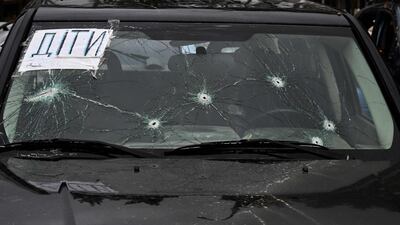
A sign that reads 'Children' is fixed on to a car windscreen riddled with bulletholes in Irpin, Ukraine. AFP -
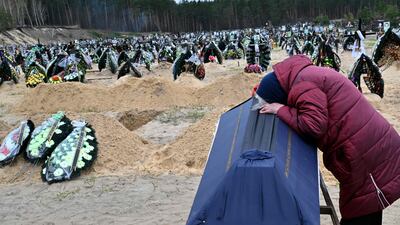
A woman weeps next to her husband's coffin at a cemetery in Irpin. AFP -
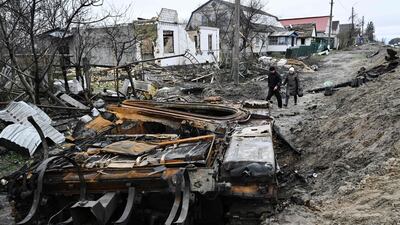
Residents walk amid debris of a charred Russian tank next to destroyed houses in the village of Zalissya. AFP -
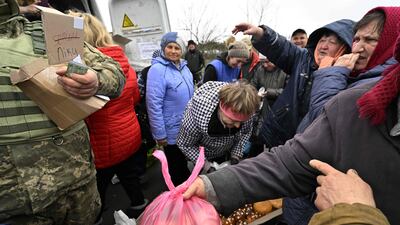
Volunteers distribute food to residents in Zalissya. AFP -
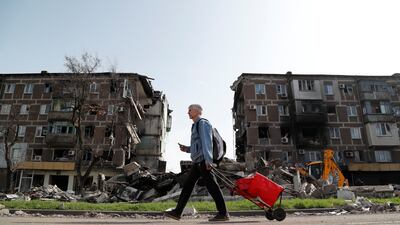
A man walks past a damaged apartment building in the southern port city of Mariupol. Reuters -
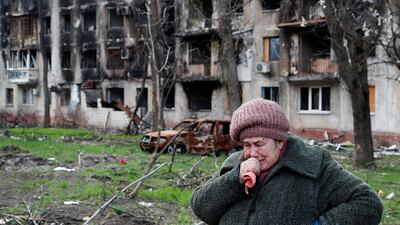
Tamara, 71, cries in front of a destroyed apartment building in Mariupol. Reuters -
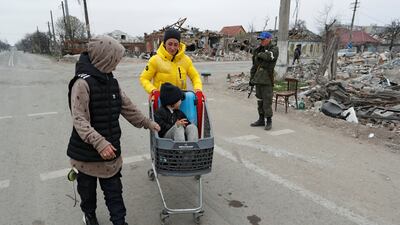
Local residents push a cart with a child past destroyed buildings in Mariupol. Reuters -
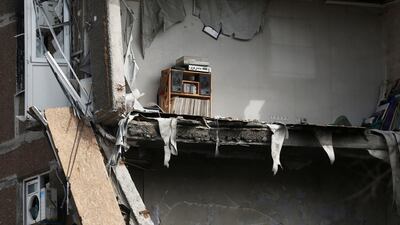
A record player sits among debris inside an apartment in Mariupol. Reuters -
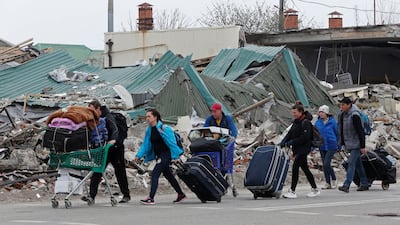
Residents carry belongings past a destroyed building in Mariupol. Reuters -
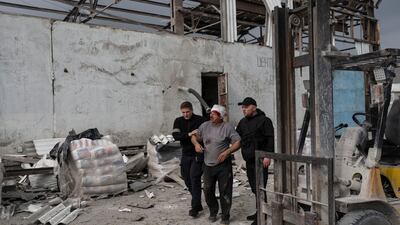
Security guards help an injured man following a Russian bombing of a factory in Kramatorsk. AP -

A man receives first aid treatment. AP -

Soldiers collect explosives after recent battles in the village of Moshchun, close to Kyiv. AP -
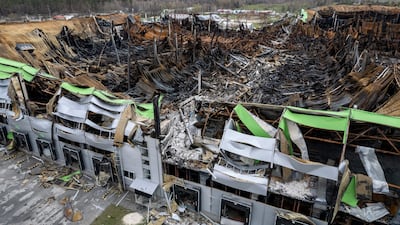
The Komodor logistics park lies in ruins after being bombed and burnt during the Russian invasion near Makarov. Getty Images -
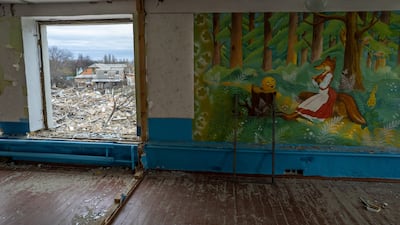
A room in a kindergarten stands windowless in Makarov. Getty Images -
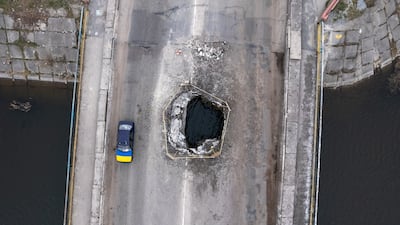
A vehicle draped with a Ukrainian flag passes over a war-damaged bridge in Makarov. Getty Images -
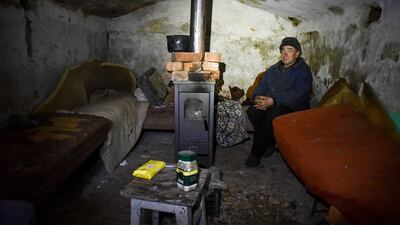
A man sits in a basement that was used as a bomb shelter in the village of Kukhari. EPA -
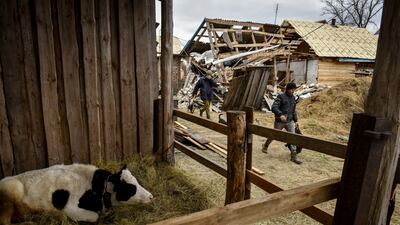
Local residents clean the area around a destroyed farm in Kukhari. EPA -
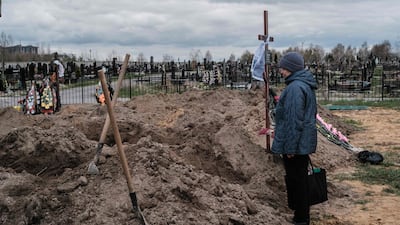
Nadia looks at her husband's coffin at a cemetery in Bucha. He was killed during the war. AFP -
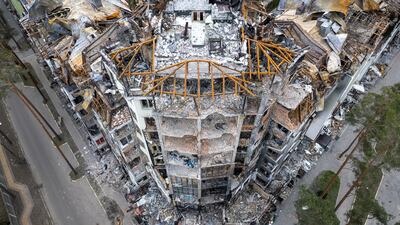
Mangled buildings in Irpin point to the ravages of the ongoing war. Getty Images -
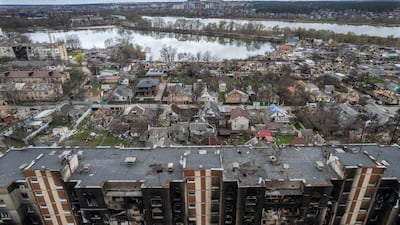
A burnt apartment tower in Irpin. Getty Images -
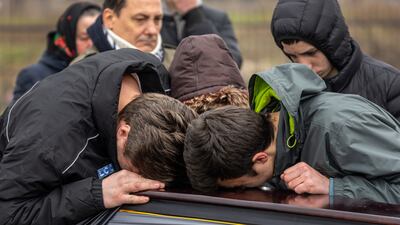
Family members grieve during the funeral of Ruslan Nechyporenko, 47, in Bucha. Getty Images -

An abandoned Russian military position in Borodyanka town near Kyiv. EPA -

Heavily pregnant Dr Marta Kopan, who fled Kyiv with her husband Dr Maxim Motsya and their three-year-old son Makar, narrates their ordeal at a relative's place in Lviv. AP -

A Ukrainian officer searches for unexploded explosives as he passes by an Antonov An-225, the world's biggest cargo aircraft, destroyed during the war on the outskirts of Kyiv. AP -

A woman stands amid the destruction caused when a civilian building was hit by a Russian missile in Lviv, western Ukraine. Getty Images -
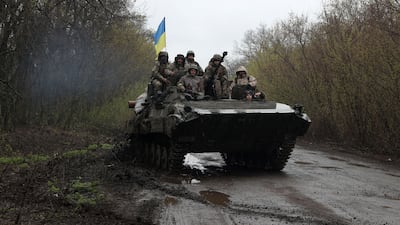
Ukrainian soldiers on an armoured personnel carrier, near the front line with Russian troops, in Izyum district, Kharkiv region, north-eastern Ukraine. AFP -
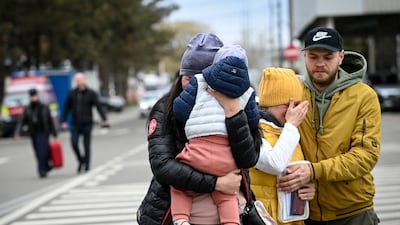
Ukrainian refugees arrive at the Siret border crossing between Romania and Ukraine. AFP -

Ukranian soldiers in a trench look out across the front line near Kharkiv. AFP -
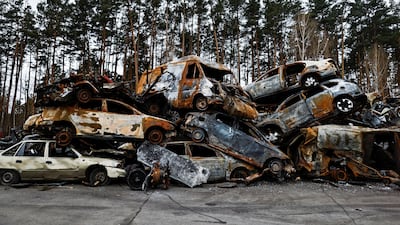
Cars destroyed in Russian attacks, in Irpin, near Kyiv. The scene of fierce fighting, the town was occupied by Russian forces. Reuters -
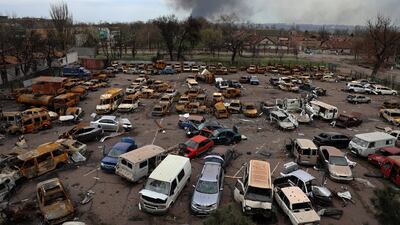
Damaged and destroyed vehicles at Illich Iron and Steel Works Metallurgical Plant, in an area controlled by Russian-backed separatists in besieged south-eastern city Mariupol. AP -
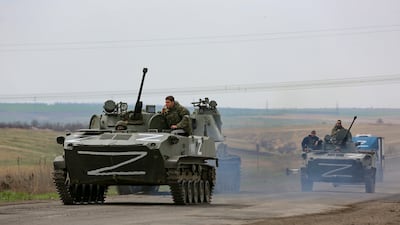
Russian military vehicles in an area controlled by Moscow-backed separatists near Mariupol. AP -
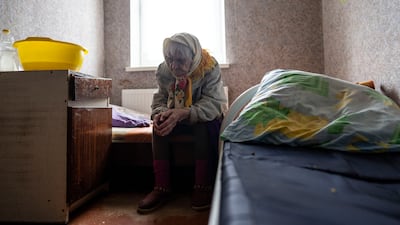
An elderly woman waits do be evacuated from a hospice in Chasiv Yar city, in Donetsk, eastern Ukraine. At least 35 residents have been helped to flee from the region that has been under attack for weeks. AP -
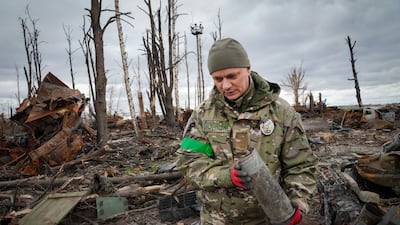
A Ukrainian Interior Ministry serviceman collects unexploded shells, grenades and mines, following fierce fighting in Hostomel. AP


Why did Russia test the ICBM now?
The test launch of the Sarmat missile comes as tensions soar between Moscow and the West over the Russian military action in Ukraine.
It again highlights the Kremlin’s emphasis on the country’s nuclear forces.
Russia’s Defence Ministry said the Sarmat was launched on Wednesday from the Plesetsk launch facility in northern Russia and its practice warheads had successfully reached mock targets on the Kura firing range on the far eastern Kamchatka Peninsula.
It said the launch was fully successful, proving the missile’s characteristics “in all phases of its flight”.
What does the West think of the test?
The US did not seem concerned about the test.
Russia told the US in advance about the launch, in line with the New START nuclear arms control treaty between Moscow and Washington, according to Pentagon press secretary John Kirby.
“Russia properly notified the United States under its New START obligations that it planned to test this ICBM,” he said. “Such testing is routine. It was not a surprise. We did not deem the test to be a threat to the United States or its allies.”
What do experts make of the test?
Jack Watling of the Rusi think tank in London told Reuters there was an element of posturing and symbolism involved, less than three weeks before the annual Victory Day parade where Russia traditionally shows off its latest weapons.
"The timing of the test reflects the Russians wanting to have something to show as a technological achievement in the lead-up to Victory Day, at a time when a lot of their technology has not delivered the results they would have liked," Mr Watling said.
Douglas Barrie, a senior fellow for military aerospace at the International Institute for Strategic Studies, said the launch was an important milestone after years of delays caused by funding issues and design challenges.
He said more tests would be needed before Russia could actually use it to replace ageing SS-18 and SS-19 missiles that were "well past their sell-by date".
Mr Barrie said the Sarmat's ability to carry 10 or more warheads and decoys, and Russia's option of firing it over either of the Earth's poles, posed a challenge to ground and satellite-based radar and tracking systems.
Igor Korotchenko, editor in chief of Russia's National Defence magazine, told RIA news agency it was a signal to the West that Moscow was capable of meting out "crushing retribution that will put an end to the history of any country that has encroached on the security of Russia and its people".

