


French President Emmanuel Macron and far-right challenger Marine Le Pen clashed in a heated debate on Wednesday over who would be best placed to improve voters' cost of living and run France's foreign policy.
It was their only debate before Sunday's election and was watched by more than 15 million French across a handful of broadcasters. Polls released in the aftermath of the event showed Mr Macron was ahead on 56 per cent in the two way contest which concludes on Sunday.
Mr Macron and Ms Marine Le Pen on Thursday launched a final push for votes in working class heartlands of France after a pre-election debate marked by bitter clashes.
The televised debate on Wednesday evening -- a pivotal moment ahead of Sunday's run-off vote -- was marked by a highly aggressive performance by Mr Macron, who lost no opportunity to attack his opponent throughout the marathon three-hour session.
Ms Le Pen chose a more cautious approach, making every effort not to be ruffled by the incoming fire and clearly mindful not to repeat her flustered appearance in a 2017 debate that was widely derided as a fiasco.
The televised debate was tense throughout, peppered with "Don't interrupt me," "This is wrong," and both accusing each other of having a shrivelled, unambitious visions of France and its future.
"Stop mixing everything up," Mr Macron told Ms Le Pen during a tense exchange about France's debt.
"Don't lecture me," she responded.
Mr Macron has warned that Ms Le Pen’s proposed measure to ban Muslim headscarves in French public spaces would create “civil war” if introduced.
The far-right presidential candidate said she was fighting radical Islam not Muslims.
“I am not carrying out a war against their religion,” she said.
“I’m telling it in a very clear manner: I think the headscarf is a uniform imposed by Islamists. I think a great proportion of young women who are wearing it have no other choice, in reality.”
“What you’re saying is very serious,” Mr Macron said. “You’re going to create civil war if you do it.”
France would be “the first country in the world to ban religious displays in public spaces", he said.

Ms Le Pen, slamming Mr Macron's record in office, which she said had made the French "suffer", said: "I will make it my absolute priority over the next five years to give the French their money back.
"I would like to tell them that another choice is possible, I will be the president of the cost of living."
Mr Macron's strongest line of attack at the start of the debate was her past admiration of Russian President Vladimir Putin, a loan for the 2017 campaign contracted through a Russian bank, and her recognition of Russia's annexation of Crimea.
"You depend on the Russian power, you depend on Mr Putin. You took out a loan from a Russian bank," he told his opponent. "A lot of your choices can be explained by this dependence.
"You don't speak to other leaders, you speak to your banker when you speak to Russia. That's the problem."
In a heated exchange — during which Mr Macron at one point asked Ms Le Pen, "Are you kidding me?" — she rejected the accusations, saying: "I am a completely free and independent woman."
With unemployment at a 13-year low, Mr Macron said he was proud of job creation during his term.
"The best way to gain purchasing power is to fight unemployment," he said.
The two candidates kept interrupting each other at the start of the debate, with Ms Le Pen saying that "in real life" her proposals would improve voters' situation much more than her opponent, while Mr Macron said some of her proposals were not realistic.
"Mrs Le Pen, what you said is inaccurate," Mr Macron told his opponent about her proposals to slash VAT to improve people's purchasing power.
"And you responded to none of my remarks because you have no response."
Ms Le Pen said Mr Macron's cost of living proposals would be inefficient.
-
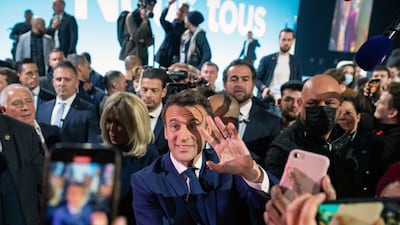
Emmanuel Macron, the president of France, at an election night event after voting in the first round of the French presidential election, in Paris. Bloomberg -
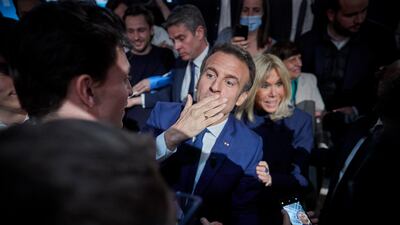
Emmanuel Macron at a rally in Paris after the first round of voting in the French presidential election as early exit polls suggested victory. Getty Images -
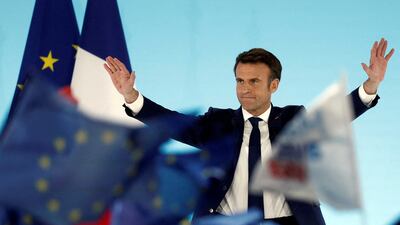
Mr Macron after partial results were declared in the first round of the 2022 French presidential election. Reuters -
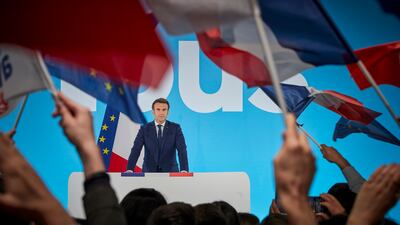
Supporters in Paris cheer Mr Macron at a rally after the first-round vote. Getty Images -
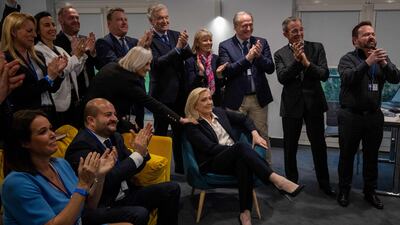
Marine Le Pen, centre, of the French far-right party Rassemblement National, and supporters after the first round of voting. AFP -
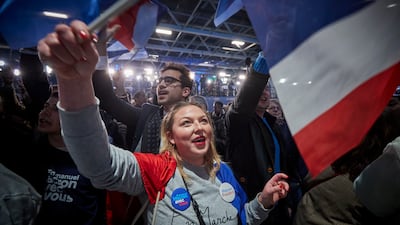
Supporters cheer in Paris as exit polls indicated Mr Macron would win the election. Getty Images -
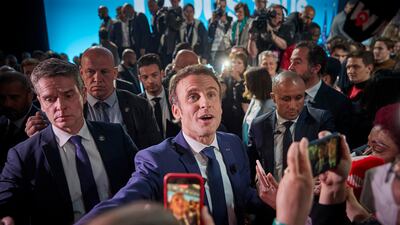
The French leader acknowledges his supporters at a rally in Paris. Getty Images -
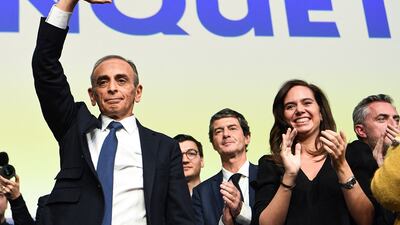
Eric Zemmour, candidate of the far-right Reconquete! party, waves to supporters after voting ended in the first round of the French presidential election. AFP -
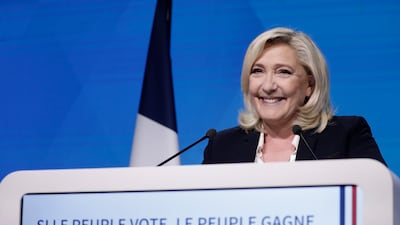
Far-right candidate Marine Le Pen delivers a speech at her election day headquarters in Paris. AP -
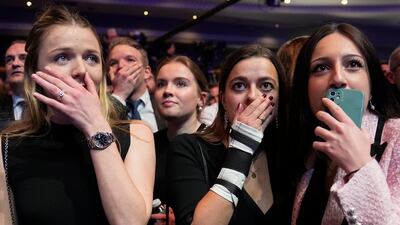
Supporters of Mr Zemmour as preliminary results of the first round of the presidential election were announced in Paris. AP -
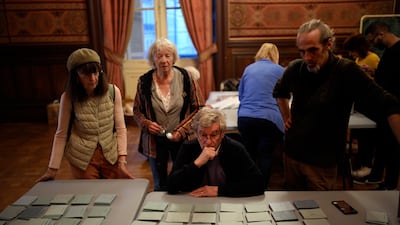
Ballots for the first round of the presidential election are counted in Marseille, southern France. AP -

French President Emmanuel Macron, who was seeking re-election, accompanied by his wife Brigitte, greets people at a polling station in Le Touquet-Paris, France. EPA -
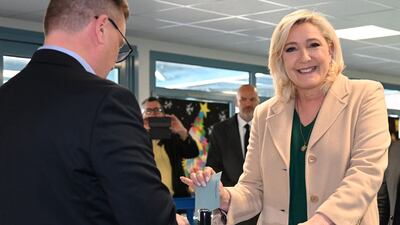
Far-right presidential candidate Marine Le Pen casts her ballot at a polling station in Henin-Beaumont, northern France. AFP -
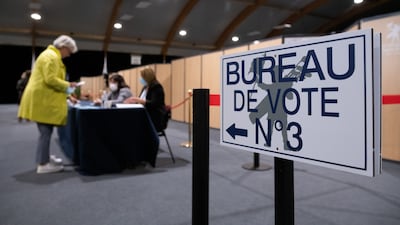
A sign indicates where to vote at a polling station, in Le Touquet-Paris. Bloomberg -
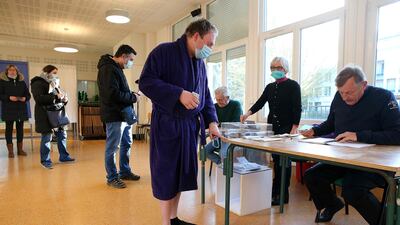
A voter wearing a robe and slippers arrives to cast his ballot at a polling station in Reims, north-eastern France. AFP -
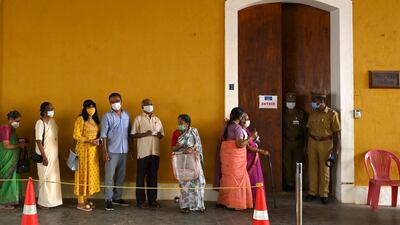
French citizens living in India arrive to cast their votes at France's consulate general, in the region of Pondicherry. AFP -

A man votes in Saint-Denis, outside Paris. AP -
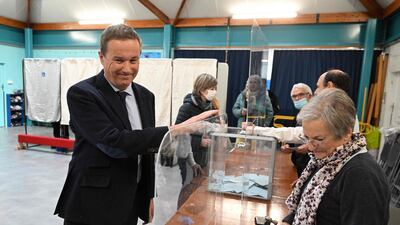
Presidential candidate of the far-right DLF party, Nicolas Dupont-Aignan, casts his ballot in Yerres, south-east of Paris. AFP -
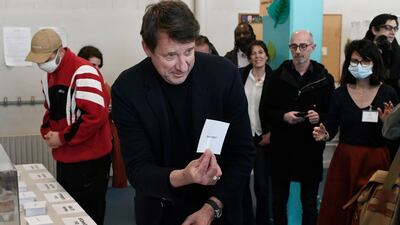
The French ecologist party EELV's presidential candidate, Yannick Jadot, takes ballots before voting at a polling station in Paris. AFP -
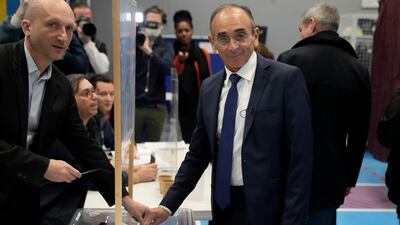
Far-right candidate Eric Zemmour votes in Paris. AP -
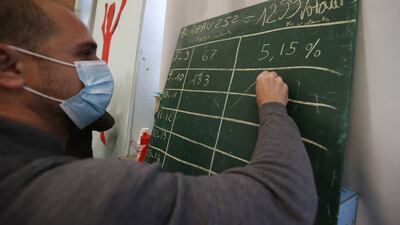
A polling station worker checks voters turnout by hour at a polling station in Marseille. EPA -
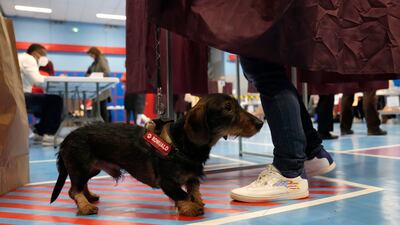
A voter inside a voting booth in Paris. AP -
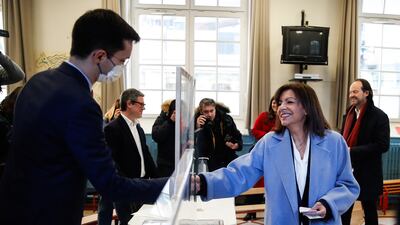
Mayor of Paris and presidential candidate Anne Hidalgo votes at a polling station in the French capital. EPA -
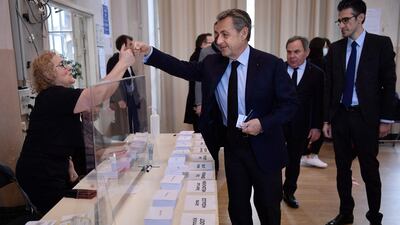
Former French president Nicolas Sarkozy, centre, greets an electoral officer at a polling station in Paris. AFP -
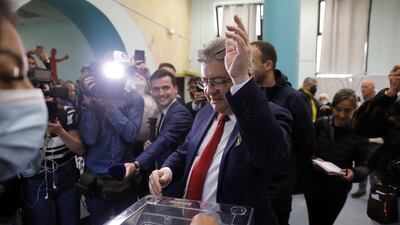
The presidential candidate of the LFI party, Jean-Luc Melenchon, casts his ballot at a polling station in Marseille. EPA


The election presents voters with two opposing visions of France: Mr Macron offers a pro-European, liberal platform; while Ms Le Pen's nationalist policies are founded on deep euroscepticism.
Much haggling went on behind the scenes before the debate, from the temperature of the room to flipping a coin to decide what theme they would start with, to who would speak first, which was Ms Le Pen.
Last time they faced off in a debate, in 2017, Ms Le Pen's presidential challenge unravelled as she mixed up her notes and lost her footing.
The prime-time debate on that occasion cemented Mr Macron's status as the clear front-runner.
But Mr Macron is no longer the disruptor from outside politics and now has a record that Ms Le Pen can attack.
Meanwhile, she has tacked towards mainstream voters and worked hard at softening her image.
After more than half of the electorate voted for far-right or hard left candidates in the first round, Mr Macron's lead in opinion polls is much narrower than five years ago, when he beat Ms Le Pen with 66.1 per cent of the vote.
Voter surveys on Wednesday projected he would win with between 55.5 and 56.5 per cent this time.

