


The Russian Air Force’s long-range air-launched cruise missiles are proving to be highly unreliable, coming up short in President Vladimir Putin's campaign against Ukraine, according to a military expert.
The weapons, believed to be the Raduga Kh-101 (RS-AS-23A Kodiak), are failing at an exorbitant rate when it comes to hitting enemy targets in Ukraine, said Douglas Barrie, a senior fellow for military aerospace at the International Institute for Strategic Studies think tank in London.
Such a high failure rate could be down to multiple factors, including issues with launching capabilities or the weapons failing to explode after hitting targets, he said.
The Russian-made weapons which carry a conventional warhead are designed to defeat air defence systems by flying at low, terrain-hugging altitudes to avoid radar systems.
The missile has a range of up to 2,800 kilometres. At its launch it weighs between 2,300 and 2,400 kilograms and is fired without a booster, using the aircraft’s momentum at release to give it initial velocity.
Experts had believed its accuracy to be quite high due to the electronic Glonass satellite navigation ― the Russian equivalent to GPS ― and TV terminal guidance used in deploying it.
However, US intelligence suggests it has not been performing well for the Russians in Ukraine.
Mr Barrie said intelligence laid out in a US Department of Defence briefing gave further weight to the widely held assessment that Russia’s war against its neighbour is not going according to plan.
“Russia’s invasion of Ukraine appears to have been poorly planned and executed, with the expectation that the campaign would last only two-to-three days,” he wrote in a blog on Friday.
“As it has progressed, or stalled, it has also exposed the failings in some of Moscow’s most capable air-launched systems, shortcomings that the Russian military will want to resolve.”
-
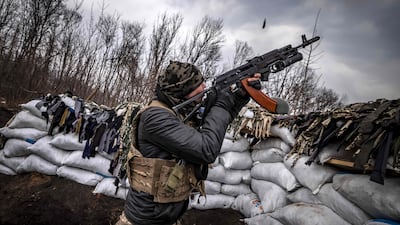
A Ukrainian soldier fires his rifle from a trench at the front east of Kharkiv in the north of Ukraine, which continues to be shelled by Russian forces. AFP -
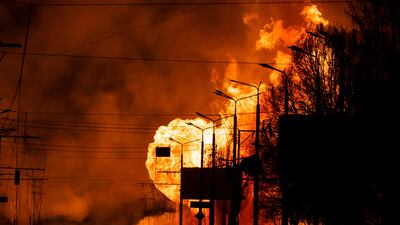
A gas station on fire in Kharkiv after Russian ttack on the northern city. AFP -
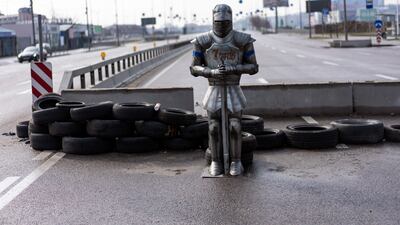
A medieval suit of armour 'stands guard' at a a Ukrainian checkpoint, on the outskirts of the capital Kyiv. AP Photo -
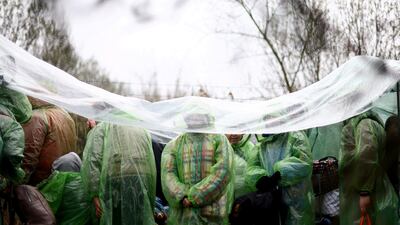
Ukrainian refugees wait in line to cross the border into Poland at Shehyni. Reuters -
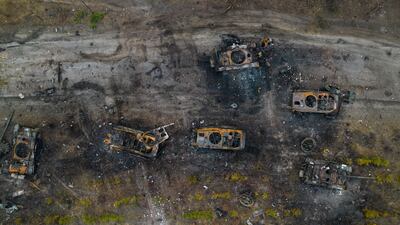
Destroyed Russian armoured vehicles on the outskirts of Kyiv. AP Photo -
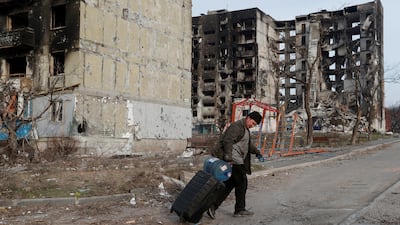
A resident passes apartment buildings destroyed by Russian attacks in the besieged southern port city of Mariupol, Ukraine. Reuters -
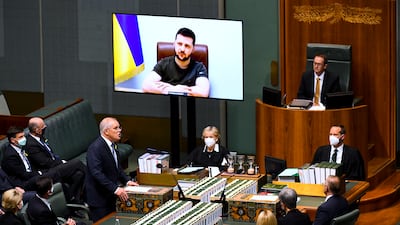
Australian Prime Minister Scott Morrison, standing, welcomes Ukrainian President Volodymyr Zelenskyy to address the House of Representatives via video link at Parliament House in Canberra. Mr Zelenskyy appealed directly to Australian legislators for more help in the war against Russia, including armoured vehicles and tougher sanctions. AP -
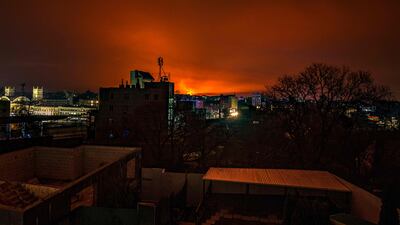
Fire lights up the sky east of Kharkiv, where Ukrainian forces pushed back Russian troops from a motorway outside the country's second-largest city. AFP -
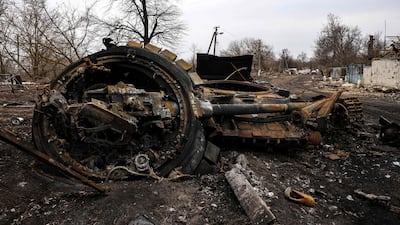
A destroyed Russian tank in the village of Lukianivka near Kyiv. AFP -
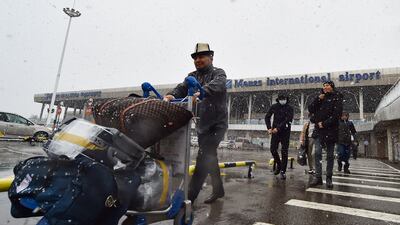
Passengers arriving from Moscow at Manas International Airport, Bishkek, Kyrgyrzstan. Hundreds of thousands of citizens of former Soviet countries in Central Asia are facing difficult choices: shrinking work opportunities in Russia and wages in the weakened rouble versus a return to the homeland where they have family homes, but even fewer job prospects. AFP -

Fire and smoke light up the sky east of Kharkiv as Ukrainian forces push back Russian troops from a motorway outside the country's second-largest city. AFP -
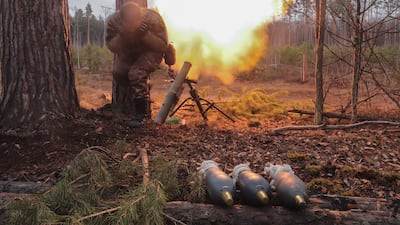
A Ukrainian soldier shoots at the Russian positions not far from the capital Kyiv. EPA -
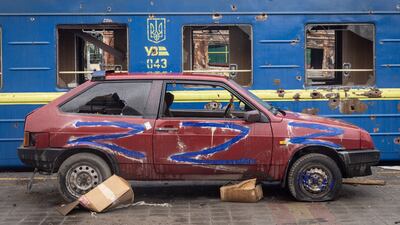
A car marked with the English letter 'Z' is found destroyed at the central Ukrainian train station that was used as a Russian base in Trostyanets. Ukrainian forces said they had retaken the north-eastern town from the Russians. Getty Images -
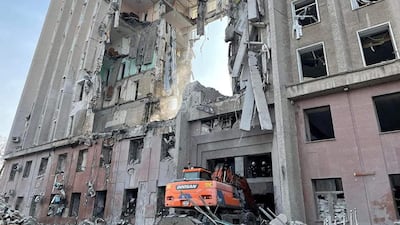
Rescue workers at the site of the regional administration building hit by Russian cruise missiles, in Mykolaiv, Ukraine. Reuters -
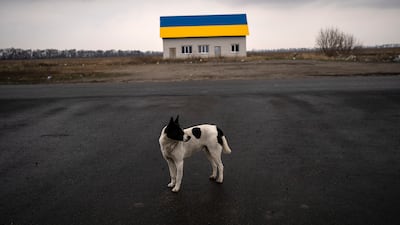
A dog looks at cars passing by on the road near a house painted with the colors of the Ukrainian flag, on the outskirts of the capital Kyiv. AP Photo -
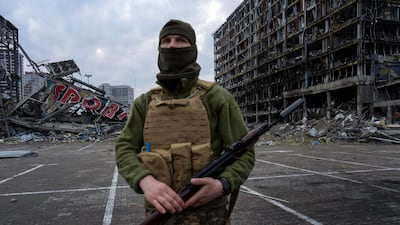
A soldier poses for the picture in Kyiv, Ukraine, while standing guard amid the destruction caused after shelling of a shopping center. AP Photo -
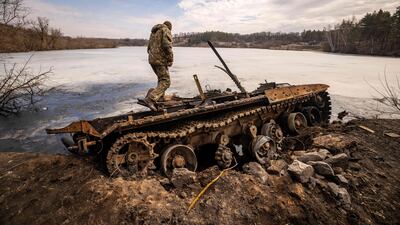
A Ukrainian serviceman stands near a destroyed Russian tank in the north-eastern city of Trostianets. AFP -
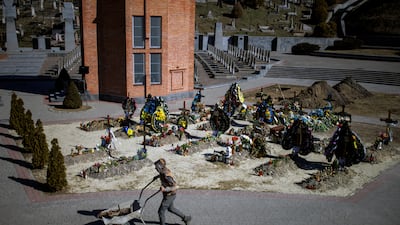
A worker pushes a cart past graves of Ukrainian soldiers who were killed in battle during Russia’s attack on Ukraine, at the Lychakiv cemetery in Lviv. Reuters -
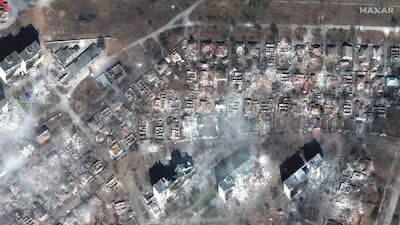
This satellite image provided by Maxar Technologies shows damaged apartment buildings and homes in Mariupol. AP -
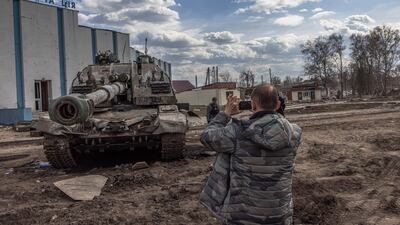
A resident takes photos of a destroyed Russian tank next to the railway station where the Russian forces were stationed, in Trostyanets, a town recaptured by the Ukrainian army. EPA -

A rescuer clears the rubble of a warehouse containing more than 50,000 tons of deep-frozen food in the town of Brovary, north of Ukrainian capital of Kyiv, after it was destroyed by Russian shelling. AFP -
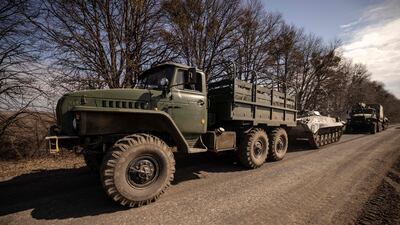
A Ukrainian army vehicle carries a Russian tank in Trostyanets. AFP -
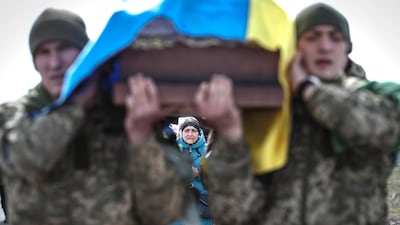
Ukrainian soldiers carry a coffin during the funeral ceremony of a comrade in Odesa. EPA -
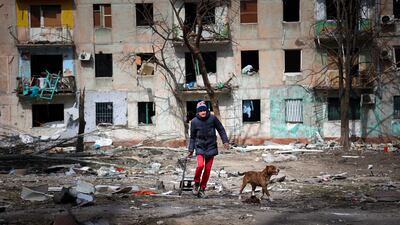
A man walks with his dog near an apartment building damaged by shelling from fighting on the outskirts of Mariupol. AP Photo -
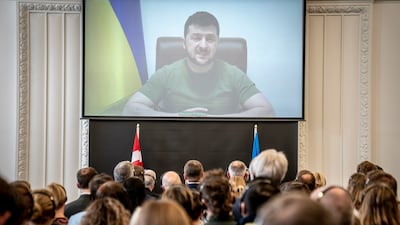
Members of the Danish Parliament attend the Ukrainian President, Volodymyr Zelensky's speech to the Danish Parliament via a video link, at the Christiansborg Castle in Copenhagen, Denmark. EPA -

A satellite image shows crowds outside a Metro grocery store in Mariupol. Reuters -
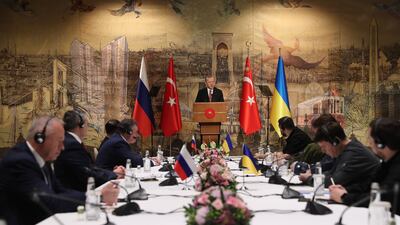
Turkish President Recep Tayyip Erdogan opens Ukrainian-Russian talks in Istanbul. President Erdogan told the delegations that "both parties have legitimate concerns." AFP -
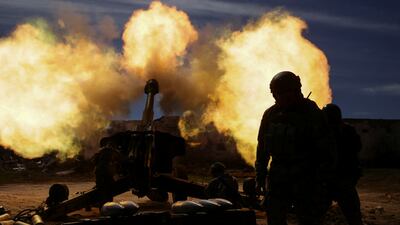
Members of the Ukrainian Volunteer Corps fire a howitzer at a position in the Zaporizhzhia region. Reuters -
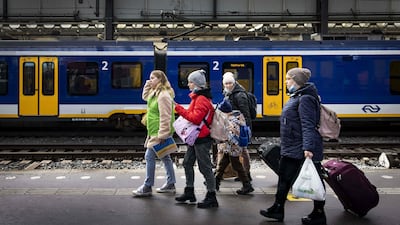
Ukrainian refugees are helped by volunteers upon their arrival at Amsterdam Central station by train from Berlin. AFP -

Ukrainian soldiers ride an armoured people carrier through the town of Trostsyanets, about 400 kilometres east of Kyiv. AP Photo -
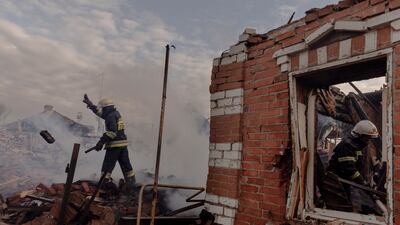
Firefighters work amid the debris of residential houses that were destroyed by Russian shelling in a settlement outside Kharkiv. Reuters -

President Joe Biden said that he is not advocating for regime change in Moscow after saying Russian counterpart Vladimir Putin "cannot remain in power." AP Photo -

Firefighters work to extinguish a fire at a warehouse after it was hit by Russian shelling in Kharkiv, Ukraine. More than half of Kharkiv's 1.4 million people have fled the city since Russia's invasion on February 24. Getty Images -
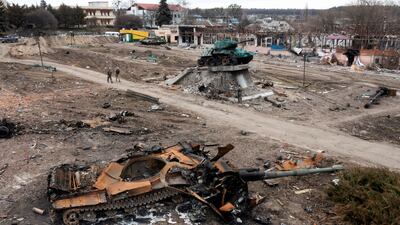
Local residents pass by a destroyed Russian tank in the town of Trostyanets, east of capital Kyiv, Ukraine. The monument to the Second World War is seen in background. AP Photo -
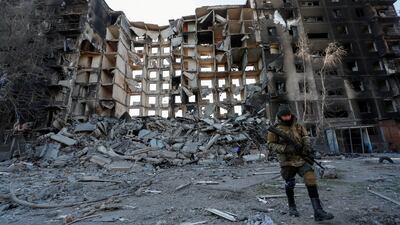
A pro-Russian troop service member walks near a destroyed apartment building in the besieged southern port city of Mariupol. Reuters -
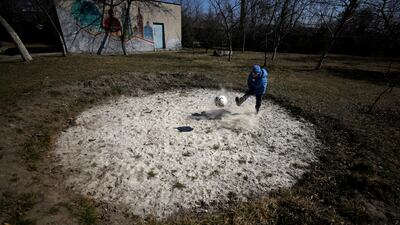
Mykhaylo, 8, who was taken away from his widowed mother along with his 9-year-old brother and 16-year-old sister, plays with a ball in the garden of a state shelter in Lviv. Reuters -

Halyna Falko, 52, talks to reporters while looking at the destruction caused after a Russian attack inside her house near Brovary, on the outskirts of Kyiv. AP Photo -
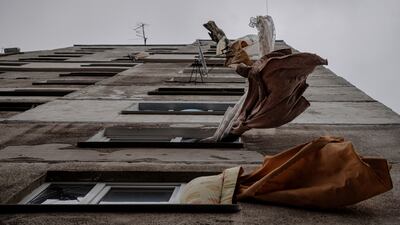
Curtains flutter in the wind at a building that was damaged by shelling in a neighbourhood that has been largely abandoned and left without water, gas and heating, as Russia's attack on Ukraine continues, in Kharkiv, Ukraine. Reuters -

People, mainly women and children, arrive at Przemysl on a train from Odesa in war-torn Ukraine in Przemysl, Poland. The Polish government has said it may spend €24 billion this year hosting refugees fleeing the war in Ukraine, and is seeking more support from the European Union. Getty Images -
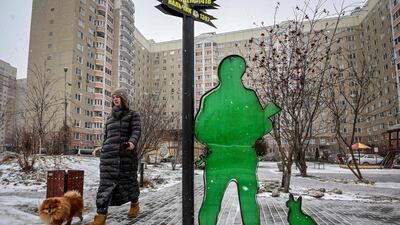
A woman walks a dog past the so-called "people's installation to a Russian soldier" nicknamed the "polite people" created by residents in the backyard of their apartment building in the town of Podolsk, outside Moscow. AFP


He wrote: “The Kh-101 was used successfully during Russia’s intervention in the Syrian civil war to strike enemy targets and is now the primary conventionally armed long-range land-attack cruise missile in the air force inventory.
“However, it is being used in far greater numbers in the war Russia is currently waging on Ukraine, with an apparent failure rate that, if correct, will be of significant concern to Moscow.”
In a US Department of Defence briefing on March 21, unnamed officials discussed Russia’s guided weapons inventory.
They said: “They [Russia] still have the majority of their stocks available to them, but they have expended quite a bit, particularly in sensitive cruise missiles, air-launched cruise missiles, and they have also suffered a not-insignificant number of failures of those munitions.”
The officials did not provide evidence to back up their assessment. Citing American intelligence, three sources said the US estimated that Russia's failure rate varied day-to-day, depended on the type of missile being launched, and could sometimes exceed 50 per cent. Two of them said it reached as high as 60 per cent.
Mr Barrie said: “Given that Ukraine appears to have a significant number of ground-based air defence missile systems and air-surveillance radars that remain operational, and are being used effectively, Kh-101 launches are likely to have taken place well inside Russian airspace.”
The weapons sent to aid Ukraine


