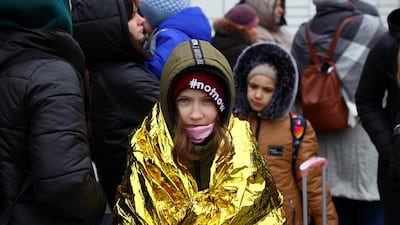
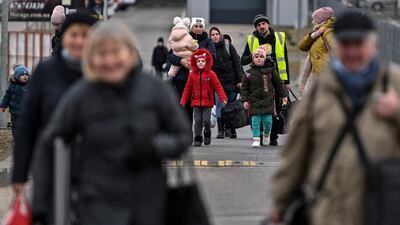
Aydar Kudirmekov, left, helps translate for Ukrainians who arrive in Vienna. Karina, right, and her 6-year-old son left Ukraine for Austria by car. Tim Stickings/The National

Ukrainians in Europe's charitable embrace would rather go home


Tim Stickings
  • English
  • Arabic

Live updates: follow the latest news on Russia-Ukraine

Europe is powering up its humanitarian machine to look after Ukrainian refugees like Karina, who arrived in Austria with her 6-year-old son — but the sales manager from Zaporizhzhia would rather go home.

“We want to get back home because we had good lives,” says Karina, 33, at the entrance of a refugee reception centre in Vienna. “Everything was OK before.”

Like many Ukrainian women, Karina left the country without her husband because men of fighting age are expected to stay behind.

Travelling with a friend, who also had a child in tow, she drove for five days across Slovakia to reach Vienna.

For Karina, who is staying in another friend’s apartment in Vienna, keeping in touch with her husband is hard because of frequent interruptions to internet services in Ukraine. She knows he is alive but she worries for his safety and mental state as the war with Russia stretches into its third attritional week.

“When you can hear the sounds of bombs and aeroplanes around in the sky, you can’t be OK,” she said.

More than 2.5 million people have fled the war in the space of two weeks, a number the EU has said could double as the conflict continues.

A charity called People's Aid is offering advice and donations to Ukrainians. Tim Stickings/The National

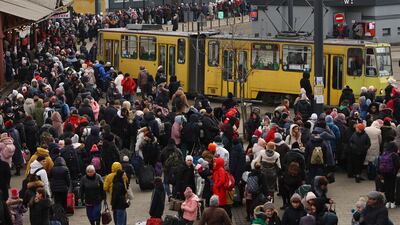
At Vienna’s central station, between 1,000 and 10,000 people arrive from Ukraine every day, stepping off dozens of trains and into the care of local humanitarians.

Helpers from the charity Caritas hand out masks and hold up blue and yellow flags to advertise their offer of help, while Ukrainians exchange tips among themselves as they figure out how to navigate a new city. Aydar Kudirmekov, who speaks Russian, German and English, helps to translate for the new arrivals.

“I think Mr Putin made a great mistake in the history of Russia,” said Mr Kudirmekov of the Russian president’s aggression against Ukraine.

“It’s a war, it’s a real war. It’s not only a problem for Russia and Ukraine but for all of Europe.”

Some of the arrivals are looking to shelter in Vienna, already home to about 7,000 Ukrainians, while others want to continue their journey to Germany or Italy.

Even the Ukrainians who do initially set up camp in Vienna do not know how long they will stay and hope they will not be seeking charity for too long.

“It’s a war. What do you do?” asked one woman who left Ukraine by herself, her hands clasped in prayer that the conflict would soon be over.

Although grateful for the humanitarian help, Ukraine’s government would like its allies to make that charity unnecessary by doing more to fight Russia — but western powers say escalation would only prolong human suffering.

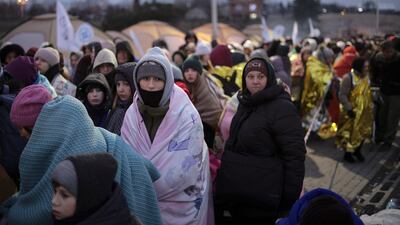
  • Refugees who fled Ukraine wait outside a temporary centre in Przemysl, Poland. Reuters
    Refugees who fled Ukraine wait outside a temporary centre in Przemysl, Poland. Reuters
  • Refugees intent on fleeing Ukraine wait for hours to board a train from Lviv to Poland. Reuters
    Refugees intent on fleeing Ukraine wait for hours to board a train from Lviv to Poland. Reuters
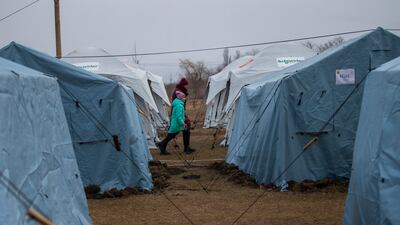
  • People arrive at a refugee camp near Palanca, in Moldova, about 3 kilometres from the border with Ukraine. EPA
    People arrive at a refugee camp near Palanca, in Moldova, about 3 kilometres from the border with Ukraine. EPA
  • Pupils in Sache village, France, welcome Anastasia and her son Dary, refugees fleeing Ukraine. AFP
    Pupils in Sache village, France, welcome Anastasia and her son Dary, refugees fleeing Ukraine. AFP
  • Refugees from Ukraine disembark a ferry at the border crossing in Isaccea, Romania. Getty
    Refugees from Ukraine disembark a ferry at the border crossing in Isaccea, Romania. Getty
  • People who fled Ukraine wait for transport after crossing the border into Poland. AP
    People who fled Ukraine wait for transport after crossing the border into Poland. AP
  • Refugees at a makeshift shelter set up at a four-star hotel in Suceava, Romania. AP
    Refugees at a makeshift shelter set up at a four-star hotel in Suceava, Romania. AP
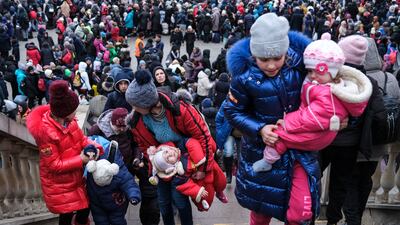
  • Women and children arrive at Lviv train station in western Ukraine as they try to flee the country. EPA
    Women and children arrive at Lviv train station in western Ukraine as they try to flee the country. EPA
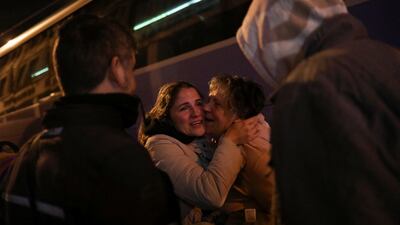
  • Relatives are reunited after crossing from Ukraine into Hungary. Getty
    Relatives are reunited after crossing from Ukraine into Hungary. Getty
  • A woman welcomes a child who has arrived in Berlin on a train from Poland. Reuters
    A woman welcomes a child who has arrived in Berlin on a train from Poland. Reuters
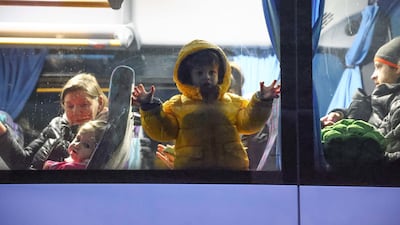
  • Refugees from Odesa arrive in Athens. Reuters
    Refugees from Odesa arrive in Athens. Reuters
  • People fleeing Ukraine arrive at Velke Slemence, Slovakia. EPA
    People fleeing Ukraine arrive at Velke Slemence, Slovakia. EPA
  • Parents and children make their way through Berlin's main station after arriving in Germany from Poland. Reuters
    Parents and children make their way through Berlin's main station after arriving in Germany from Poland. Reuters
  • Refugees at the Medyka border crossing in Poland, where thousands are fleeing as a result of the Russian military offensive. AFP
    Refugees at the Medyka border crossing in Poland, where thousands are fleeing as a result of the Russian military offensive. AFP
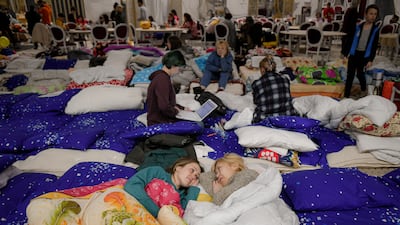
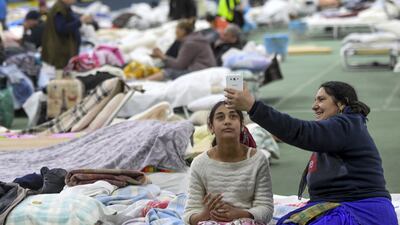
  • A sports hall in Chisinau, Moldova, where more than 500 people who fled from Ukraine found shelter. EPA
    A sports hall in Chisinau, Moldova, where more than 500 people who fled from Ukraine found shelter. EPA
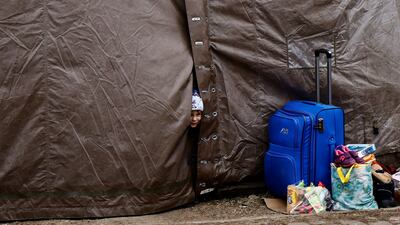
  • A child looks out from a tent at a temporary camp for refugees in Przemysl, Poland. Reuters
    A child looks out from a tent at a temporary camp for refugees in Przemysl, Poland. Reuters
  • A worker prepares a gym in Perpignan, France, before the arrival of people fleeing Ukraine. AFP
    A worker prepares a gym in Perpignan, France, before the arrival of people fleeing Ukraine. AFP

Charities spring into action

When it comes to organising humanitarian aid, Europe has had years of practice. The flow of Middle East refugees that peaked in 2015 was followed by a flood of evacuees from Afghanistan last year, before the war in Ukraine triggered yet another mass movement of people.

Vienna had mobilised its first reception centre within a week of the invasion and Ukrainians were offered an unusually generous status in the EU that grants them access to employment and education and spares them a bureaucratic asylum process.

In typically migrant-averse Austria, the public willingness to help “is enormous”, says Lilli Gneisz, who works at a Vienna humanitarian charity called People’s Aid.

Austria’s President Alexander van der Bellen has supported this grassroots humanitarian effort and said in a television appearance that Austrians should not see the newcomers as a burden.

Ukrainians in Vienna often arrive with almost nothing, aside from a few changes of clothes.

The People’s Aid store room, near the main railway station, is overflowing with donated items including clothes, mattresses, children’s nappies and toys.

Dolls and teddy bears may not be much use on the front line but they are kept in the store room to cheer someone up back in Austria.

“We get a crazy number of offers,” said Ms Gneisz.

A store room full of items that people have donated for Ukrainians in Vienna. Tim Stickings/The National

Three lorries have been dispatched to Ukraine at the request of partner charities in the war zone that tell their suppliers in Austria what they need, with medicines and sleeping bags in particularly high demand.

There is a steady stream of arrivals to the reception centre, up to 150 a day. Since few of them speak German, some have prepared a written request on their phone while others rely on English.

The charity provides food vouchers that are valid at supermarkets and restaurants such as Burger King and KFC, and helps disoriented Ukrainians find somewhere to live if they do not have family or friends to put them up.

Meanwhile, finding longer-term accommodation in Vienna can be complicated because an “initial euphoria” from the public about helping Ukrainians could give way to a reluctance to put people up indefinitely, said Ms Gneisz.

.
.

Europe’s current political warmth towards the arriving Ukrainians may not last and even refugee-friendly humanitarian workers can become burnt out over the constant human distress they witness. The Ukrainian refugees join the asylum seekers and dispossessed of Vienna that the charity initially set out to help. The pandemic, too, has not yet disappeared.

Even if the fighting stops, Ukraine has suffered enough severe damage from Russian shelling that some refugees may not see their battered country as a safe place to return.

Ms Gneisz believes that most of the Ukrainians are longing to go home, but she hopes that a friendly embrace from charities can, at least, help them adjust to life as refugees.

“It’s good that they arrive and feel there is someone there,” she said. “They don’t think nobody is looking after them.”


Dust and sand storms compared

Sand storm

  • Particle size: Larger, heavier sand grains
  • Visibility: Often dramatic with thick "walls" of sand
  • Duration: Short-lived, typically localised
  • Travel distance: Limited 
  • Source: Open desert areas with strong winds

Dust storm

  • Particle size: Much finer, lightweight particles
  • Visibility: Hazy skies but less intense
  • Duration: Can linger for days
  • Travel distance: Long-range, up to thousands of kilometres
  • Source: Can be carried from distant regions

Qosty Byogaani

Starring: Hani Razmzi, Maya Nasir and Hassan Hosny

Four stars

Specs

Engine: Dual-motor all-wheel-drive electric

Range: Up to 610km

Power: 905hp

Torque: 985Nm

Price: From Dh439,000

Available: Now

Fixtures
%3Cp%3E%3Cstrong%3EWednesday%2C%20April%203%3C%2Fstrong%3E%3C%2Fp%3E%0A%3Cp%3EArsenal%20v%20Luton%20Town%2C%2010.30pm%20(UAE)%3C%2Fp%3E%0A%3Cp%3EManchester%20City%20v%20Aston%20Villa%2C%2011.15pm%20(UAE)%3C%2Fp%3E%0A%3Cp%3E%3Cstrong%3EThursday%2C%20April%204%3C%2Fstrong%3E%3C%2Fp%3E%0A%3Cp%3ELiverpool%20v%20Sheffield%20United%2C%2010.30pm%20(UAE)%3C%2Fp%3E%0A
Ten tax points to be aware of in 2026

1. Domestic VAT refund amendments: request your refund within five years

If a business does not apply for the refund on time, they lose their credit.

2. E-invoicing in the UAE

Businesses should continue preparing for the implementation of e-invoicing in the UAE, with 2026 a preparation and transition period ahead of phased mandatory adoption. 

3. More tax audits

Tax authorities are increasingly using data already available across multiple filings to identify audit risks. 

4. More beneficial VAT and excise tax penalty regime

Tax disputes are expected to become more frequent and more structured, with clearer administrative objection and appeal processes. The UAE has adopted a new penalty regime for VAT and excise disputes, which now mirrors the penalty regime for corporate tax.

5. Greater emphasis on statutory audit

There is a greater need for the accuracy of financial statements. The International Financial Reporting Standards standards need to be strictly adhered to and, as a result, the quality of the audits will need to increase.

6. Further transfer pricing enforcement

Transfer pricing enforcement, which refers to the practice of establishing prices for internal transactions between related entities, is expected to broaden in scope. The UAE will shortly open the possibility to negotiate advance pricing agreements, or essentially rulings for transfer pricing purposes. 

7. Limited time periods for audits

Recent amendments also introduce a default five-year limitation period for tax audits and assessments, subject to specific statutory exceptions. While the standard audit and assessment period is five years, this may be extended to up to 15 years in cases involving fraud or tax evasion. 

8. Pillar 2 implementation 

Many multinational groups will begin to feel the practical effect of the Domestic Minimum Top-Up Tax (DMTT), the UAE's implementation of the OECD’s global minimum tax under Pillar 2. While the rules apply for financial years starting on or after January 1, 2025, it is 2026 that marks the transition to an operational phase.

9. Reduced compliance obligations for imported goods and services

Businesses that apply the reverse-charge mechanism for VAT purposes in the UAE may benefit from reduced compliance obligations. 

10. Substance and CbC reporting focus

Tax authorities are expected to continue strengthening the enforcement of economic substance and Country-by-Country (CbC) reporting frameworks. In the UAE, these regimes are increasingly being used as risk-assessment tools, providing tax authorities with a comprehensive view of multinational groups’ global footprints and enabling them to assess whether profits are aligned with real economic activity. 

Contributed by Thomas Vanhee and Hend Rashwan, Aurifer

Kathryn Hawkes of House of Hawkes on being a good guest (because we’ve all had bad ones)

  • Arrive with a thank you gift, or make sure you have one for your host by the time you leave. 
  • Offer to buy groceries, cook them a meal or take your hosts out for dinner.
  • Help out around the house.
  • Entertain yourself so that your hosts don’t feel that they constantly need to.
  • Leave no trace of your stay – if you’ve borrowed a book, return it to where you found it.
  • Offer to strip the bed before you go.
DRIVERS' CHAMPIONSHIP STANDINGS

1. Sebastian Vettel (Ferrari) 171 points
2. Lewis Hamilton (Mercedes-GP) 151
3. Valtteri Bottas (Mercedes-GP) 136
4. Daniel Ricciardo (Red Bull Racing) 107
5. Kimi Raikkonen (Ferrari) 83
6. Sergio Perez (Force India) 50
7. Max Verstappen (Red Bull Racing) 45
8. Esteban Ocon (Force India) 39
9. Carlos Sainz (Torro Rosso) 29
10. Felipe Massa (Williams) 22

Dubai Bling season three

Cast: Loujain Adada, Zeina Khoury, Farhana Bodi, Ebraheem Al Samadi, Mona Kattan, and couples Safa & Fahad Siddiqui and DJ Bliss & Danya Mohammed 

Rating: 1/5

Teri%20Baaton%20Mein%20Aisa%20Uljha%20Jiya
%3Cp%3E%3Cstrong%3EDirectors%3A%3C%2Fstrong%3E%20Amit%20Joshi%20and%20Aradhana%20Sah%3C%2Fp%3E%0A%3Cp%3E%3Cstrong%3ECast%3A%3C%2Fstrong%3E%20Shahid%20Kapoor%2C%20Kriti%20Sanon%2C%20Dharmendra%2C%20Dimple%20Kapadia%2C%20Rakesh%20Bedi%3C%2Fp%3E%0A%3Cp%3E%3Cstrong%3ERating%3A%3C%2Fstrong%3E%204%2F5%3C%2Fp%3E%0A
Key findings of Jenkins report
  • Founder of the Muslim Brotherhood, Hassan al Banna, "accepted the political utility of violence"
  • Views of key Muslim Brotherhood ideologue, Sayyid Qutb, have “consistently been understood” as permitting “the use of extreme violence in the pursuit of the perfect Islamic society” and “never been institutionally disowned” by the movement.
  • Muslim Brotherhood at all levels has repeatedly defended Hamas attacks against Israel, including the use of suicide bombers and the killing of civilians.
  • Laying out the report in the House of Commons, David Cameron told MPs: "The main findings of the review support the conclusion that membership of, association with, or influence by the Muslim Brotherhood should be considered as a possible indicator of extremism."
Destroyer

Director: Karyn Kusama

Cast: Nicole Kidman, Toby Kebbell, Sebastian Stan

Rating: 3/5 

UAE release: January 31 

Dr Amal Khalid Alias revealed a recent case of a woman with daughters, who specifically wanted a boy.

A semen analysis of the father showed abnormal sperm so the couple required IVF.

Out of 21 eggs collected, six were unused leaving 15 suitable for IVF.

A specific procedure was used, called intracytoplasmic sperm injection where a single sperm cell is inserted into the egg.

On day three of the process, 14 embryos were biopsied for gender selection.

The next day, a pre-implantation genetic report revealed four normal male embryos, three female and seven abnormal samples.

Day five of the treatment saw two male embryos transferred to the patient.

The woman recorded a positive pregnancy test two weeks later. 

Updated: March 12, 2022, 8:47 PM