

Iran is nearing the point at which its most enriched material is almost ready for use in bombs, a report by the UN nuclear watchdog found on Thursday.
The report showed the stock of uranium enriched to up to 60 per cent fissile purity had almost doubled, rising by 15.5 kilograms to 33.2kg.
A diplomat said that was about three-quarters of the amount needed, if enriched further, for one nuclear bomb according to a common definition.
That definition – 25kg of uranium enriched to 90 per cent – is a theoretical yardstick but one tool used to calculate nuclear capabilities.
In real life, the amount of uranium needed would depend on other processes the metal would have to undergo, the diplomat said.
The report was published in the quarterly report of the International Atomic Energy Agency’s member states.
Negotiators at talks to salvage the 2015 deal say they are in the final stretch.
Western powers have said that time is running out before Iran’s nuclear progress makes the meetings pointless.
-
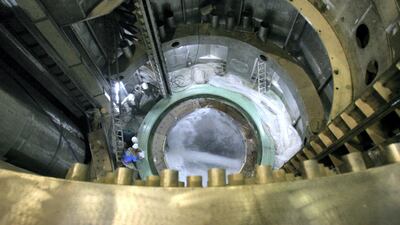
Russian contractors work at the Bushehr nuclear reactor site in 2007. The plant opened four years later. Bloomberg -
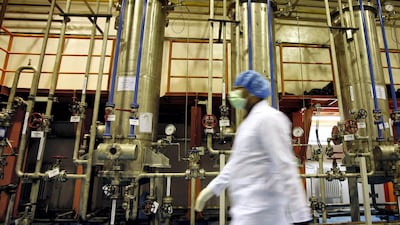
An Iranian technician at the International Atomic Energy Agency inspects the country's Isfahan plant in 2007. Tehran is no longer co-operating with the agency at nuclear sites across the country. EPA -

Workers wait to begin constructing a second reactor at the Bushehr nuclear power plant in 2019. AFP -
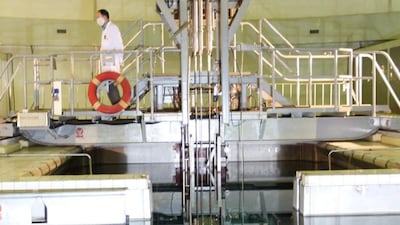
A metal-encased rod with 20 per cent enriched nuclear fuel is inserted into a reactor in Tehran in 2012. AFP -
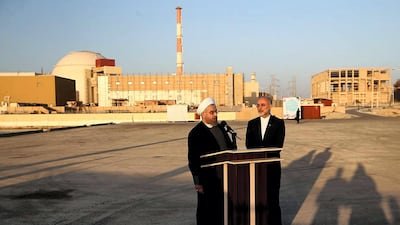
Fomer Iranian President Hassan Rouhani and the country's Atomic Energy Organisation chief Ali Akbar Salehi speak at the Bushehr nuclear site in 2015. AFP -
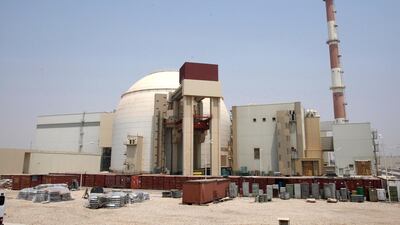
Iran's Bushehr nuclear plant has been restarted. EPA -
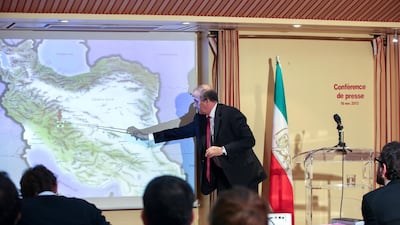
Mehdi Abrichamtchi, chairman of the Peace and Security Committee at the National Council of Resistance of Iran, shows journalists the location of a secret nuclear site in Iran in 2013. AFP -
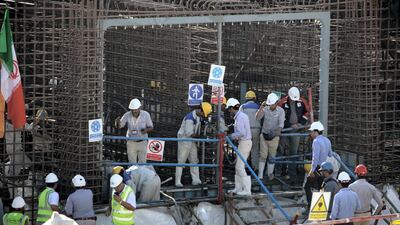
Workers prepare to begin the construction of a second reactor at the Bushehr site. AFP


The 2015 deal between Iran and world powers imposed restrictions on Tehran’s nuclear activities in exchange for the lifting of international sanctions.
In 2018, president Donald Trump pulled the US out of the agreement and reimposed economic sanctions on Tehran. Iran responded by breaching many of the deal’s restrictions.
The report is one of two that are usually issued together. The other is on unresolved concerns about nuclear material the IAEA suspects Iran has failed to declare.
It has found particles of processed uranium at three apparently old sites never mentioned by Iran.
The agency has repeatedly said Tehran has not provided satisfactory answers to its questions.
Diplomats said this lack of transparency is one of the main remaining obstacles to an agreement on reviving the 2015 deal.

