


Live updates: follow the latest news on Russia-Ukraine
British Prime Minister Boris Johnson has insisted no Nato allies are contemplating heeding Ukraine’s pleas to enforce a no-fly zone over the nation to prevent bombings by Russian planes.
The prime minister again rejected Ukrainian President Volodymr Zelenskyy’s calls for British forces to actively join the effort, warning it would trigger a wider war with Russia.
With the invasion of Ukraine now in its sixth day, Mr Johnson visited Nato members Poland and Estonia to shore up support for the defence alliance.
But he ruled out British forces fighting in Ukraine, as he faced impassioned calls for a no-fly zone to be imposed to protect civilians as a potential major assault on Kiev approaches.
Mr Johnson clarified that the UK is not actively supporting British citizens volunteering to help in the defence of Ukraine, contradicting an earlier remark from Foreign Secretary Liz Truss.
“I think for any Nato member to get involved actively in conflict with Russia is a huge step which is not being contemplated by any member,” Mr Johnson stressed during a press conference at the Tapa military base in Estonia.
“This is a time when miscalculation and misunderstanding is all too possible and it’s therefore crucial that we get that message over.
“When it comes to a no-fly zone in the skies above Ukraine, we have to accept the reality that that involves shooting down Russian planes … that’s a very, very big step, it’s simply not on the agenda of any Nato country.
“We will not fight Russian forces in Ukraine. Our reinforcements like these reinforcements here in Tapa are firmly within the borders of Nato members.”
-
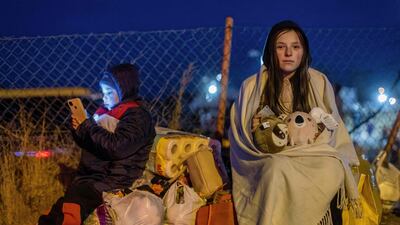
Helena, right, and her brother Bodia, from Lviv, wait at the Medyka border crossing in eastern Poland. AFP -
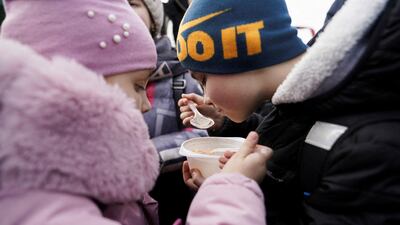
A brother and sister share a bowl of soup after they and their mother fled the Russian invasion of Ukraine and crossed the border at Medyka, Poland. Reuters -
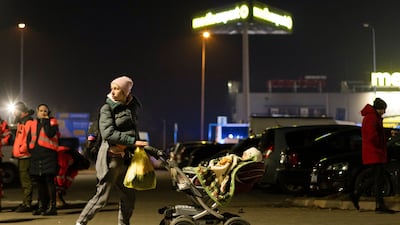
Nadia, a Ukrainian woman, walks around with her baby in a car park in Przemysl, Poland as she waits for help with transport and accommodation. Reuters -

A woman searches through donated clothes for useful items after she and her children fled the Russian invasion in Ukraine and crossed the border in Medyka, Poland. Reuters -
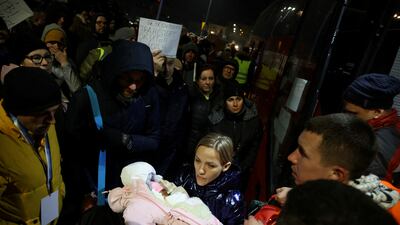
Oksana, 30, holds a seven-day-old child after arriving by bus at a rendezvous point organised to help Ukrainian refugees with accommodation and transport to different cities in Poland. Reuters -
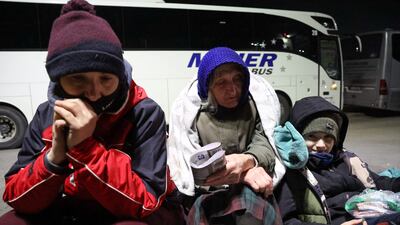
Refugees wait for help in Przemysl, Poland. Reuters -

People wait in a Polish car park to help refugees arriving from Ukraine. Reuters -
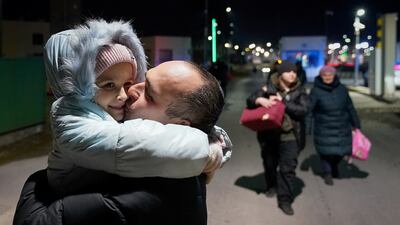
A father kisses his daughter after she, her mother and grandmother fled from the Russian invasion in Ukraine and crossed the border in Medyka, Poland. Reuters -
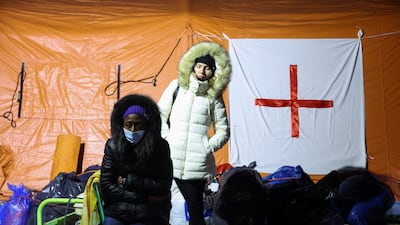
Refugees wait for help in Przemysl, Poland. Reuters -
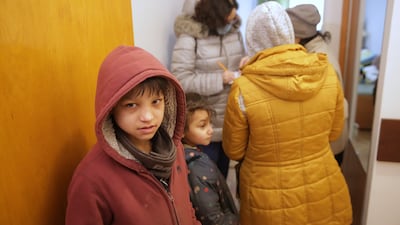
Ukrainian refugees in the town of Maroz near Olsztyn, Poland. EPA -

A Ukrainian refugee in the town of Maroz, Poland. EPA -

Ukrainian refugees in the town of Maroz, northern Poland. EPA -

Hospital employees and volunteers make hundreds of beds to prepare for an influx of Ukrainian refugees in Rzeszow, Poland. AP -
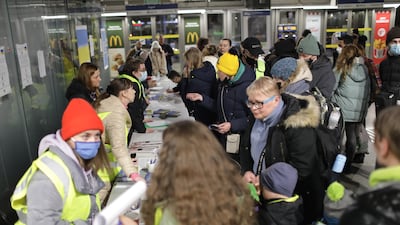
Ukrainian refugees who arrived by evening train from Kiev to Warsaw are helped at the Warszawa Wschodnia railway station in the Polish capital. EPA -
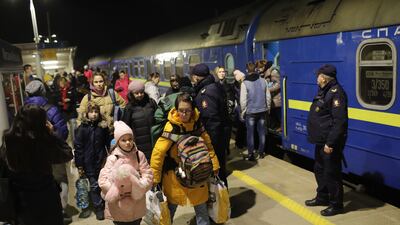
Ukrainian refugees arrive by train from Kiev at the Warszawa Wschodnia station in Warsaw. EPA -
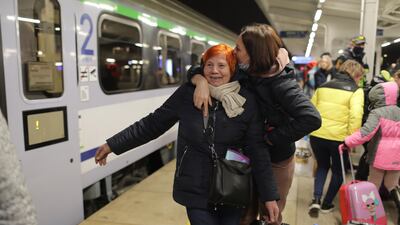
Ukrainian refugees arrive by train from Kiev to Warsaw, Poland. EPA -
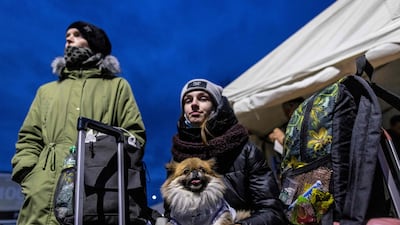
Ukrainian refugees arrive from the Medyka border crossing in eastern Poland. AFP -

A man hugs a child at the Polish-Ukrainian border crossing in Medyka, Poland. Getty


Nato Secretary General Jens Stoltenberg said that a vast column of “heavy Russian armour” moving towards Kiev would bring “more death, more suffering and more civilian casualties”, as he stressed the need for heavy sanctions.
Estonian Prime Minister Kaja Kallas said troops from Kremlin-ally Belarus had entered Ukraine and that: “There’s no doubt Belarus is a co-aggressor in this conflict.”
In an earlier visit to Warsaw, a Ukrainian journalist who fled over the border made an impassioned plea for Mr Johnson to assist with a no-fly zone.
Daria Kaleniuk, executive director of the Anti-Corruption Action Centre civil society organisation, said: “Nato is not willing to defend because Nato is afraid of World War Three, but it’s already started and it’s Ukrainian children who are there taking the hit.”
Mr Johnson apologised as he ruled out the move, having blamed Mr Putin’s regime for “barbaric and indiscriminate” violence against Ukrainian citizens.
The prime minister said evidence of Mr Putin’s attacks on civilians could be used in a future trial at the International Criminal Court.
He did, however, commit to doing more to allow Ukrainians to come to the UK, with about 200,000 people eligible under an expanded route to bring family members to the country.
“What we are going to do is we are extending the family scheme so that actually very considerable numbers would be eligible … you could be talking about a couple of hundred thousand, maybe more,” he said.
“Additionally, we are going to have a humanitarian scheme and then a scheme by which UK companies and citizens can sponsor individual Ukrainians to come to the UK.”
Meanwhile, there was a mass walkout of diplomats from the UN Human Rights Council during a speech by Russian Foreign Minister Sergey Lavrov.
Ms Truss said Mr Lavrov’s statement was “full of disinformation” and did not deserve the attention of other members.
“Russia is isolated and should be ashamed to sit in the UN chamber,” she said.
During her own speech to the Geneva meeting, Ms Truss said: “Putin is responsible for civilian casualties and over 500,000 people fleeing with the numbers still rising fast.
“The blood is on Putin’s hands — not just of innocent Ukrainians, but the men he has sent to die.”

