



Poland has appealed for more support from Nato amid the migrant crisis on its border with Belarus, while the EU said it could impose more sanctions on Minsk.
Russian President Vladimir Putin said his country was ready to help resolve the crisis, in which thousands of migrants from the Middle East have camped on the EU-Belarus border.
Western countries have accused the government of Belarusian President Alexander Lukashenko of deliberately engineering the situation by flying in migrants and urging them to illegally cross into Poland, an EU and Nato member state.
Belarus denied those charges and raised the alarm over the build-up of troops on the border in Poland.
About 50 migrants who broke through the heavily guarded frontier have been recaptured, Polish police said on Sunday. But border authorities warned there were signs of “a bigger attempt at crossing the border today".
Footage posted on Twitter by the Polish Interior Ministry showed what appeared to be a water cannon at the border, as a recorded message warned migrants that force could be used against them if they did not follow orders.
EU foreign ministers will meet on Monday to widen the sanctions already imposed on Belarus, which the bloc accuses of cracking down on dissidents.
“Lukashenko got it wrong. He thought that by acting in this way he would twist our arm and force us to cancel the sanctions. The opposite is happening,” EU foreign affairs chief Josep Borrell told French newspaper Le Journal du Dimanche.
Mr Borrell said the EU ministerial meeting on Monday would “give the green light” to expand the sanctions “to everyone who participates in smuggling migrants to this country”.
-

Poland increased security at its border with Belarus, on the EU’s eastern frontier, after a large group of people appeared to congregate on the Belarusian side of a crossing point, officials said on Monday. AP -
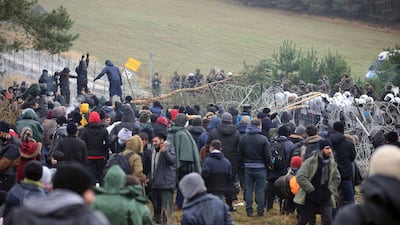
People gather at the EU border near Grodno, Belarus. AP -
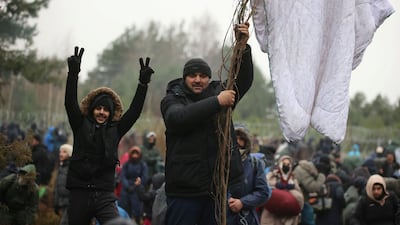
Between 3,000 and 4,000 migrants are near the Belarusian border with Poland, a Polish government spokesman said on Monday. Reuters -
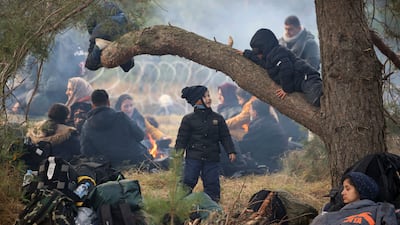
Children play in a tree near Grodno. AP -
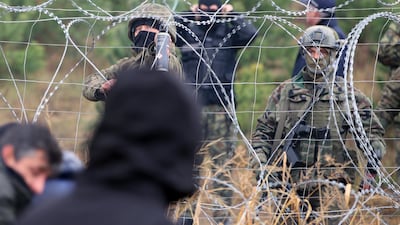
Polish border guards stand near the barbed wire at the border. AP -
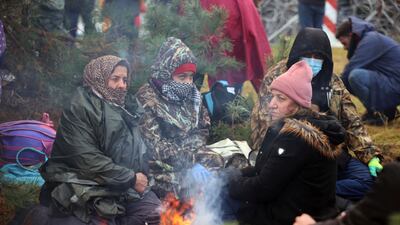
People keep themselves warm with a fire. AP -
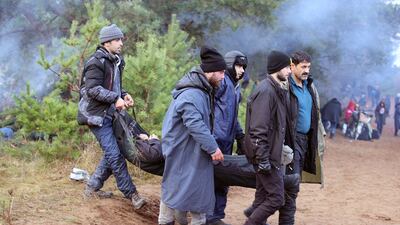
Migrants carry someone who has fallen ill. AP -
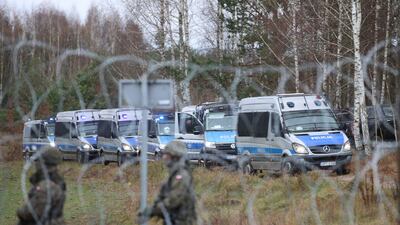
Polish border guards stand behind the barbed wire. AP


Airlines and travel agencies could be hit, while about 30 Belarus government officials thought to be involved in the crisis could also have sanctions imposed, Mr Borrell said.
Polish Prime Minister Mateusz Morawiecki also urged more action from Nato.
“We are discussing with Latvia, and especially with Lithuania, whether to trigger Article 4 of the Nato treaty,” he told state-run news agency PAP.
Under Article 4, any Nato member can request consultations whenever, in the opinion of any of them, their territorial integrity, political independence or security is threatened.
“It is not enough just for us to publicly express our concern. Now we need concrete steps and the commitment of the entire alliance,” Mr Morawiecki said.
Already at least 10 migrants have died in freezing conditions on the border.
In the biggest camp, near the village of Bruzgi in Belarus, Belarusian authorities say there are 2,000 people, including pregnant women and children. Authorities have delivered aid including tents and heaters.
“If someone thinks that Lukashenko or Belarusians will flinch, then this will not happen,” Mr Lukashenko said on Saturday.
Britain’s top general admitted he was concerned the border situation could escalate.
“I think this is a classic case of the sort of hybrid playbook where you link disinformation to destabilisation and the idea of pushing migrants on to the European Union’s borders is a classic example of that sort of thing,” General Sir Nick Carter told the BBC.
He said a small contingent of British soldiers were being sent to Poland to provide engineering support and help build fences.
“What it shows is our unity with Poland and the fact we stand beside Poland against these sorts of threats.”
Polish government quashes 'total lie'
Polish Interior Minister Mariusz Kaminski on Saturday said a rumour was being spread among the migrants that on Monday Poland would allow them through and coaches would come from Germany to pick them up.
“A provocation is being prepared,” he said.
The government has sent a text message to all foreign mobile phones along the border saying: “It's a total lie and nonsense. Poland will continue to protect its border with Belarus.
“Those who spread such rumours seek to encourage the migrants to storm the border, which may lead to dangerous developments."
After pressure from EU diplomats, Turkey has banned Iraqis, Syrians and Yemenis from flying to Belarus and private Syrian carrier Cham Wings Airlines is halting flights to Minsk.

