• The plume from the active crater and part of the 4,6 square kilometre lava field are seen from a mountain near the eruption site in Fagradalsfjall, Iceland. The volcanic eruption near the capital Reykjavik is still going strong six months after lava began flowing. AFP
    The plume from the active crater and part of the 4,6 square kilometre lava field are seen from a mountain near the eruption site in Fagradalsfjall, Iceland. The volcanic eruption near the capital Reykjavik is still going strong six months after lava began flowing. AFP
  • Visitors watch a lava flow bubbling from a tunnel near the crater, in Geldingadalir valley. AFP
    Visitors watch a lava flow bubbling from a tunnel near the crater, in Geldingadalir valley. AFP
  • The volcano slowly oozes lava at times, then spurts like a geyser and spits rocks at intervals. AFP
    The volcano slowly oozes lava at times, then spurts like a geyser and spits rocks at intervals. AFP
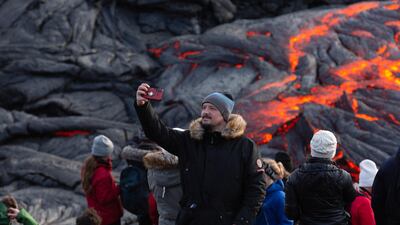
  • A man takes a picture as lava flows from the volcano. Now officially named Fagradalshraun, or 'beautiful valley of lava' after the nearby Mount Fagradalsfjall, the volcano rose up from a fissure in the ground. AFP
    A man takes a picture as lava flows from the volcano. Now officially named Fagradalshraun, or 'beautiful valley of lava' after the nearby Mount Fagradalsfjall, the volcano rose up from a fissure in the ground. AFP
  • Tourists and other onlookers watch as lava flows from a tunnel near the crater in Geldingadalir valley, southwest of Iceland's capital Reykjavik on September 15, 2021. - Slowly oozing at times, then spurting like a geyser and spitting rocks at others, a volcanic eruption near Reykjavik is still going strong six months after lava began flowing, Iceland's longest eruption since the 1960s. While thousands of curious onlookers have been captivated by the mesmerizing spectacle playing out near Mount Fagradalsfjall since March 19 -- Iceland's sixth eruption in 20 years -- experts say a six-month eruption is not extraordinary. Now officially named Fagradalshraun, or 'beautiful valley of lava' after the nearby Mount Fagradalsfjall, the volcano rose up from a fissure in the ground. It has so far spewed out almost 143 million cubic metres of lava. (Photo by Jeremie RICHARD / AFP)
    Tourists and other onlookers watch as lava flows from a tunnel near the crater in Geldingadalir valley, southwest of Iceland's capital Reykjavik on September 15, 2021. - Slowly oozing at times, then spurting like a geyser and spitting rocks at others, a volcanic eruption near Reykjavik is still going strong six months after lava began flowing, Iceland's longest eruption since the 1960s. While thousands of curious onlookers have been captivated by the mesmerizing spectacle playing out near Mount Fagradalsfjall since March 19 -- Iceland's sixth eruption in 20 years -- experts say a six-month eruption is not extraordinary. Now officially named Fagradalshraun, or 'beautiful valley of lava' after the nearby Mount Fagradalsfjall, the volcano rose up from a fissure in the ground. It has so far spewed out almost 143 million cubic metres of lava. (Photo by Jeremie RICHARD / AFP)
  • The volcano has so far spewed out almost 143 million cubic metres of lava. AFP
    The volcano has so far spewed out almost 143 million cubic metres of lava. AFP
  • While thousands of curious onlookers have been captivated by the mesmerising spectacle playing out near Mount Fagradalsfjall since March 19 - Iceland's sixth eruption in 20 years - experts say a six-month eruption is not extraordinary. AFP
    While thousands of curious onlookers have been captivated by the mesmerising spectacle playing out near Mount Fagradalsfjall since March 19 - Iceland's sixth eruption in 20 years - experts say a six-month eruption is not extraordinary. AFP
  • A couple sitting on a hill watch as the Fargradalsfjall volcano spews molten lava. Getty Images
    A couple sitting on a hill watch as the Fargradalsfjall volcano spews molten lava. Getty Images
  • Lava flows from the volcano. AFP
    Lava flows from the volcano. AFP

Volcanic eruption becomes Iceland’s longest in five decades


  • English
  • Arabic

The volcanic eruption mesmerising spectators near Reykjavik began six months ago on Sunday, making it the longest Iceland has witnessed in more than 50 years.

Lava started spewing out of a fissure close to Mount Fagradalsfjall on the evening of March 19 on the Reykjanes peninsula to the south-west of the capital city.

And the ensuing spectacle – ranging from a slow trickle of lava to more dramatic, geyser-like spurts of rocks and stones – has become a major tourist attraction which the Iceland Tourist Board says has drawn 300,000 visitors.

Iceland's sixth volcanic eruption in 20 years has already lasted longer than the preceding one in Holuhraun, in the centre-east of the island, which lasted from the end of August 2014 until the end of February 2015.

“Six months is a reasonably long eruption,” volcanologist Thorvaldur Thordarson told AFP.

The lava field that has formed this time has been called Fagradalshraun – which can be translated as “beautiful valley of lava” – and takes its name from nearby Mount Fagradalsfjall.

Almost 143 million cubic metres of lava have spewed out so far.

  • New fissures near the volcanic eruption site at Geldingadalur, close to Fagradalsfjall on the Reykjanes Peninsula, in Iceland. EPA
    New fissures near the volcanic eruption site at Geldingadalur, close to Fagradalsfjall on the Reykjanes Peninsula, in Iceland. EPA
  • Members of the Search and Rescue Team, Bjorgunasveit look at a new fissure. AP Photo
    Members of the Search and Rescue Team, Bjorgunasveit look at a new fissure. AP Photo
  • A man takes a selfie in front of the lava field on the Reykjanes Peninsula. Getty Images
    A man takes a selfie in front of the lava field on the Reykjanes Peninsula. Getty Images
  • Two new volcanic fissures have opened up near the initial eruption site in Geldingadalir. EPA
    Two new volcanic fissures have opened up near the initial eruption site in Geldingadalir. EPA
  • Lava erupts from the volcano's two craters on the Reykjanes Peninsula. Getty Images
    Lava erupts from the volcano's two craters on the Reykjanes Peninsula. Getty Images
  • Spectators look over the lava field. Getty Images
    Spectators look over the lava field. Getty Images
  • People watch the Lava flows from an eruption. AP Photo
    People watch the Lava flows from an eruption. AP Photo
  • Lava flows from a new fissure on a volcano on the Reykjanes Peninsula. AP Photo
    Lava flows from a new fissure on a volcano on the Reykjanes Peninsula. AP Photo

But this is comparatively small, representing slightly less than a tenth of the volume of the Holuhraun eruption, which emitted Iceland's biggest basalt lava flow in 230 years.

The latest eruption is “special in the sense that it has kept a relatively steady outflow, so it's been going quite strong”, said Halldor Geirsson, a geophysicist at the Institute of Earth Science.

“The usual behaviour that we know from volcanoes in Iceland is that they start really active and pour out lava, and then the outflow sort of decreases over time until it stops."

Iceland's longest-ever eruption took place more than 50 years ago on Surtsey island just off the southern coast and lasted from November 1963 until June 1967.

No end in sight

After subsiding for nine days, the lava reappeared at Fagradalshraun in early September, occasionally spurting red-hot from the crater and accompanied by a powerful plume of smoke.

It accumulated in fiery tunnels beneath the solidified surface, forming pockets that eventually gave way and unfurled like a wave on to the shore.

The number of visitors trekking to the rough hills to view the spectacle is probably even higher than the estimated 300,000, as the first counter installed on the paths leading to the site was set up only five days after the eruption.

In the first month, 10 fissures opened up, forming seven small craters, of which only two are still visible.

Only one crater is still active, measuring 334 metres, the Institute of Earth Science says, and lies a few dozen metres short of the highest peak in the surrounding area.

But the eruption is showing no sign of fading.

“There seems to be still enough magma from whatever reservoir the eruption is tapping. So it could go on for a long time,” Mr Geirsson said.


Updated: September 19, 2021, 2:11 PM